My next door neighbor got their winter delivery of firewood and I immediately asked if I could have a look through the pile for a possible log for turning. They kindly said I could go ahead and after a short search I found a nice Birch log with no cracks or other faults and that wasn’t dried. I suspect it got into their delivery from another pile that hadn’t been to the kiln.
I took it back to the shop and popped the bark off since it was already detaching. Then I measured it and figured out that I could get three bowl blanks from it. I cut one off on the band saw.
There was moisture exuding from the grain just along the band saw cut. I drew a circle on one side that represented a nice sized bowl. I trimmed it roughly round.
I drilled a 2 1/4” diameter recess that was about 1/2” deep to help with the uneven surface. I got it mounted on the lathe and started rough turning it to a round shape.
In the image above you can see how wet this blank was, there is water collecting on the surface from the cutting. It was pretty easy to turn with the shavings coming off in streamers. It had an bit of an issue with grain tear out because it is a relatively soft wood and until I got it to the state above I had to run it at a relatively low RPM.
I refined the outside as I was able to raise the RPM using gouges and also my scrapers to get a much smoother finish. I defined a tenon/foot for the bowl on the bottom/tail stock side so I could turn it around for hollowing. I also flattened the top of the bowl to define the top, I didn’t want to do a “natural” edge since the top profile was defined by splitting the log and was very jagged and splintered.
I sanded the outside of the bowl up to 320 grit and then turned it around and chucked it on the tenon. I hollowed it out using carbide tools and also some scrapers to an average thickness of around 3/8”.
I then sanded the inside of the bowl to 320 grit and removed the bowl from the lathe.
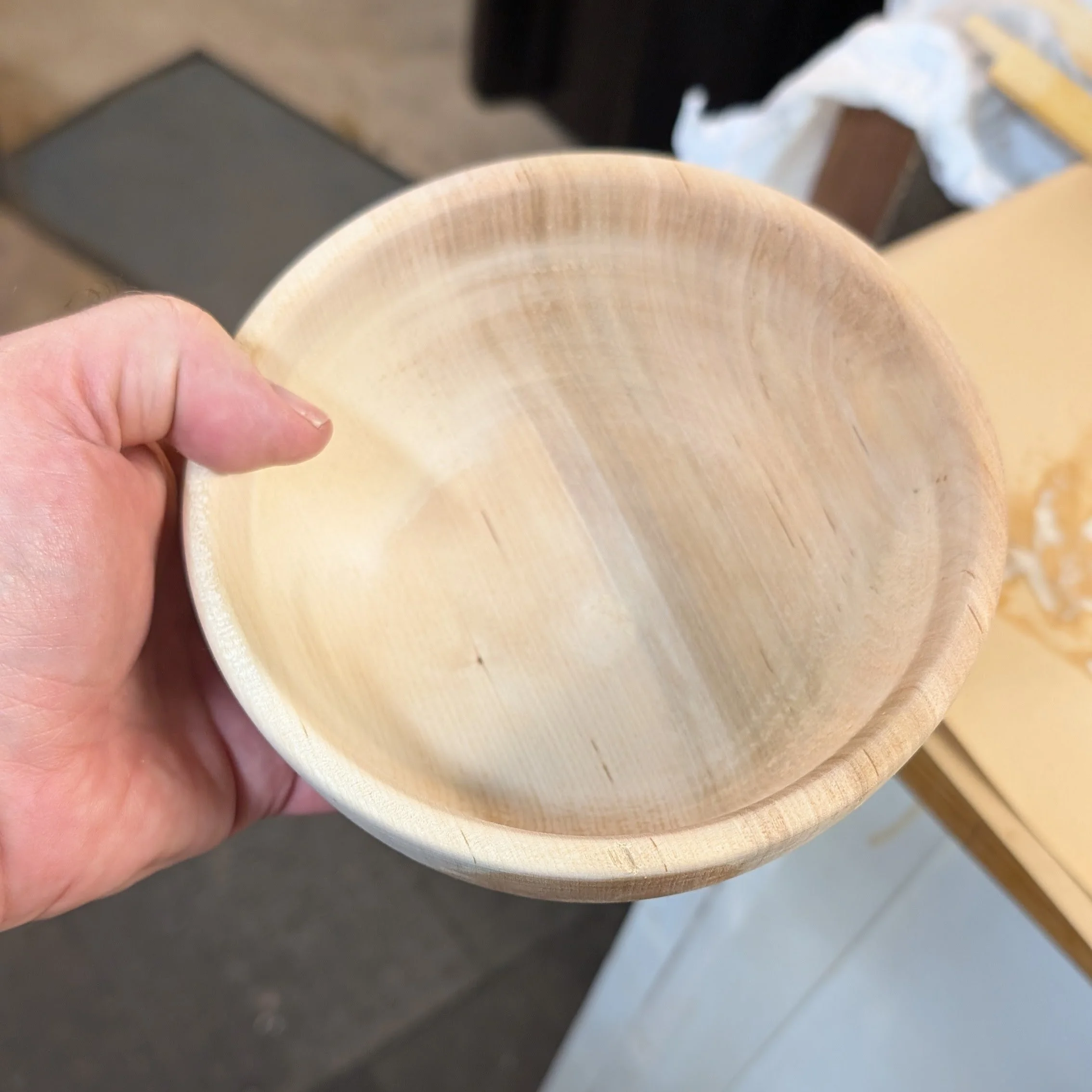
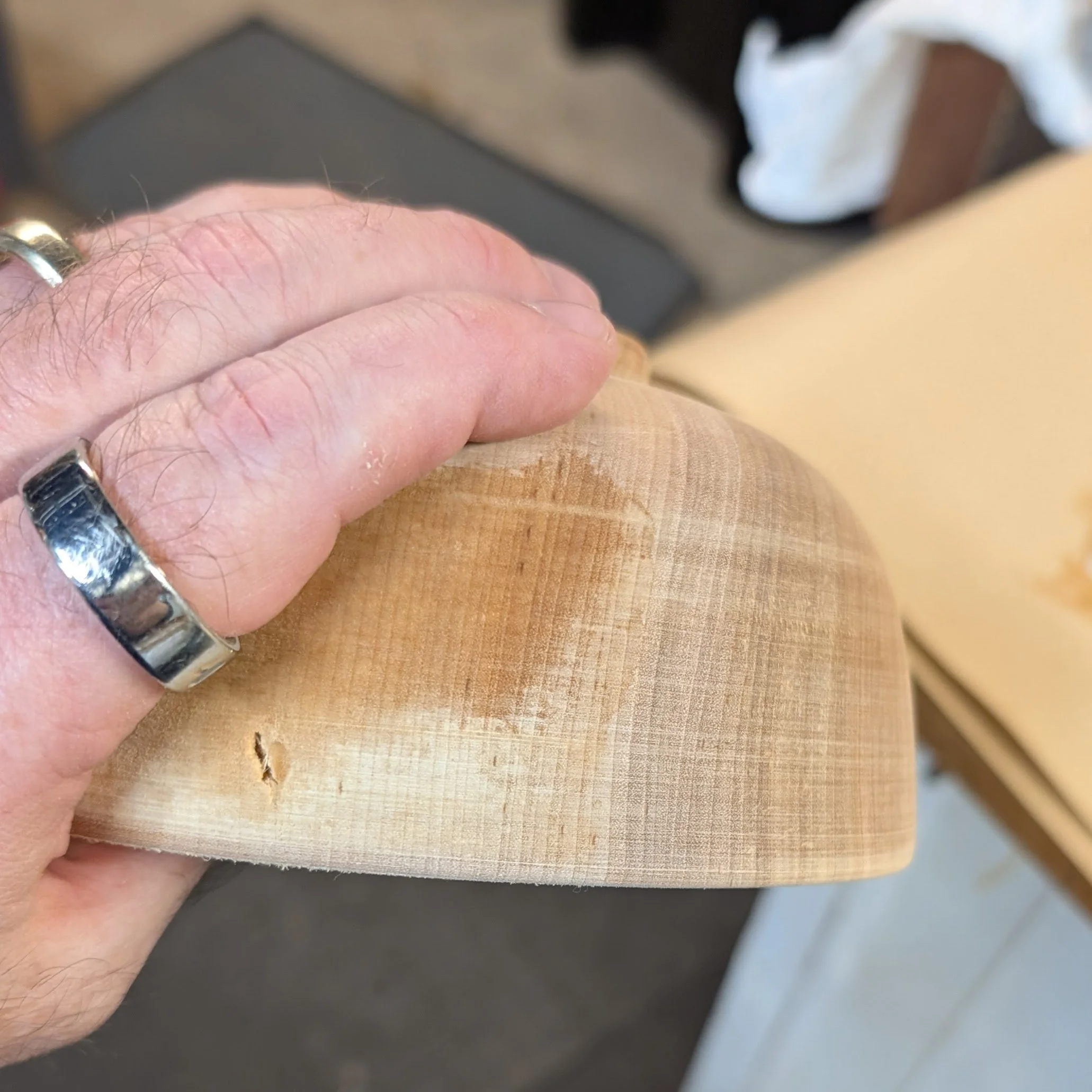
After weighing the bowl I put it into my big box of desiccant to dry. In the meantime I cut the other two blanks from the log and marked them up and cut them to rough circular blanks. I painted them all over with Titebond III wood glue to seal up the surface and slow down the drying so hopefully they won’t split before I get back to turn them.
After two days of drying the bowl’s moisture had stabilized and I took it out of the desiccant. It had slightly ovalized in an attractive way with no cracking and the bottom was still quite flat.
I did some sanding touch ups and removed some lathe jaw marks from the edge of the foot. I applied a coat of shellac based sanding sealer.
Instead of waiting overnight I let the sanding sealer dry for a couple of hours and then sanded the bowl up to 1000 grit with a combination of hand sanding and 2” drill sanding. This worked well and saved a day in the process.
The grain pattern from the Birch was very nice with a sweeping pattern of darker grain looking like feathers or a paint brush stroke through the side of the bowl. I really like this wood and I look forward to turning the other two blanks.