• Home
  • Blog
  • About
  • Privacy Policy
Menu

James Goodwin

  • Home
  • Blog
  • About
  • Privacy Policy

Gift box and charcuterie board

January 22, 2026

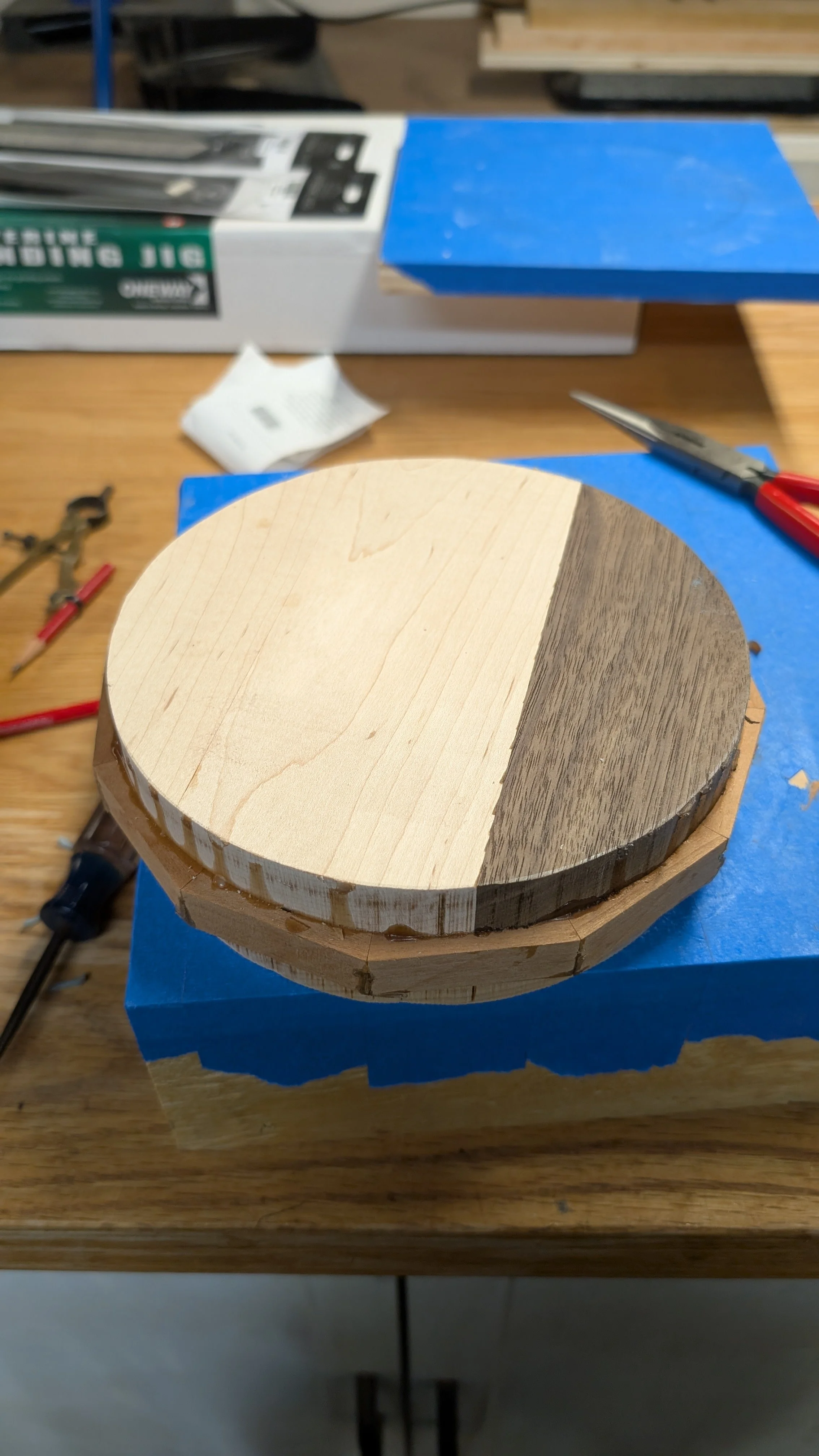
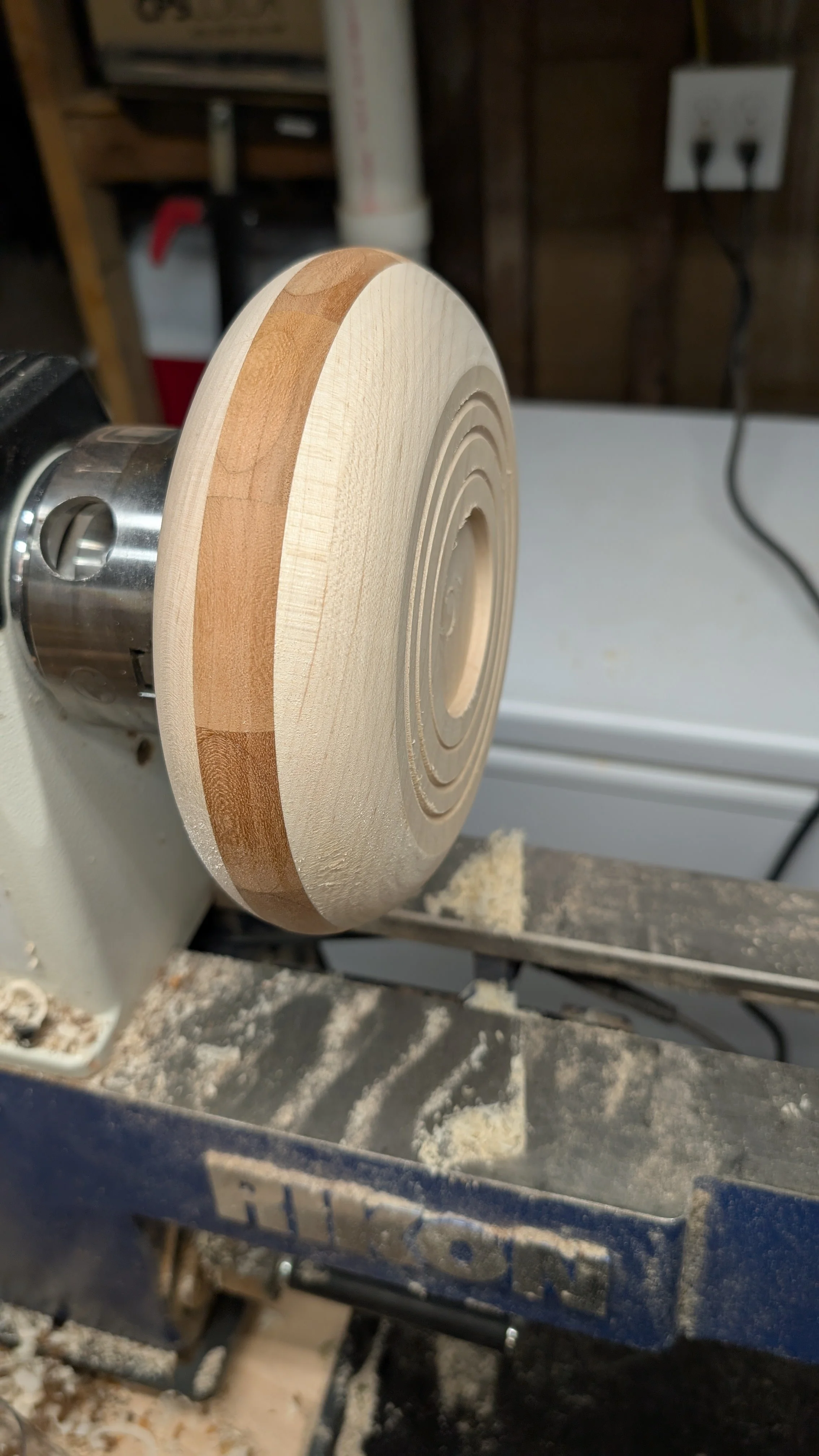
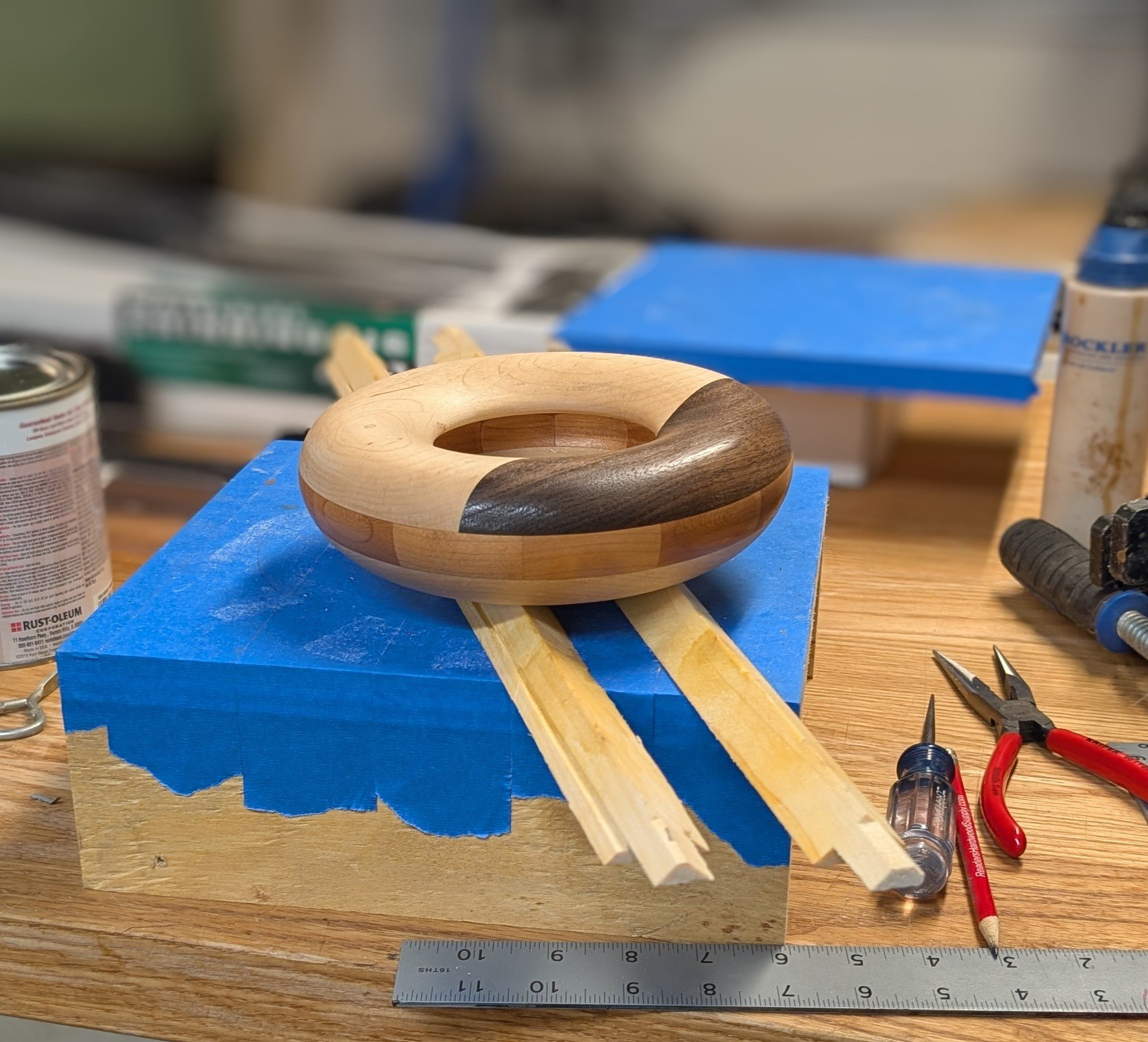
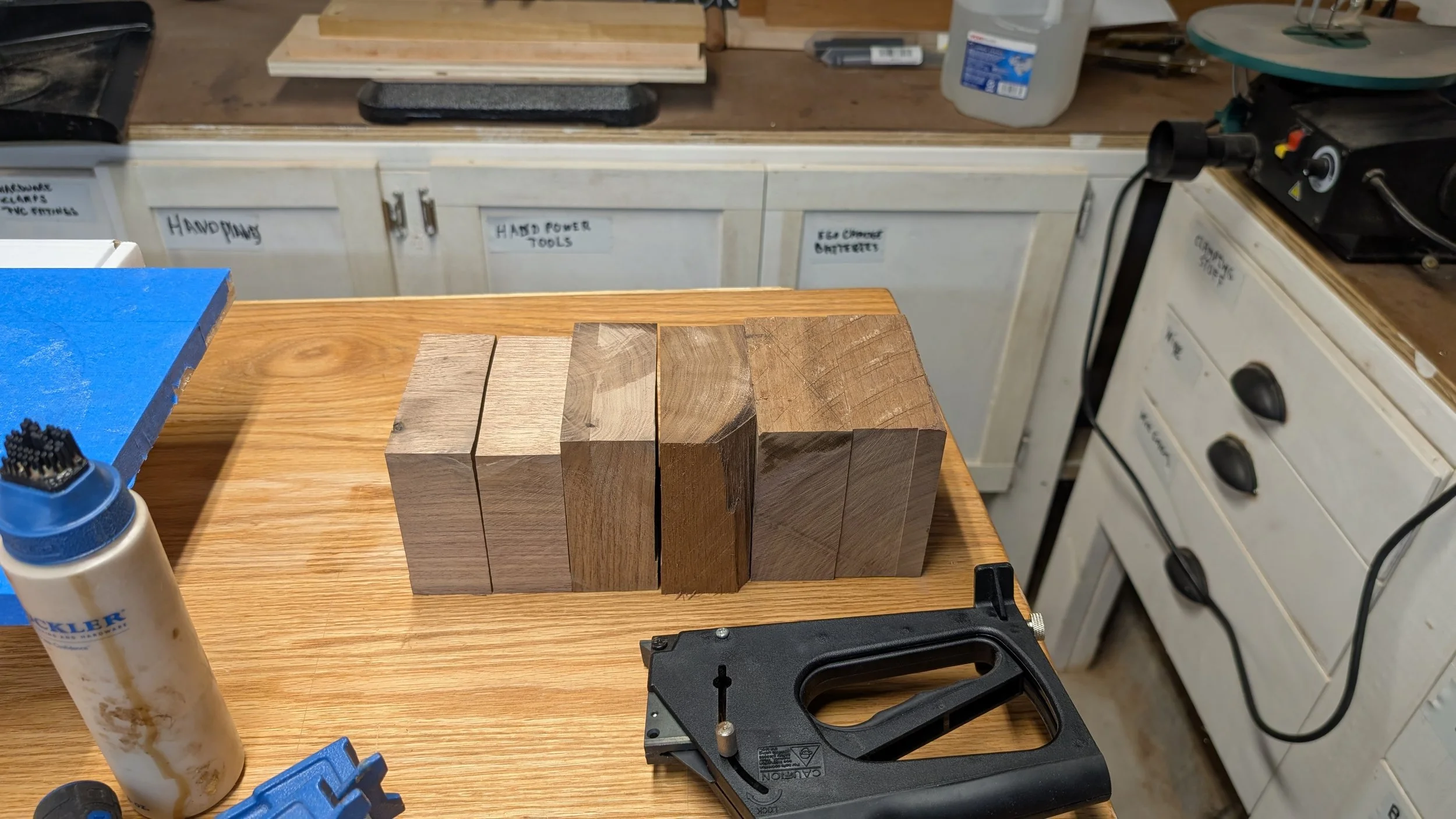
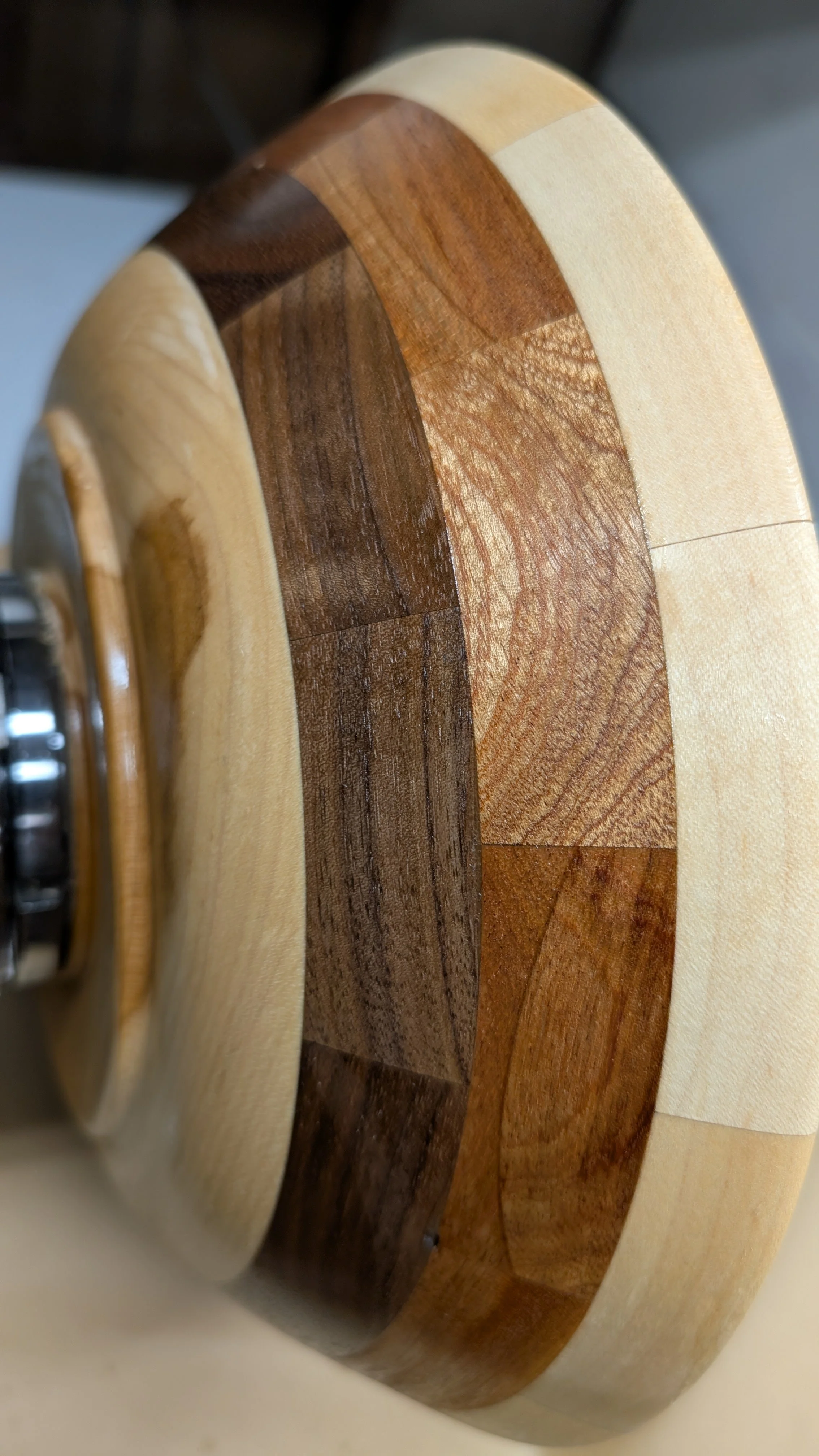
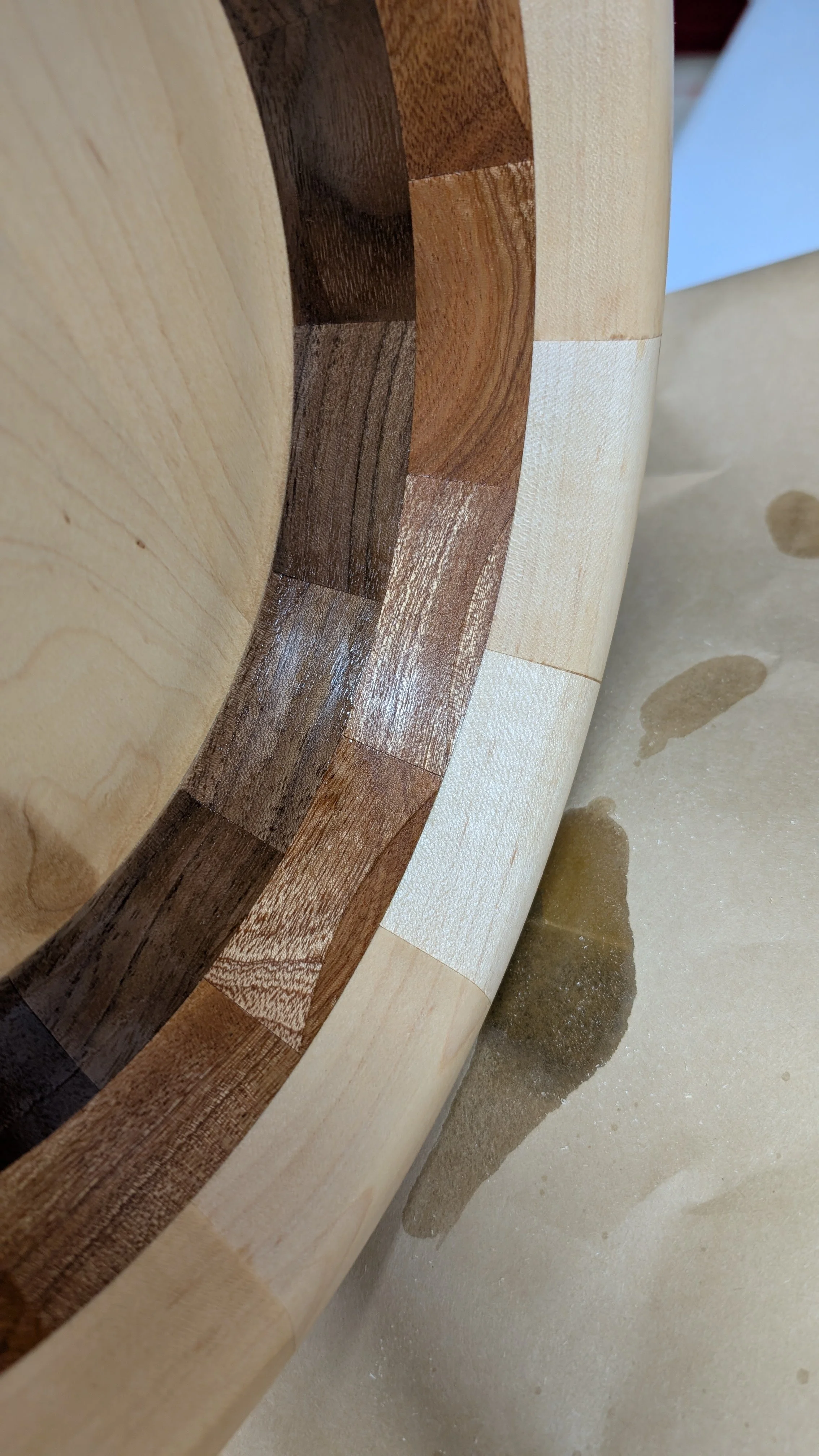
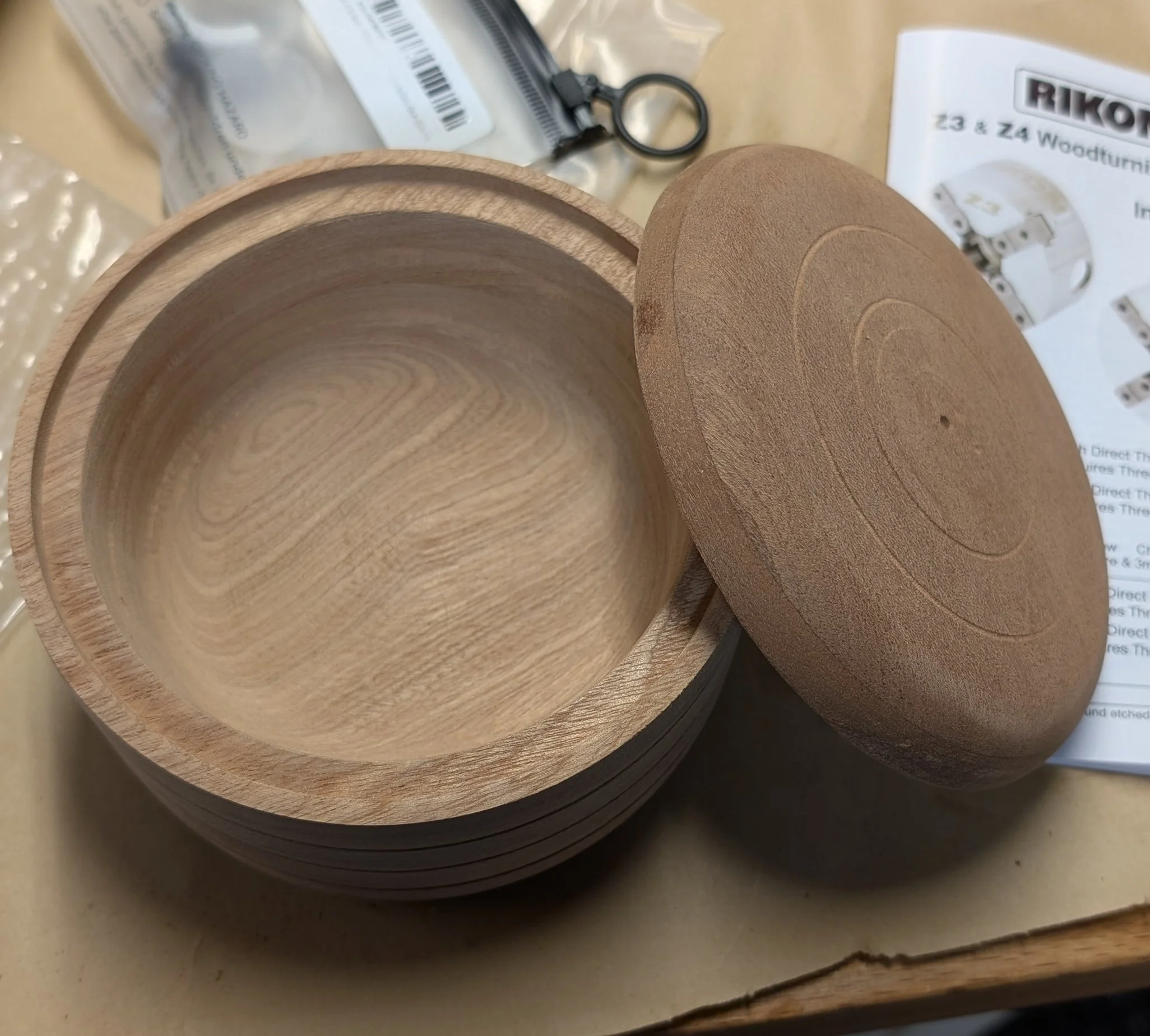
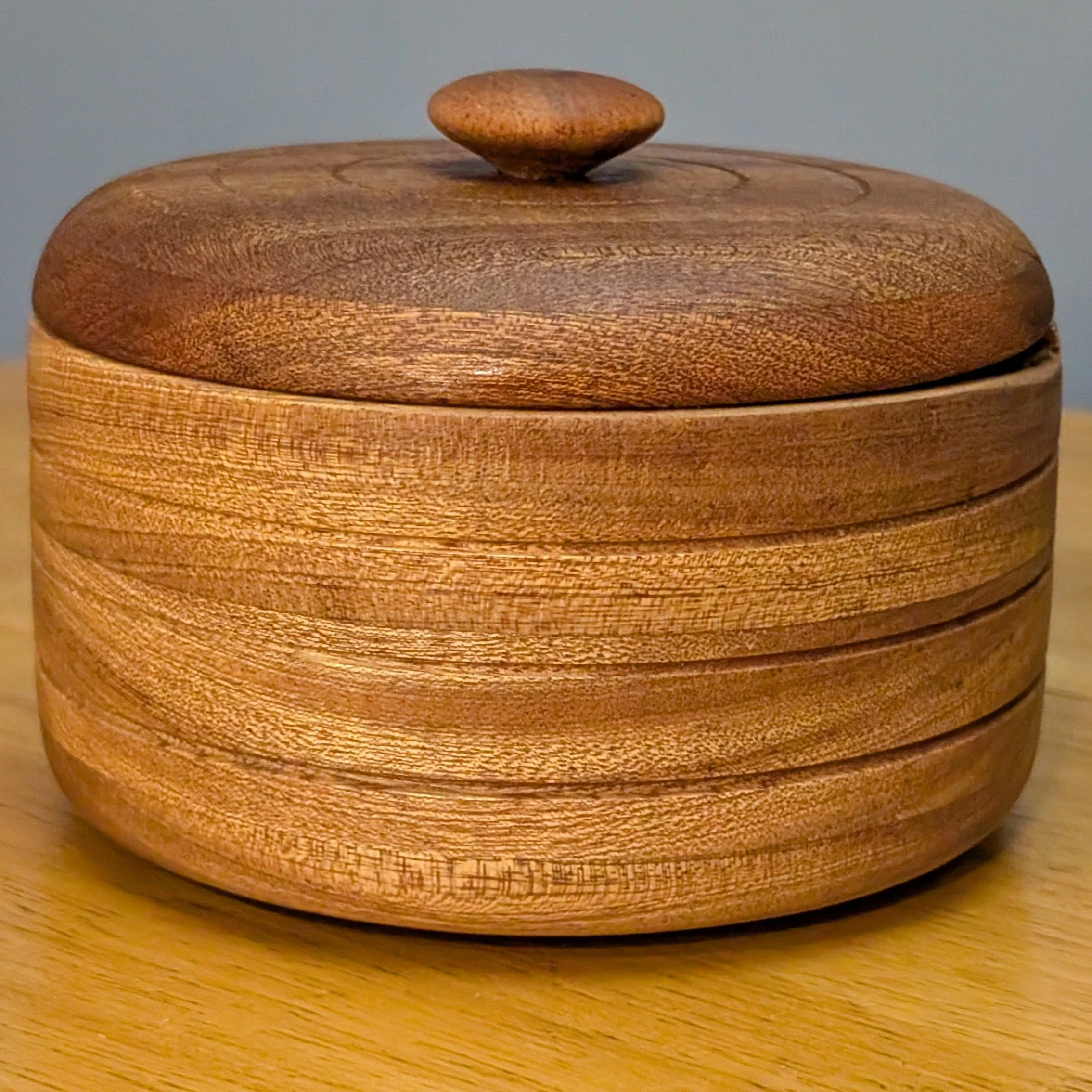
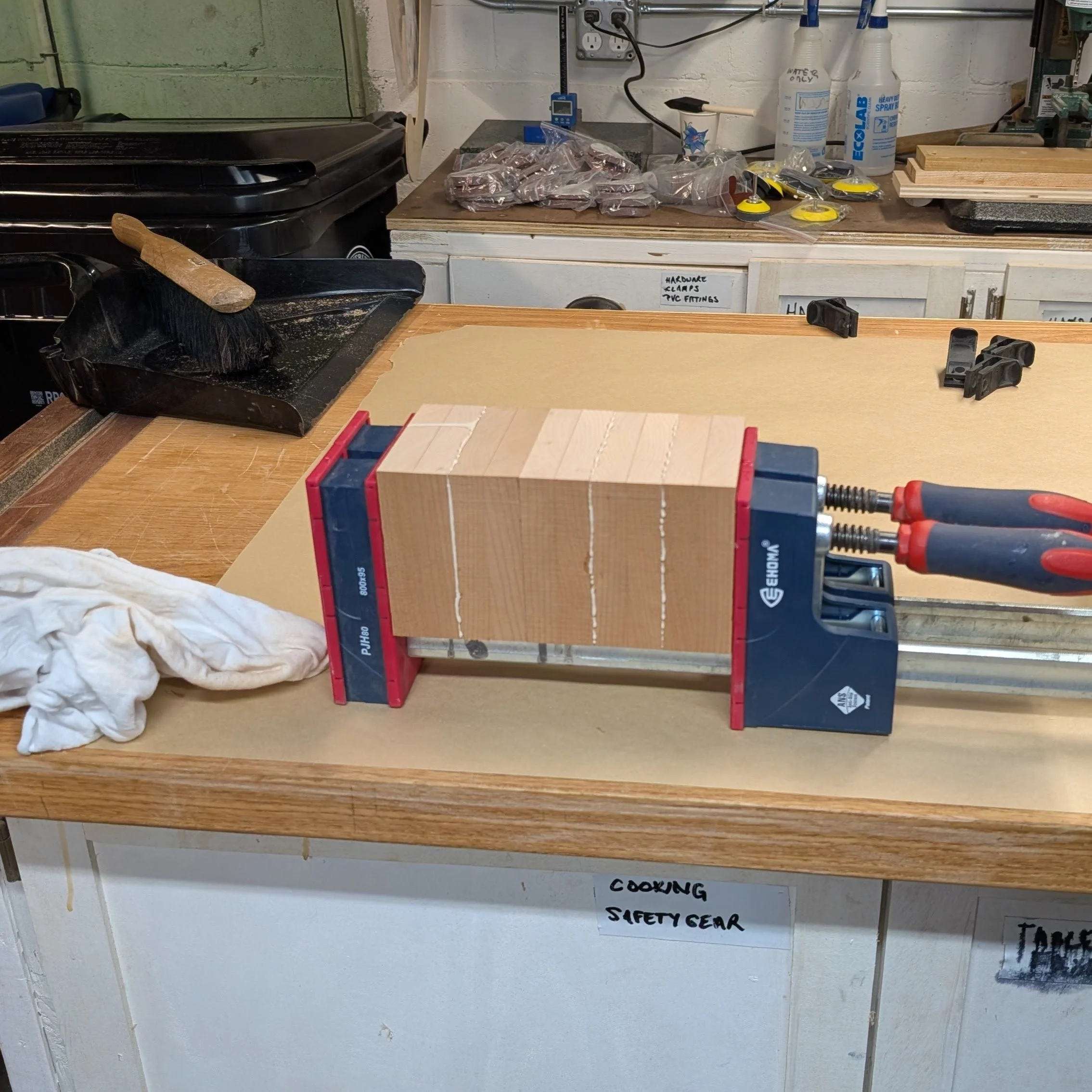
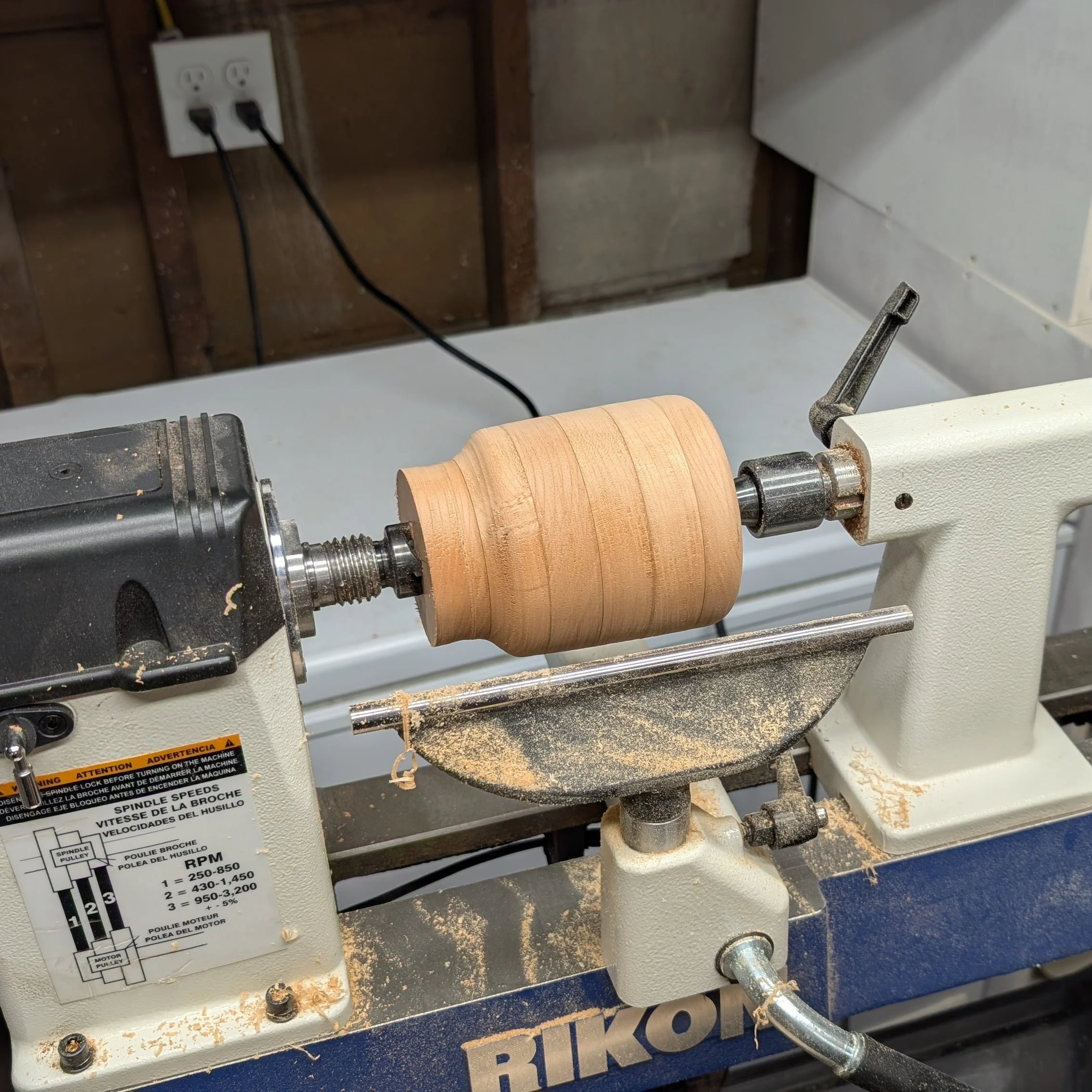
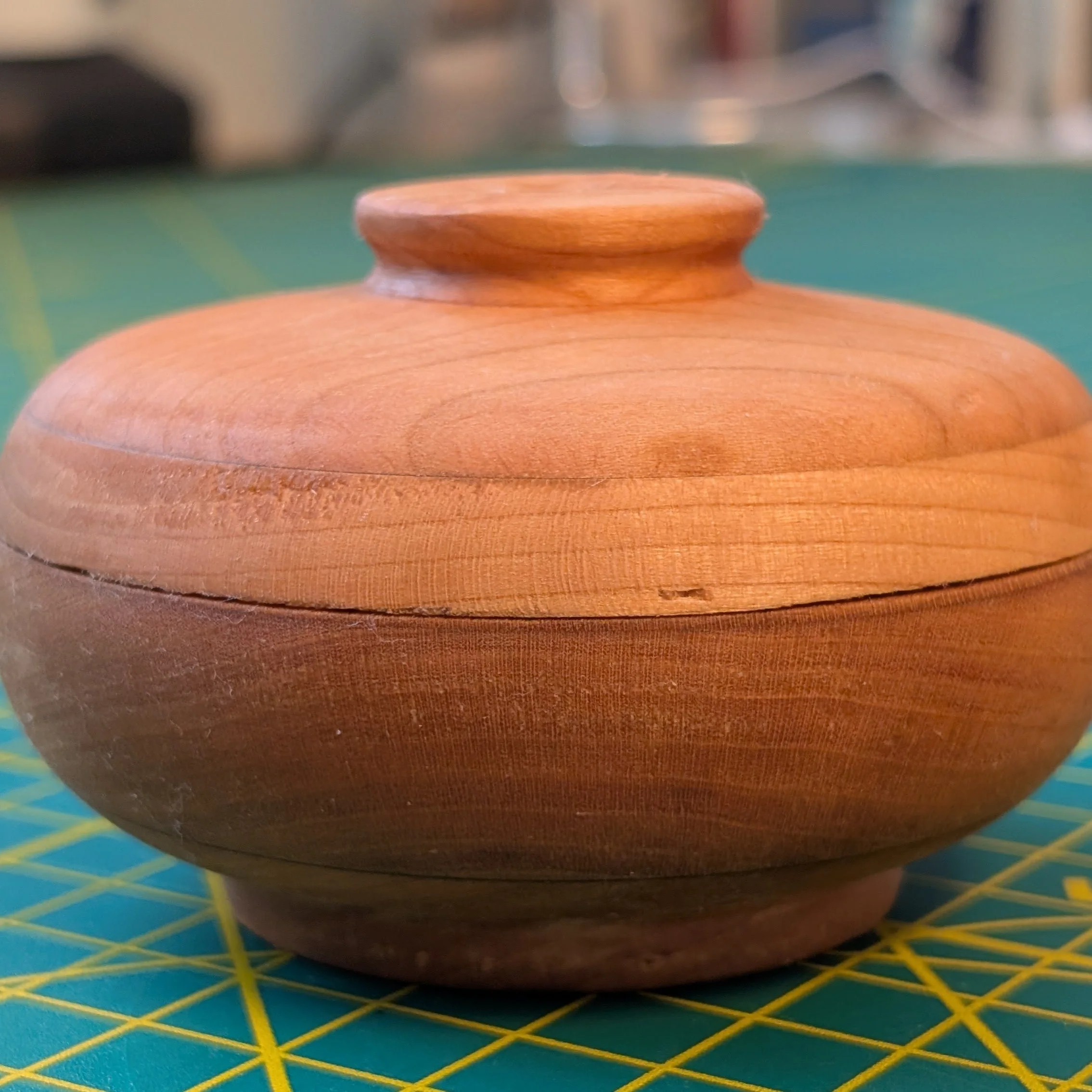
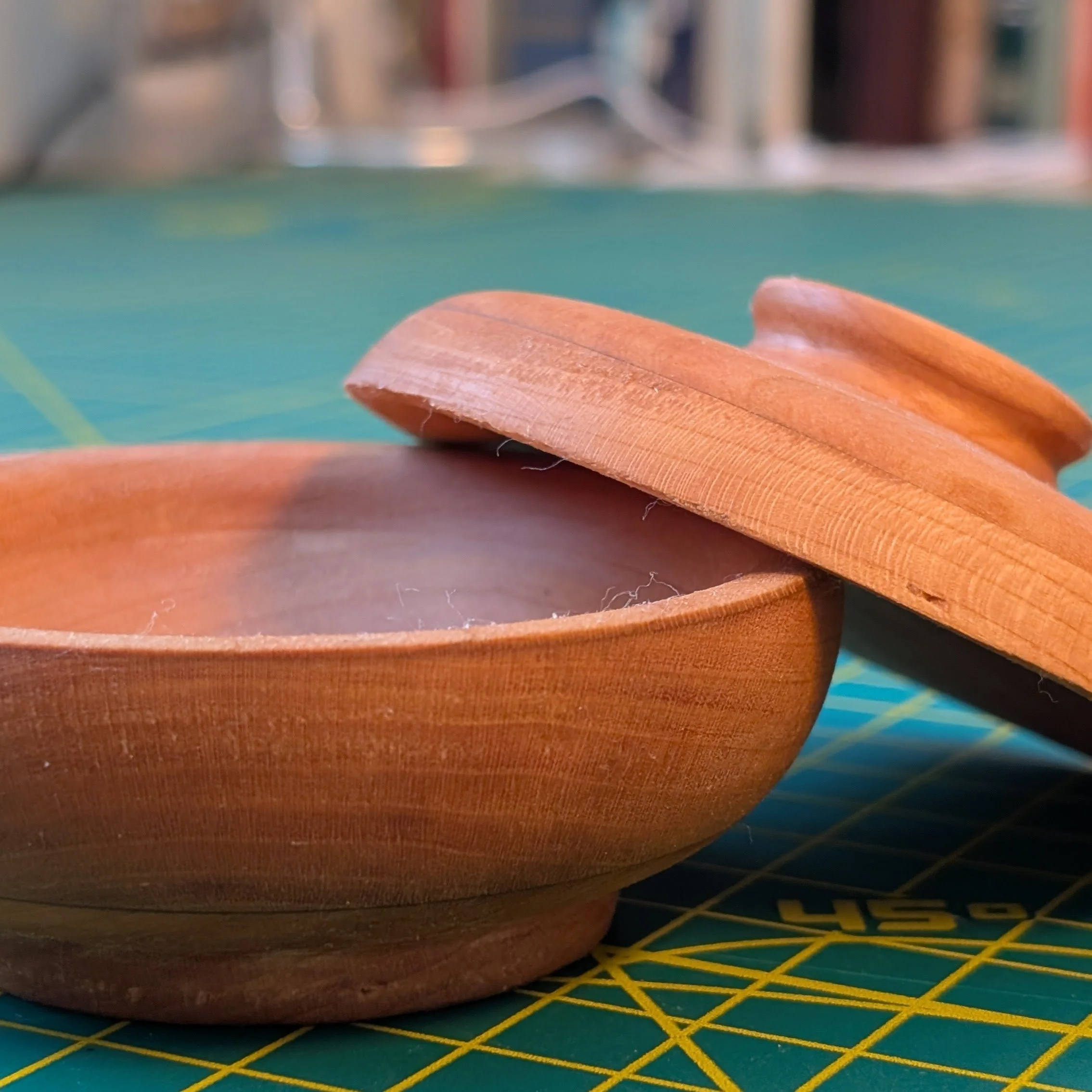
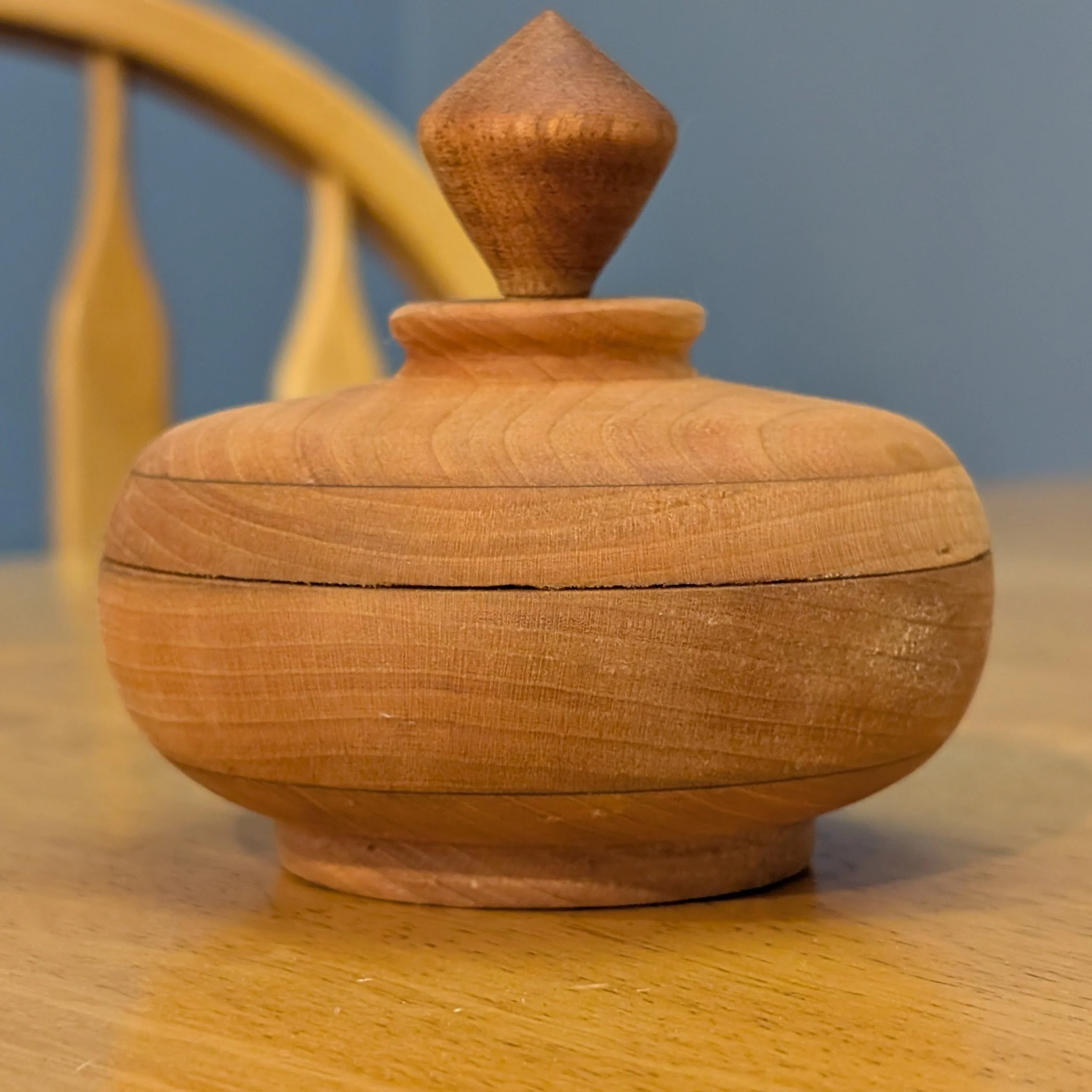
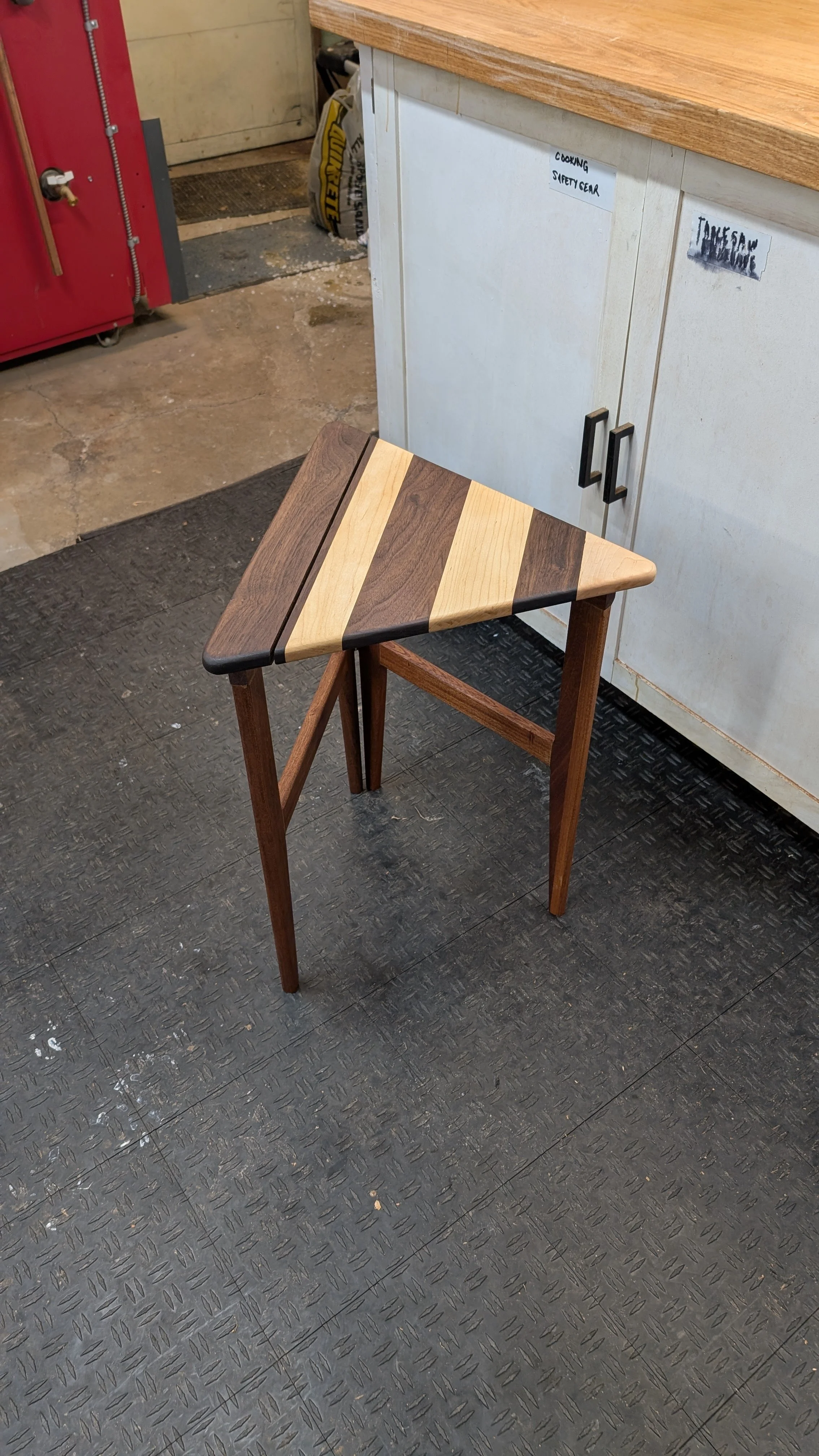
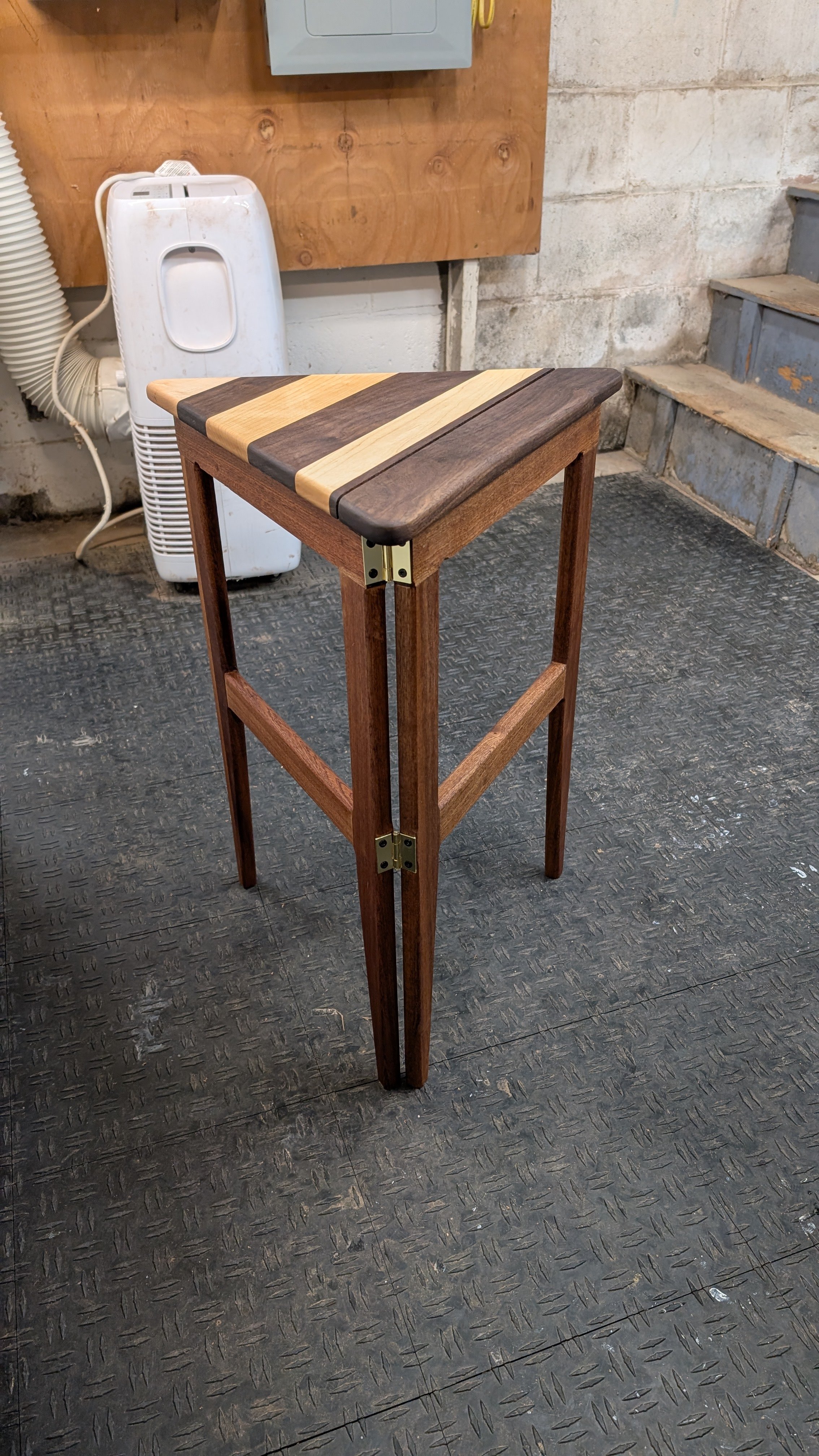
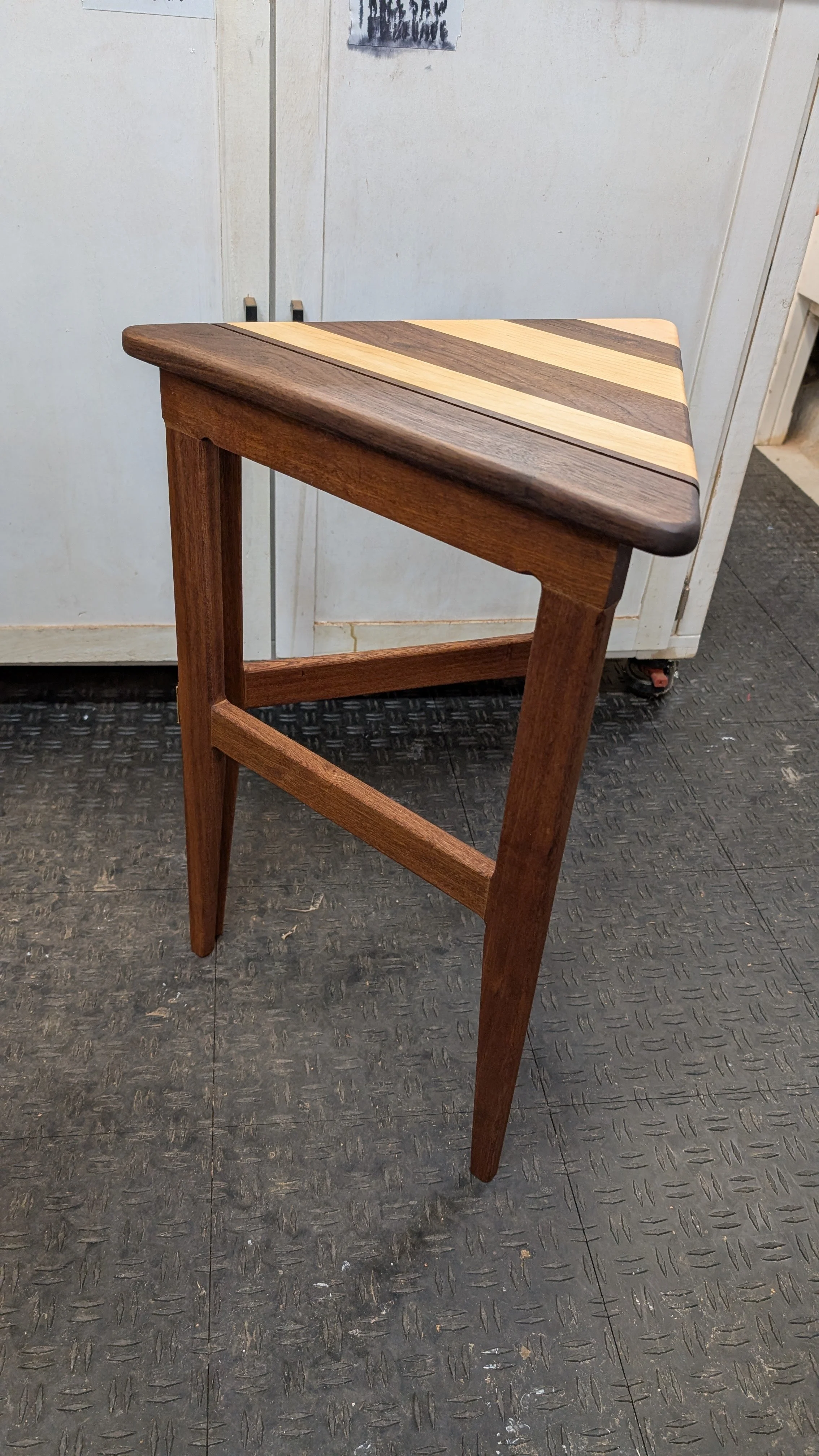
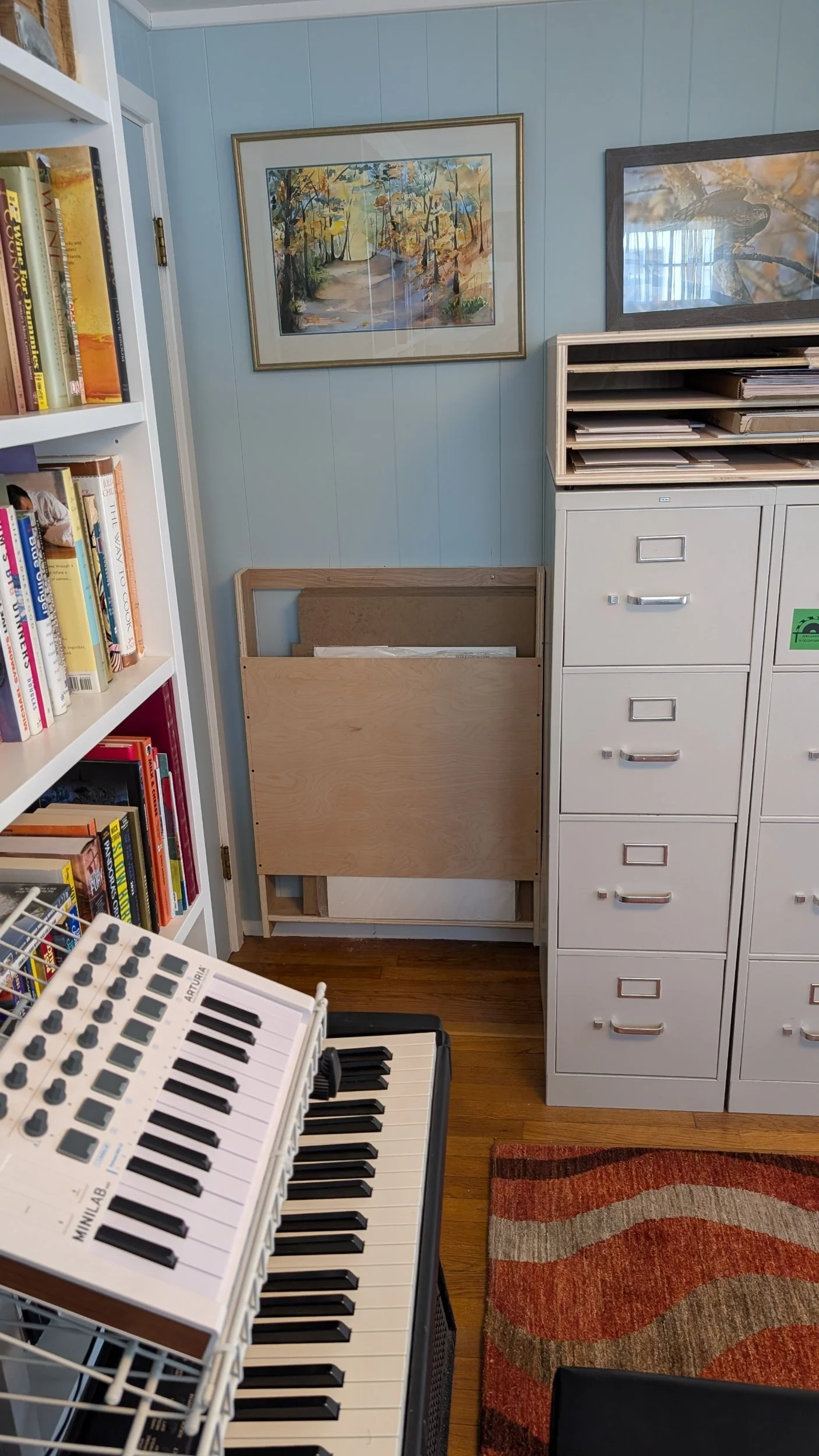
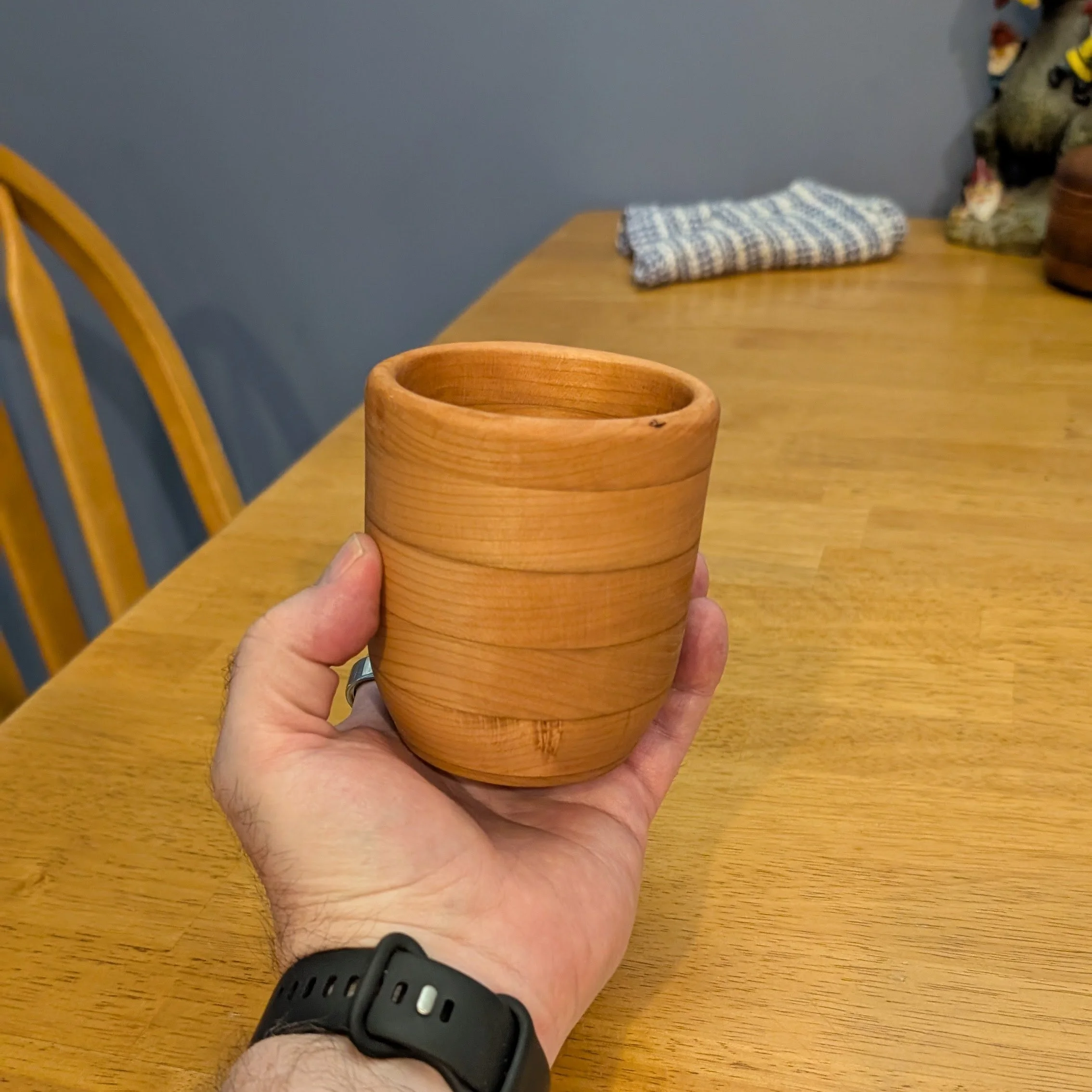
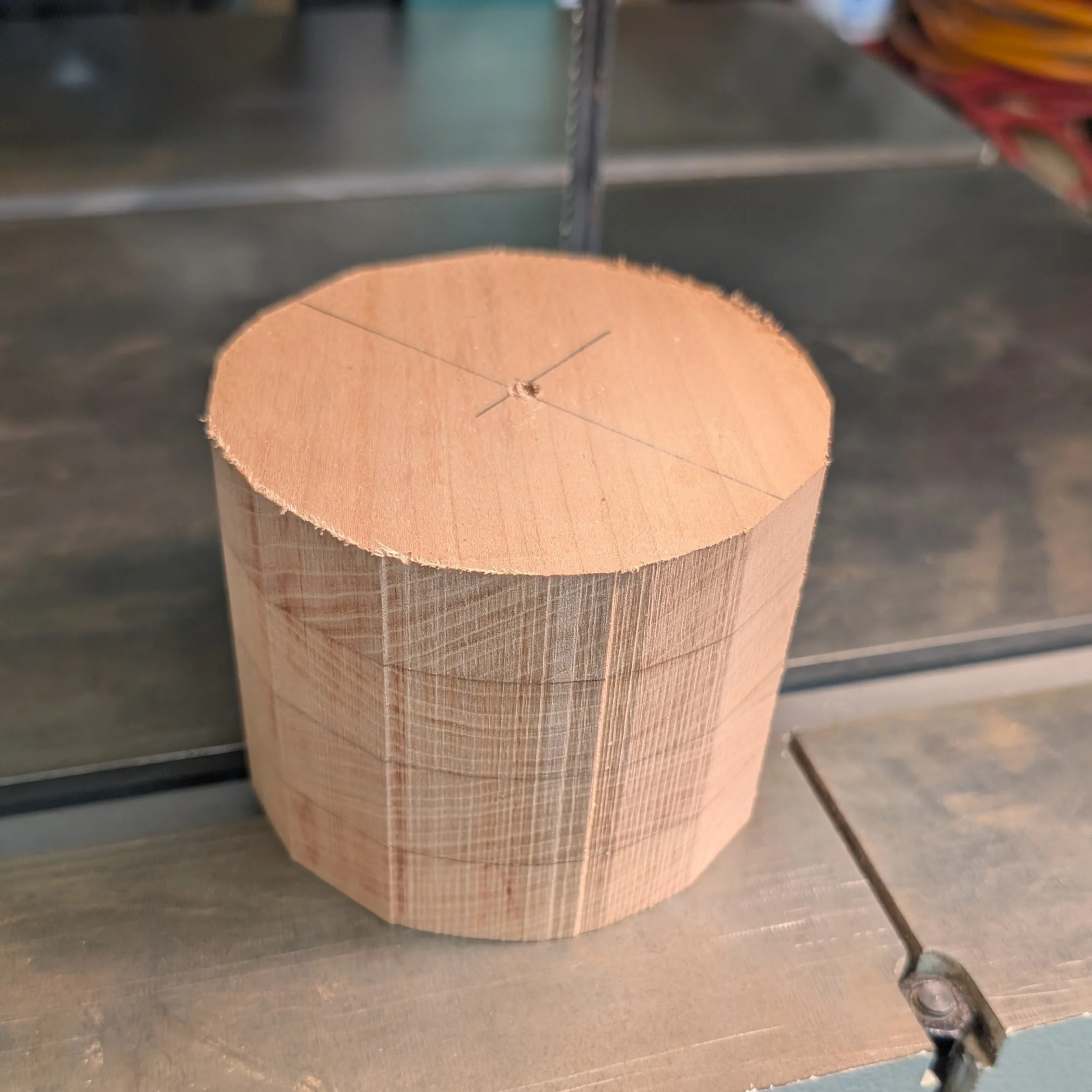
A couple of small projects came out of a recent cleanup of my ever expanding scrap wood pile.

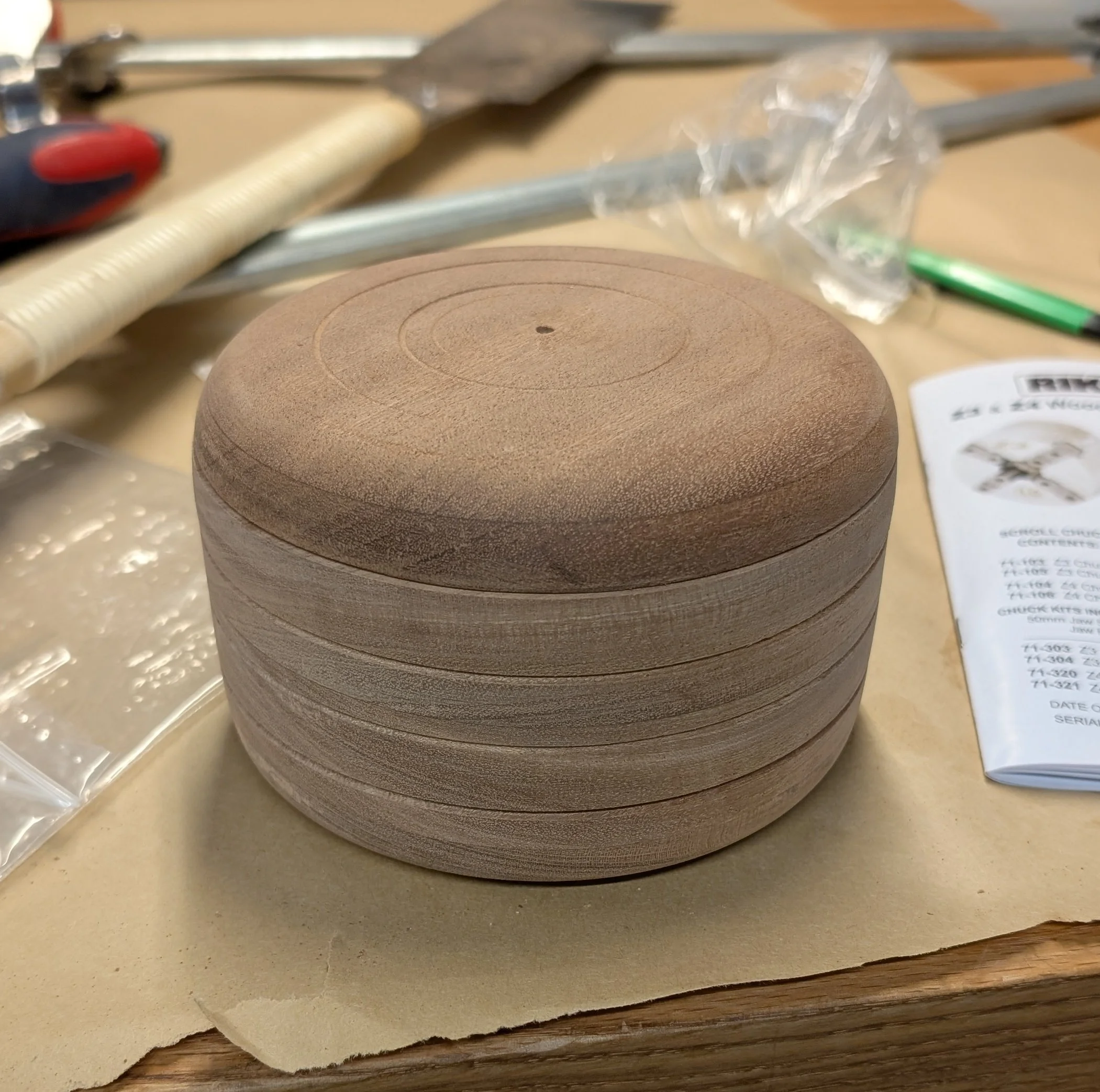
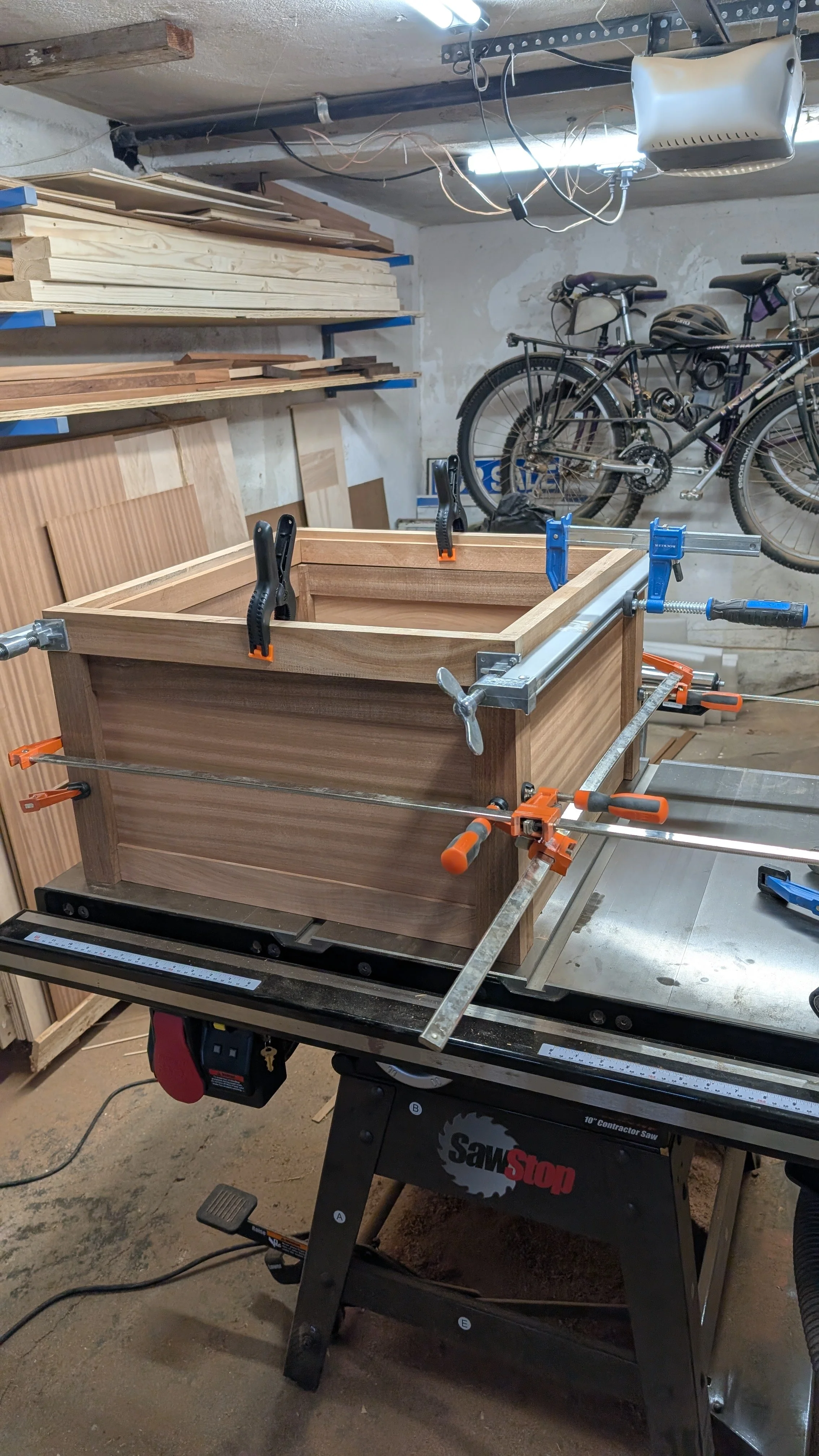
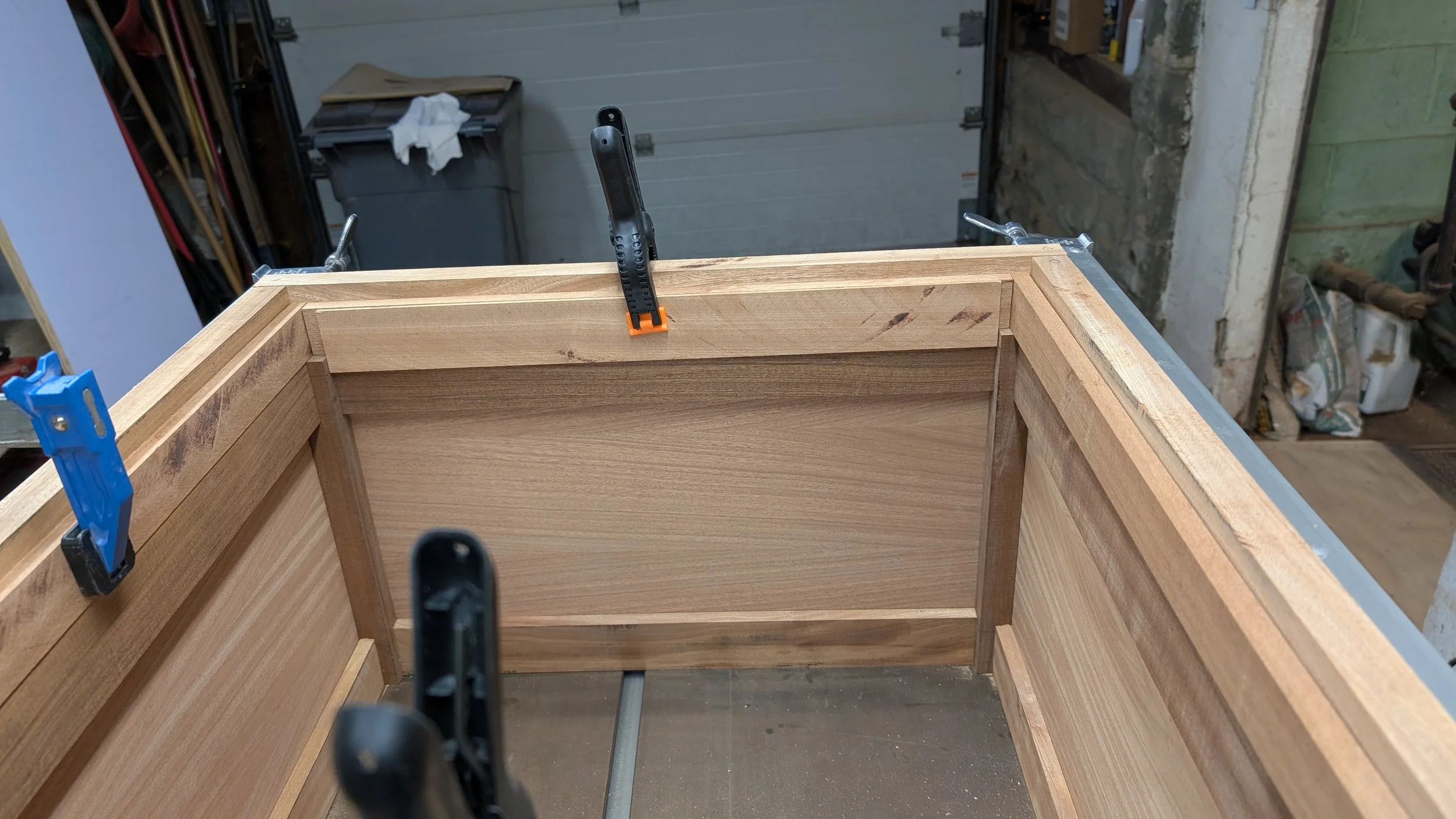
The first one is a “continuous grain” box about 3 1/2” x 4 1/2” x 1 1/2” that I made from a spare glue up of some scraps from a couple of years ago. The woods were maple, sapele, and western red cedar. I had a gift that I was sending to a friend and I decided to jazz it up by making a box for it. I barely had enough material but I managed it. The cool part was I actually got the grain to wrap in all directions. The miters were not perfect and the glue up was a little off so it is somewhat asymmetrical but that just gives it a bit of an organic feel. I was able to hide most of my errors.

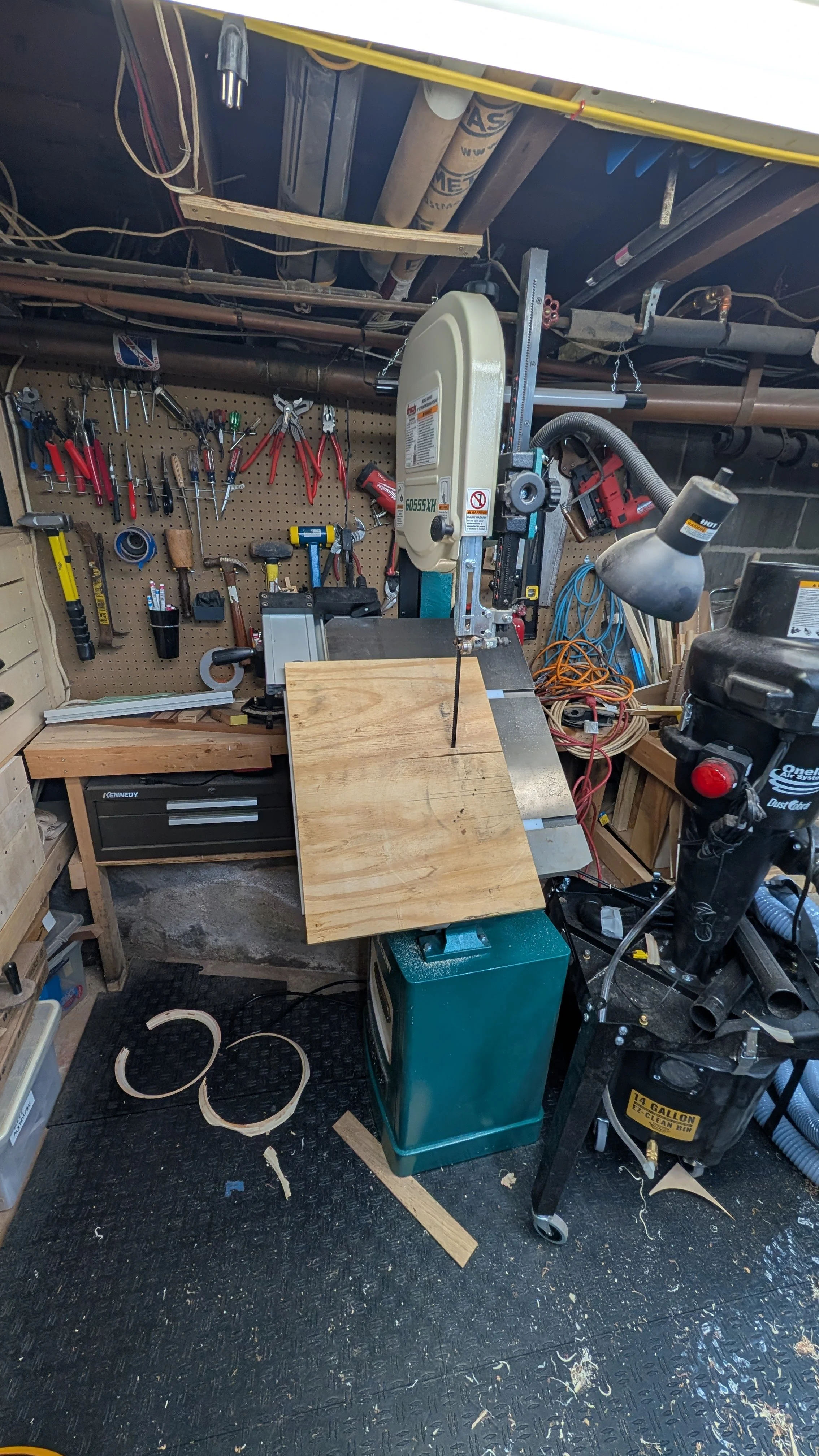
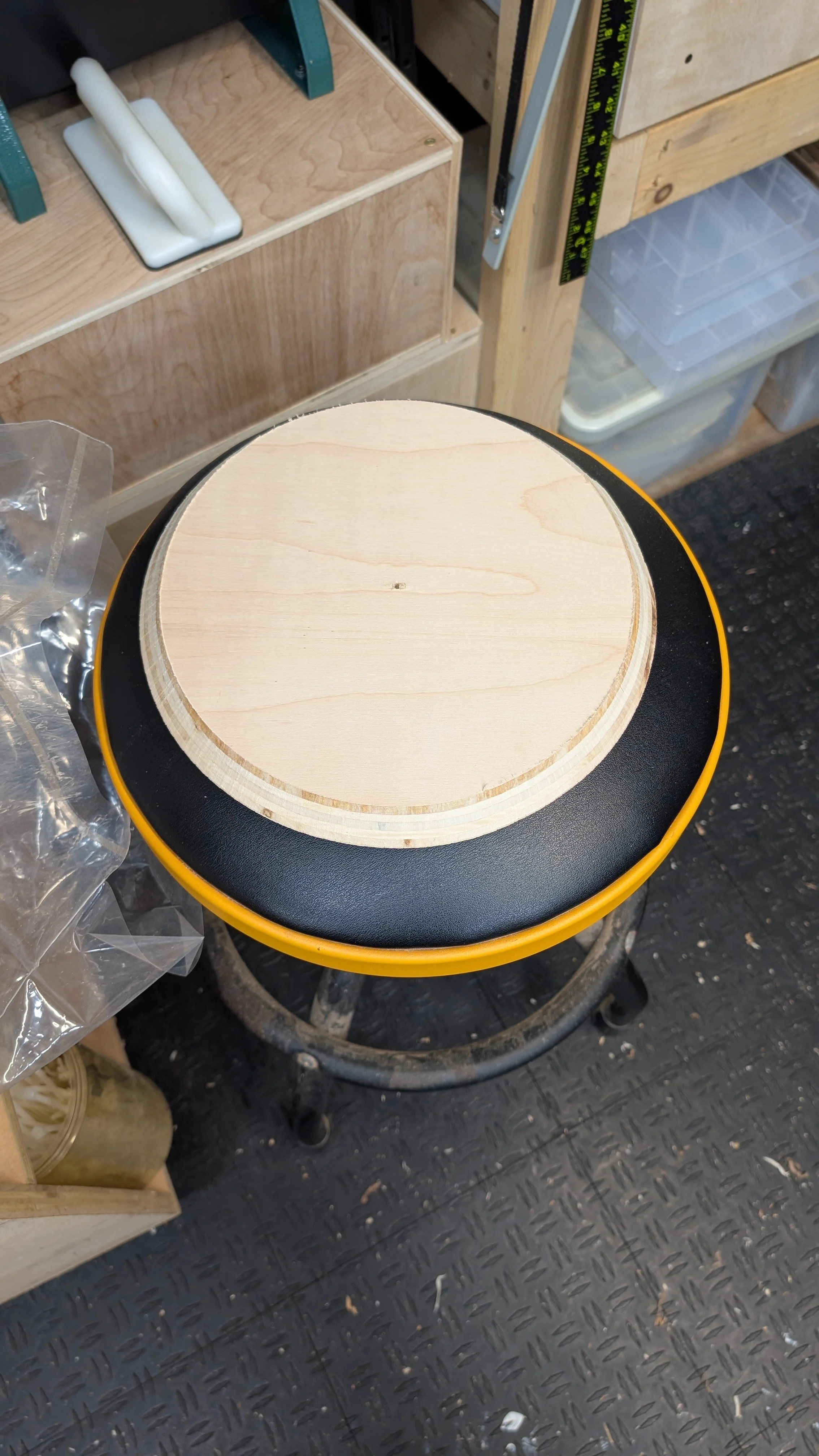
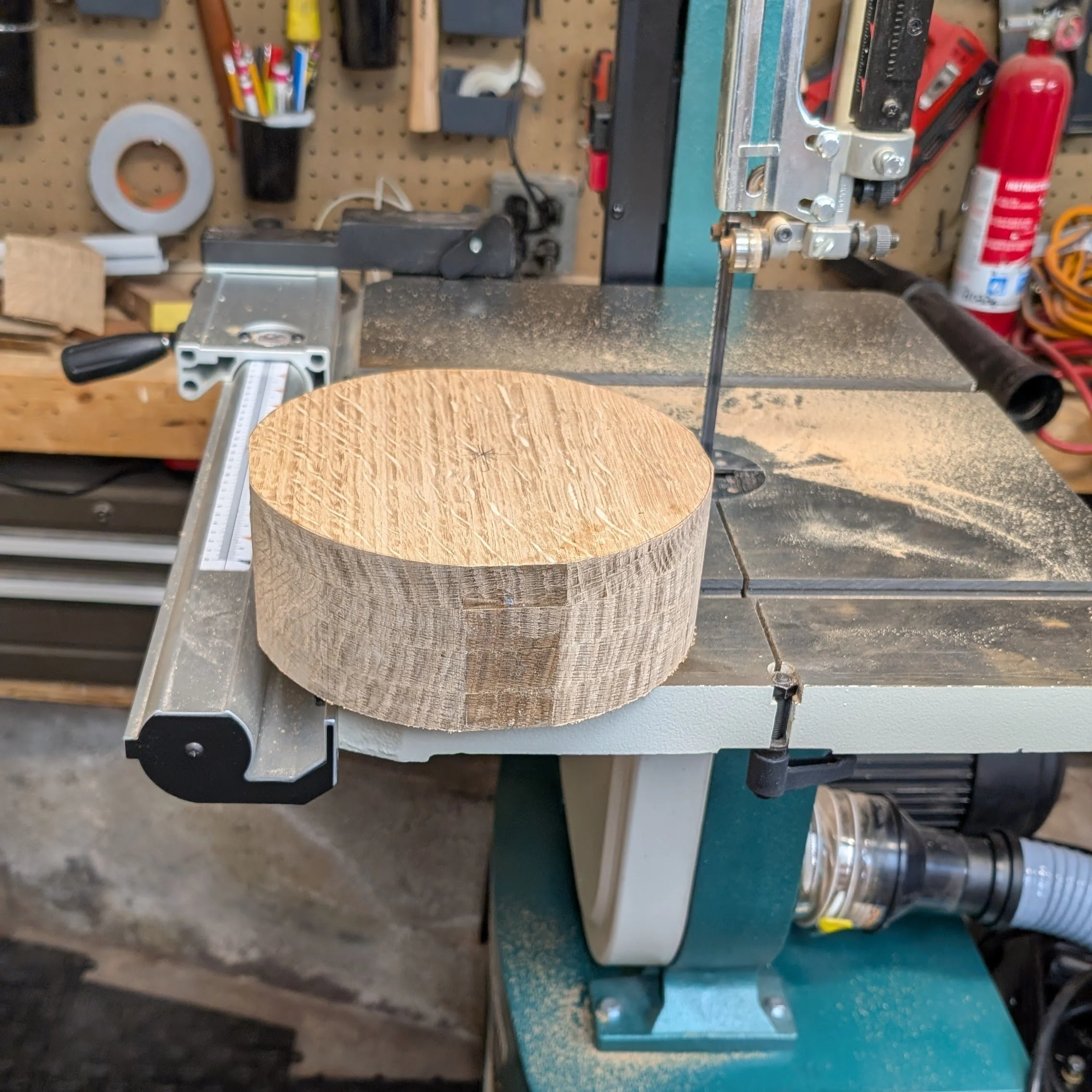
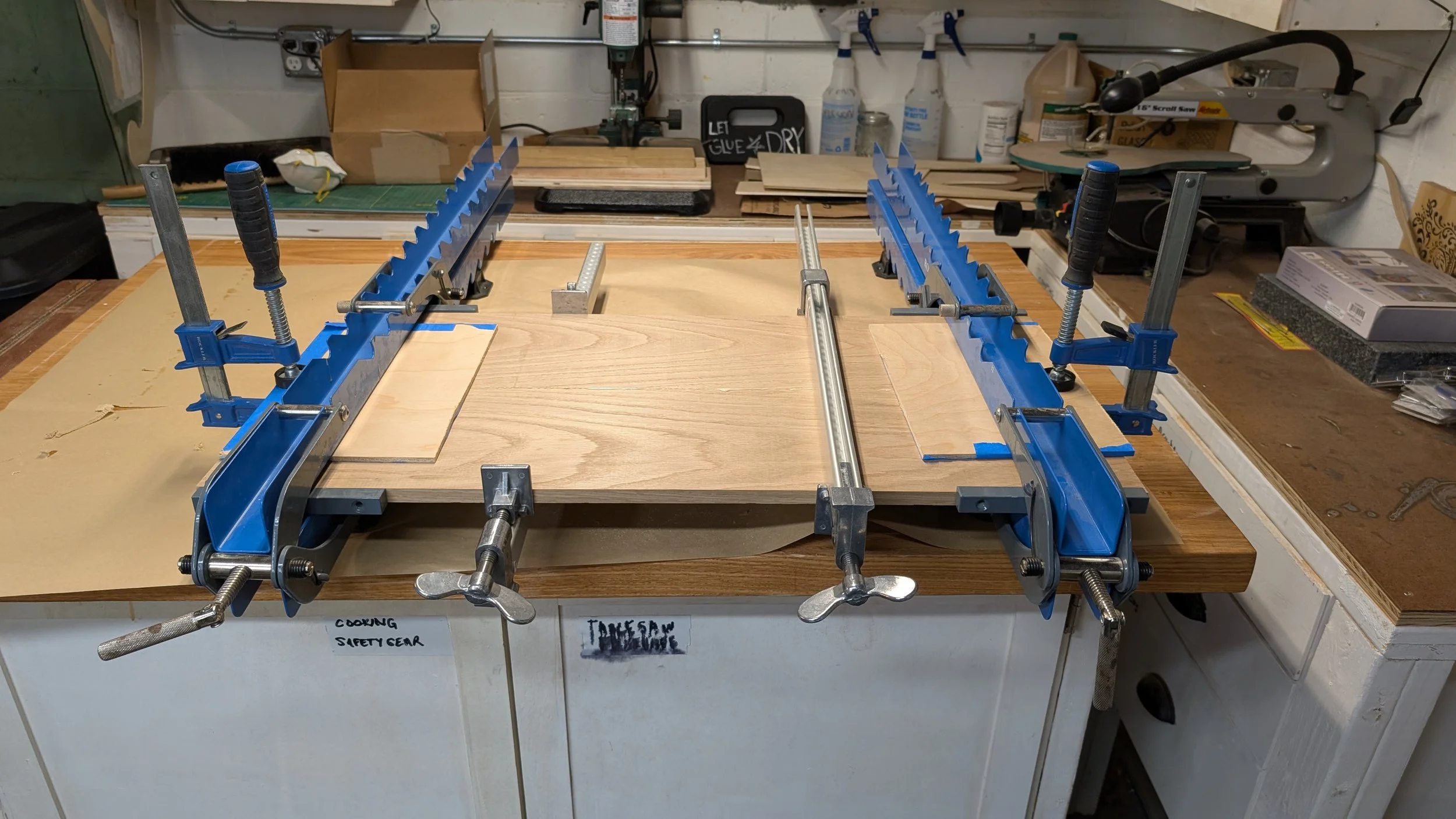
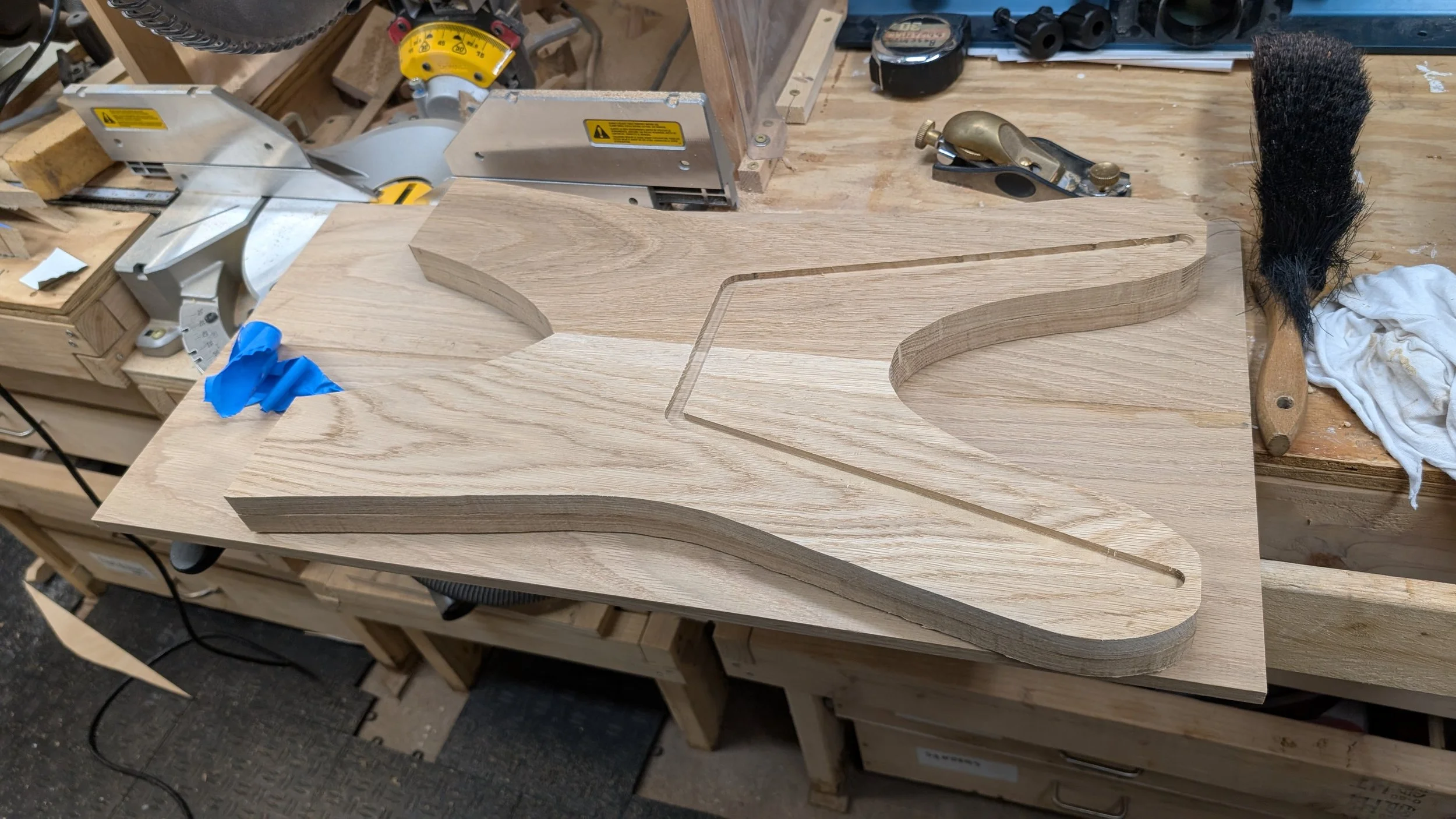
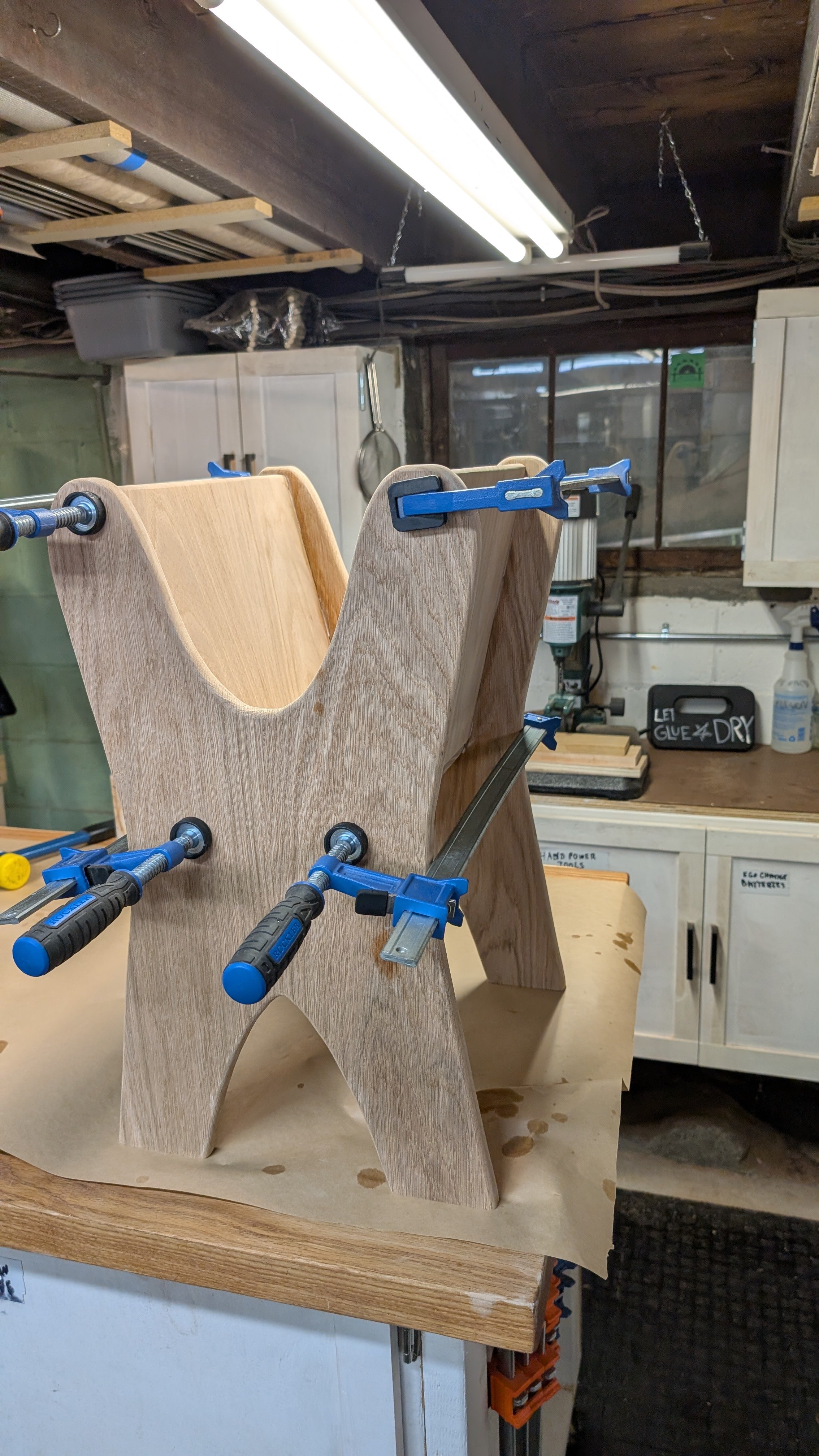
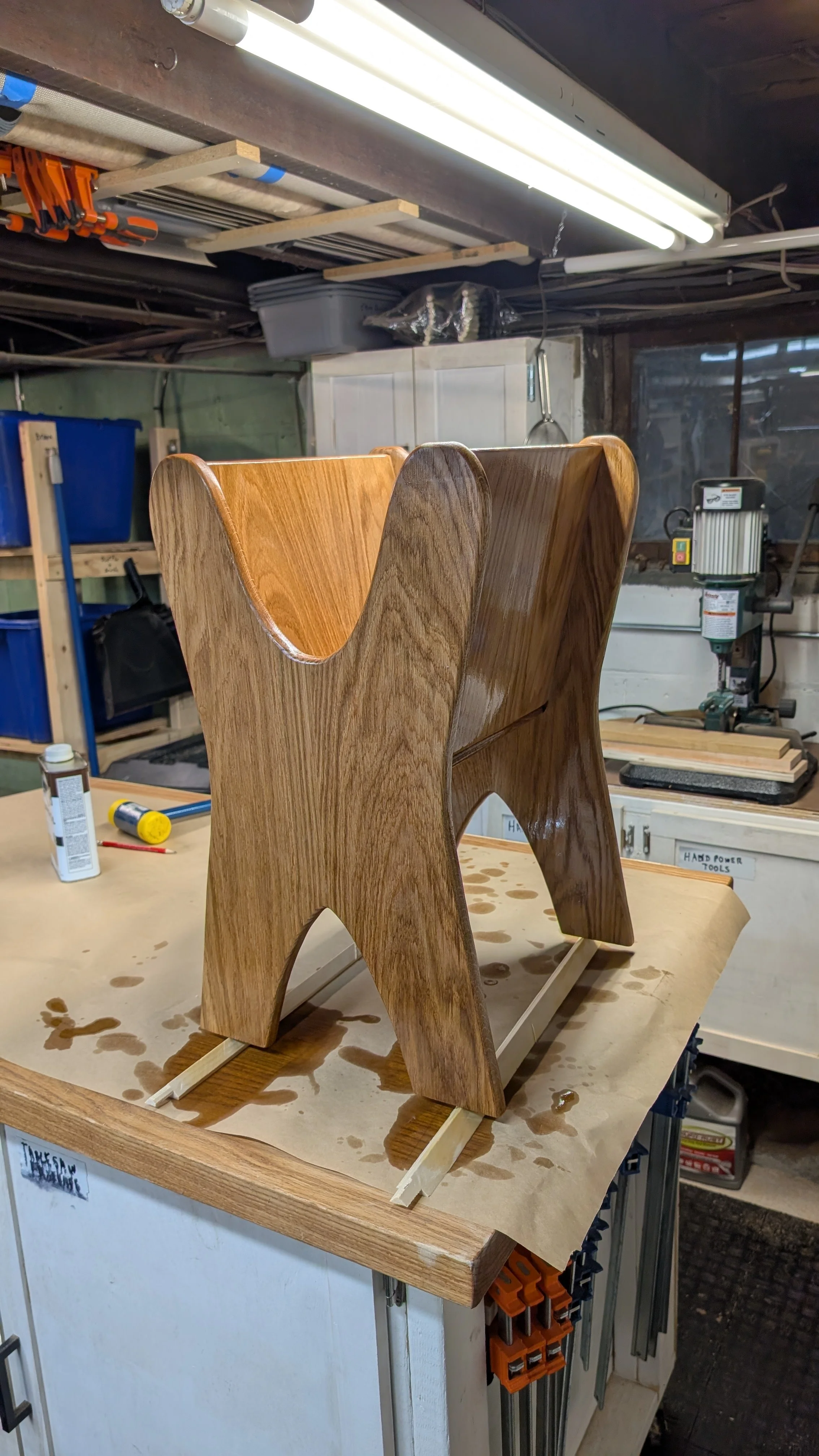
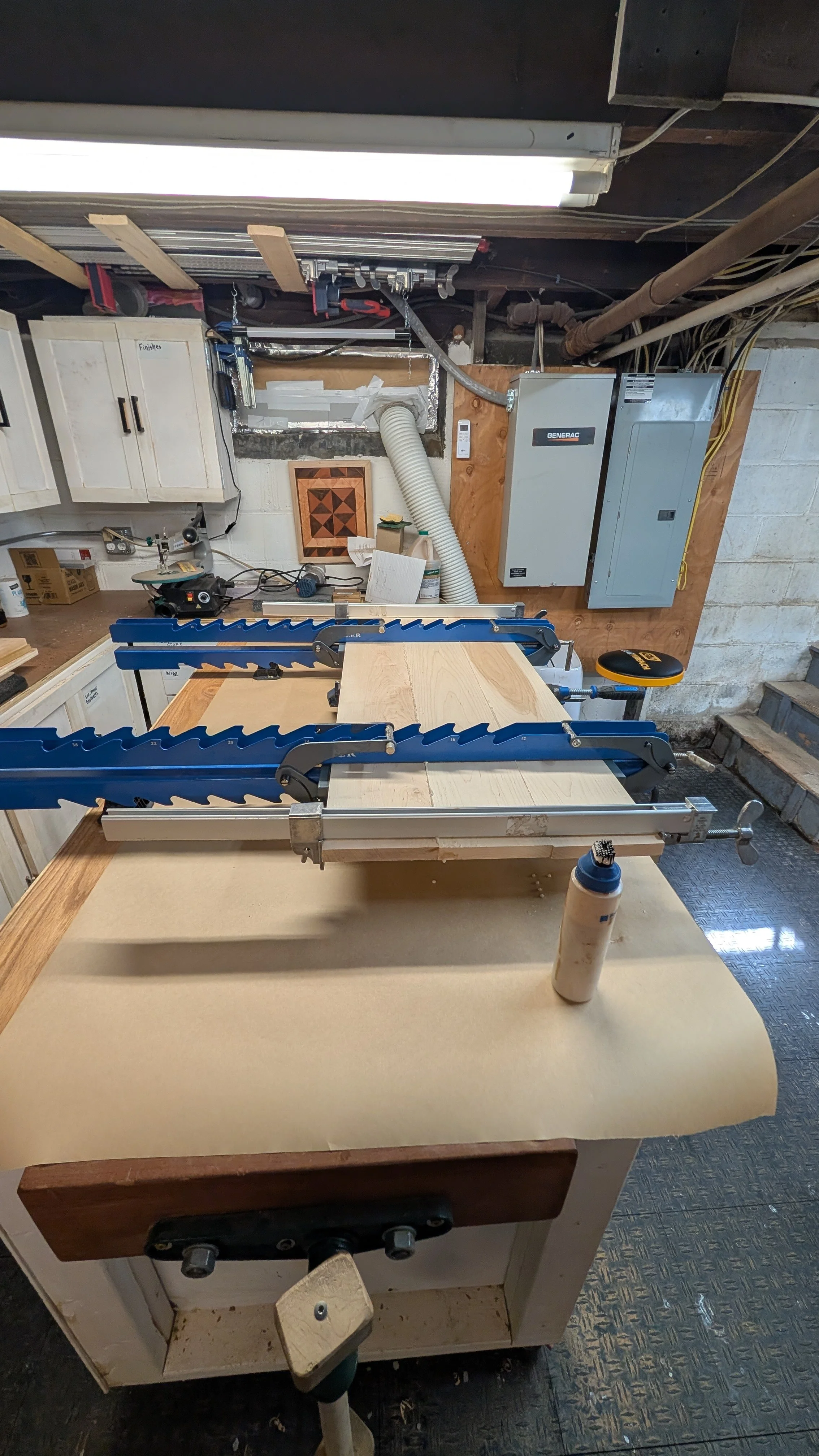
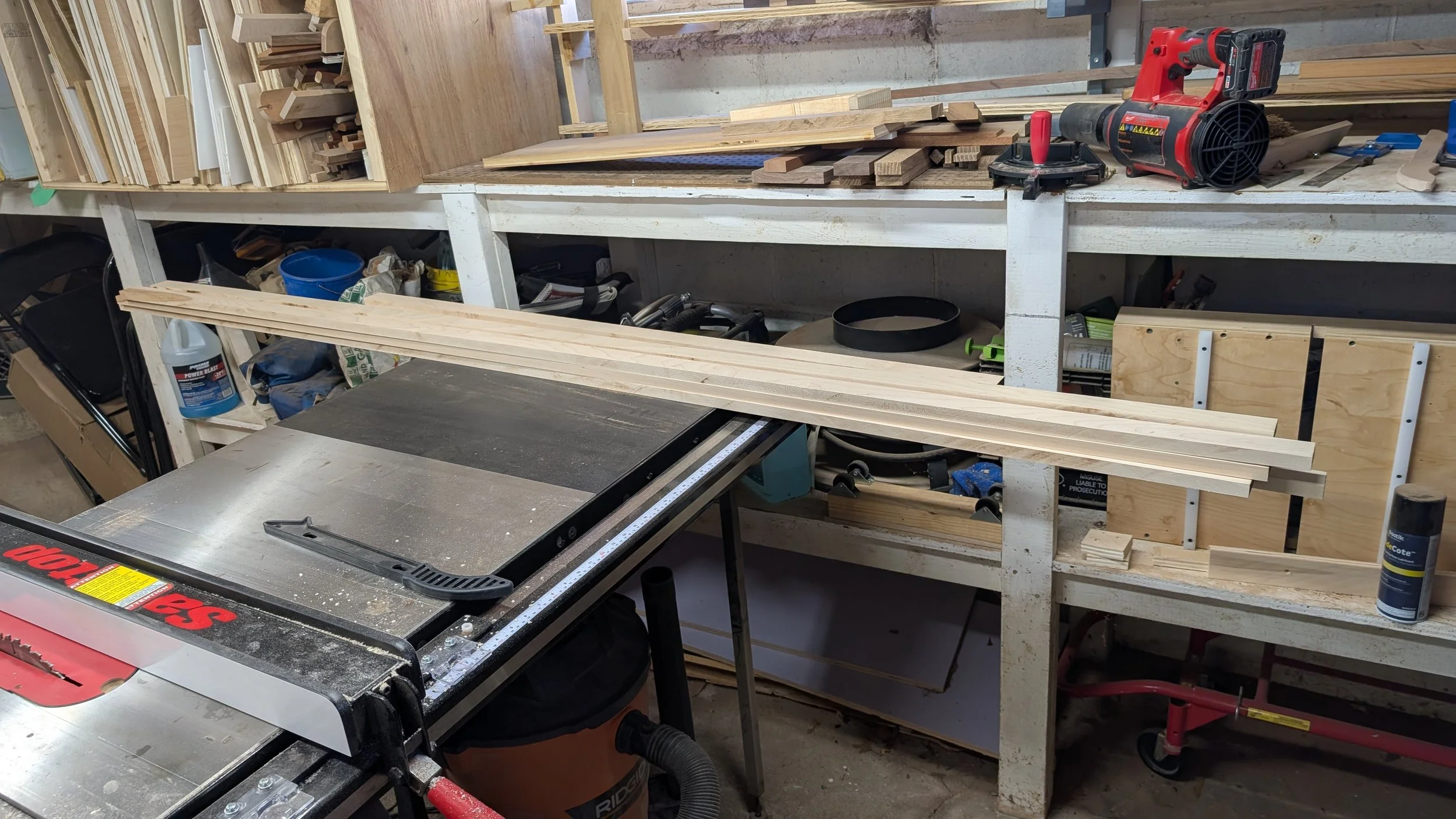
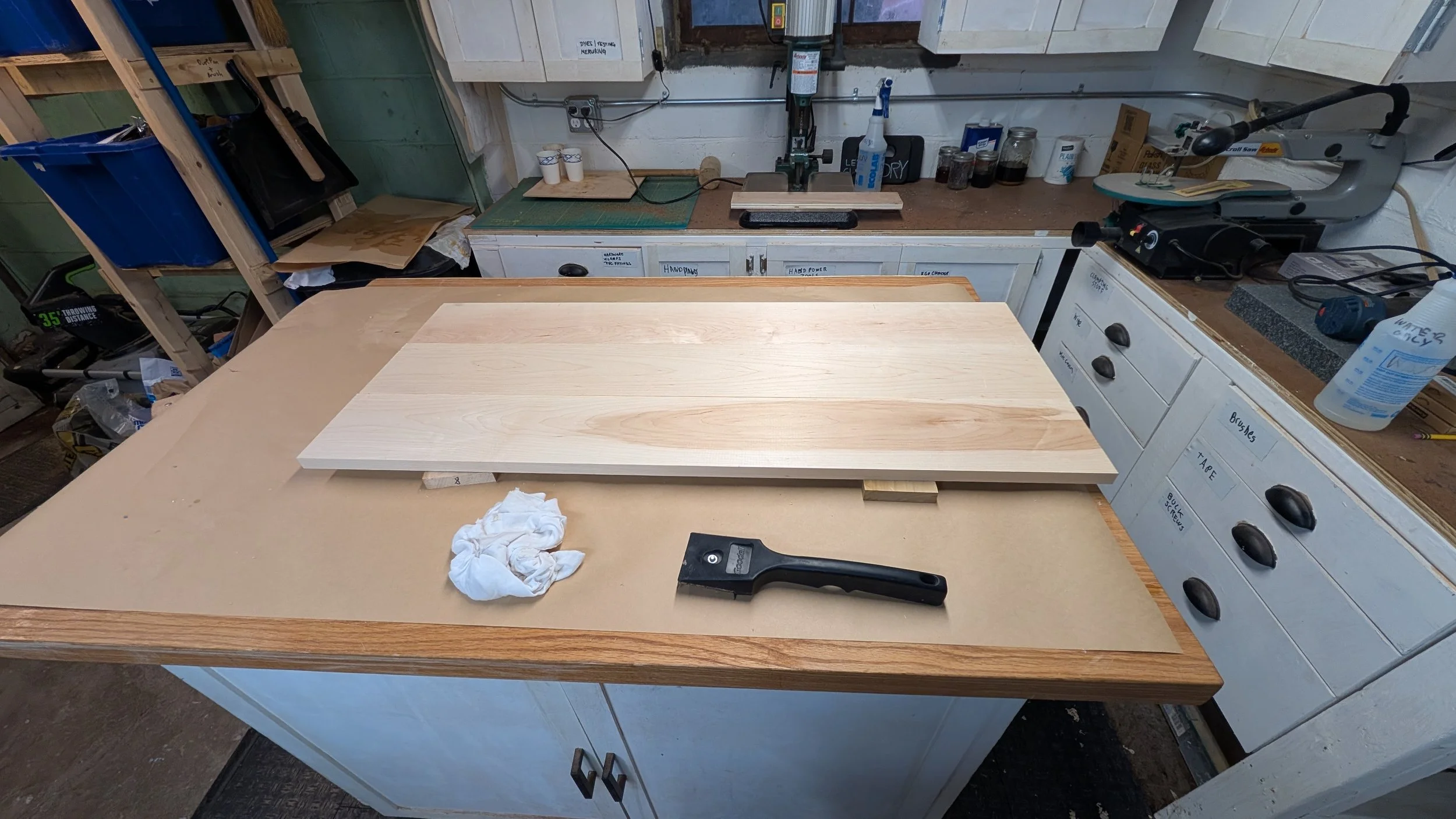
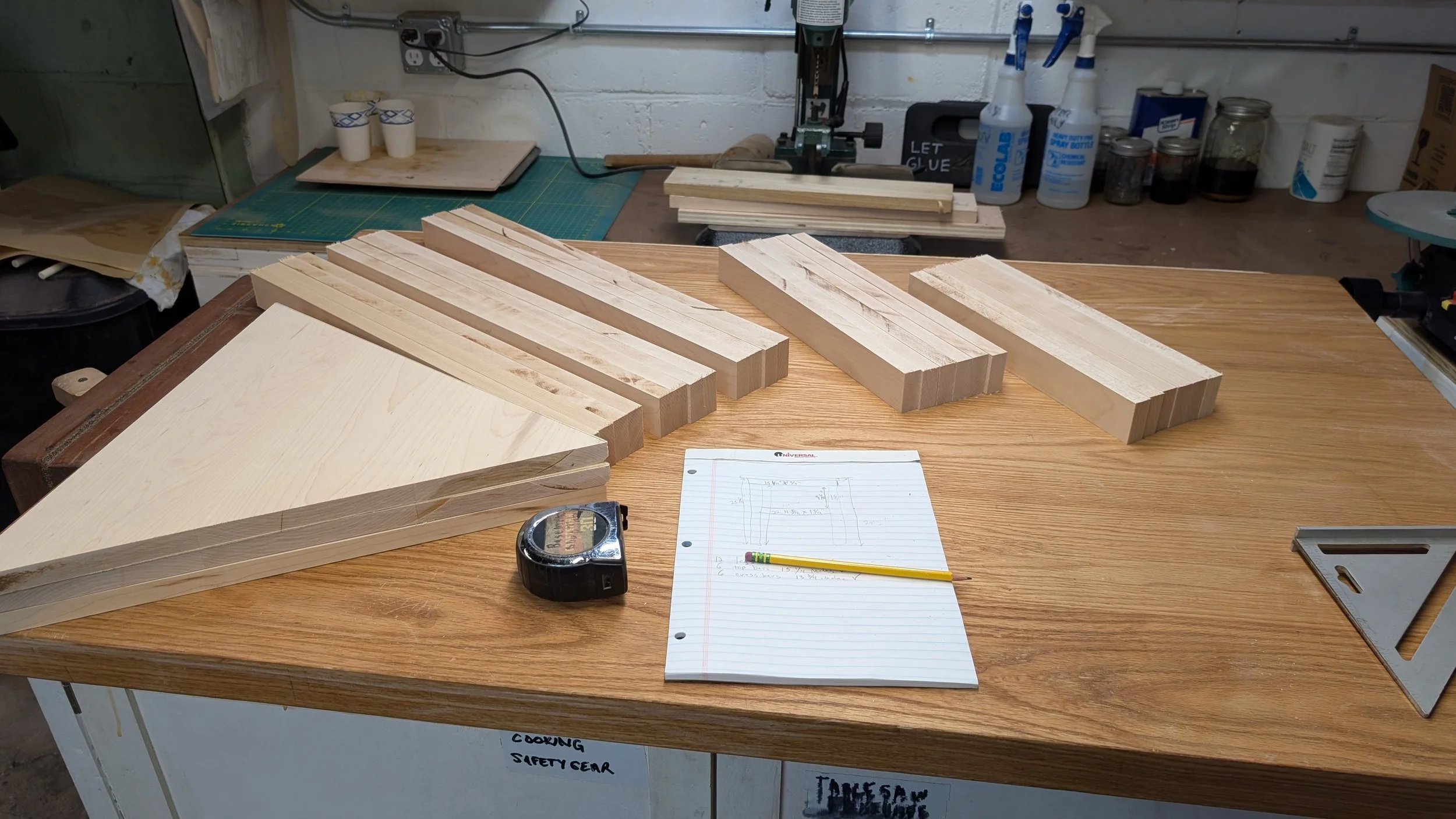
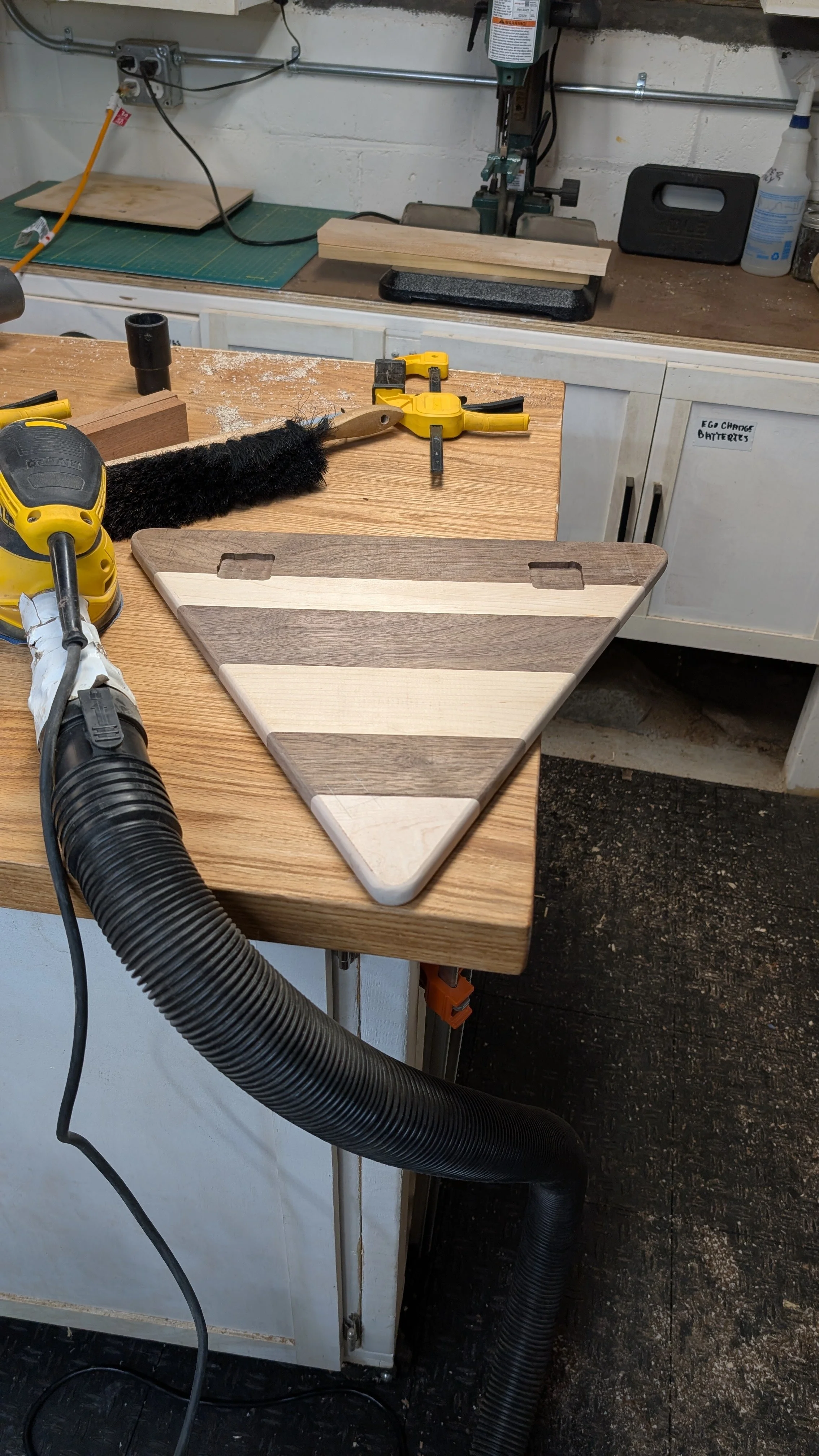
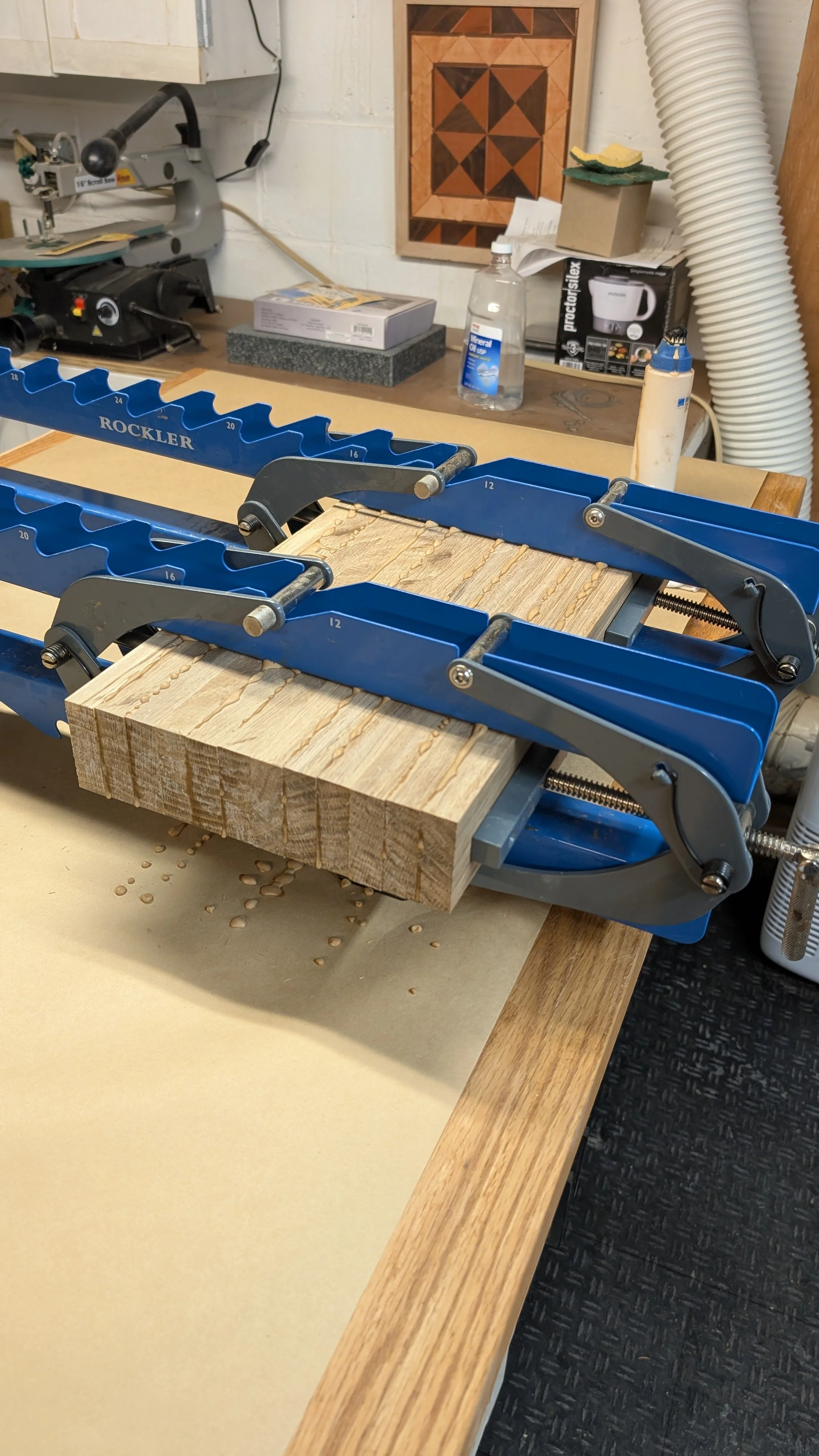
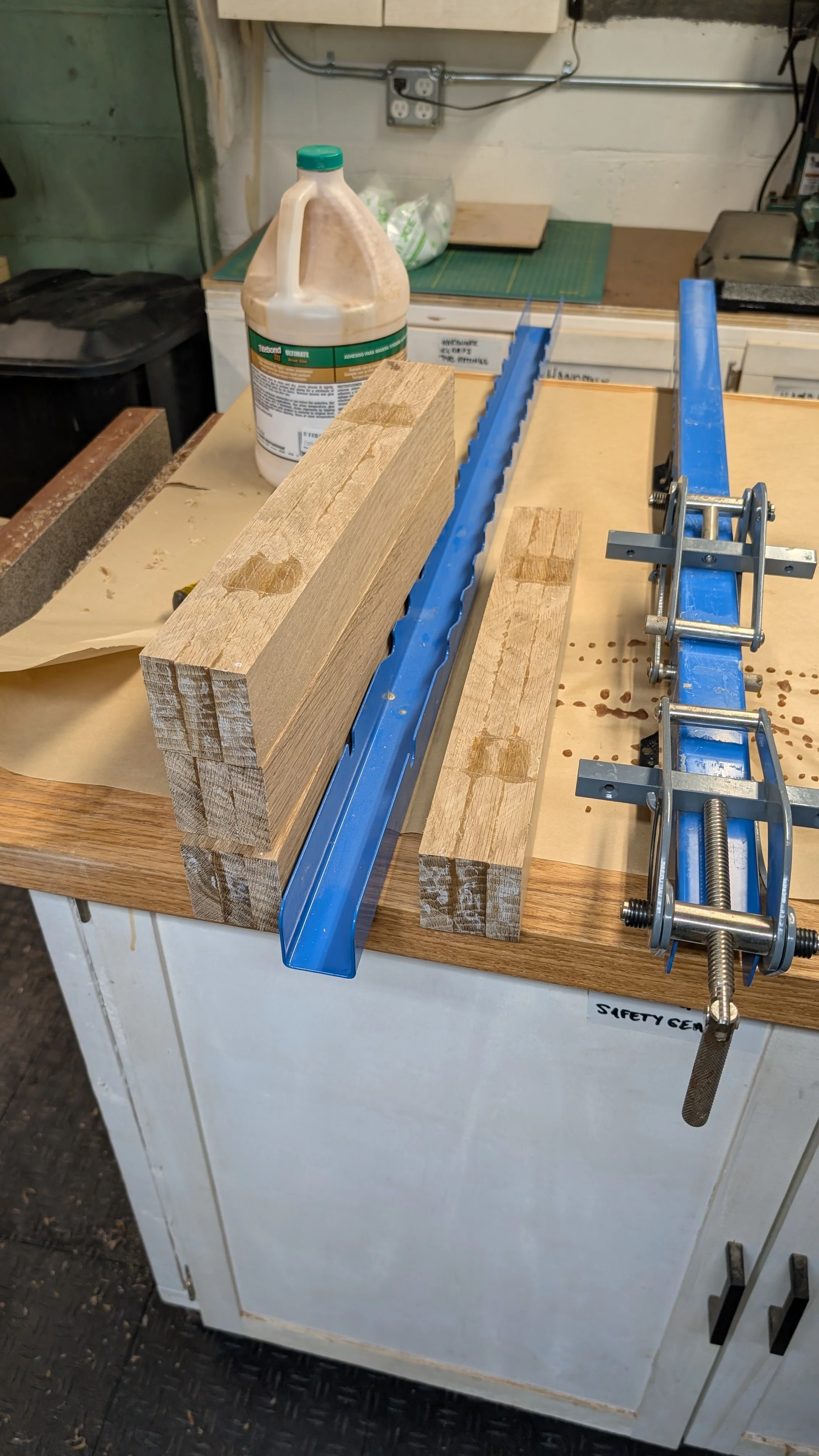
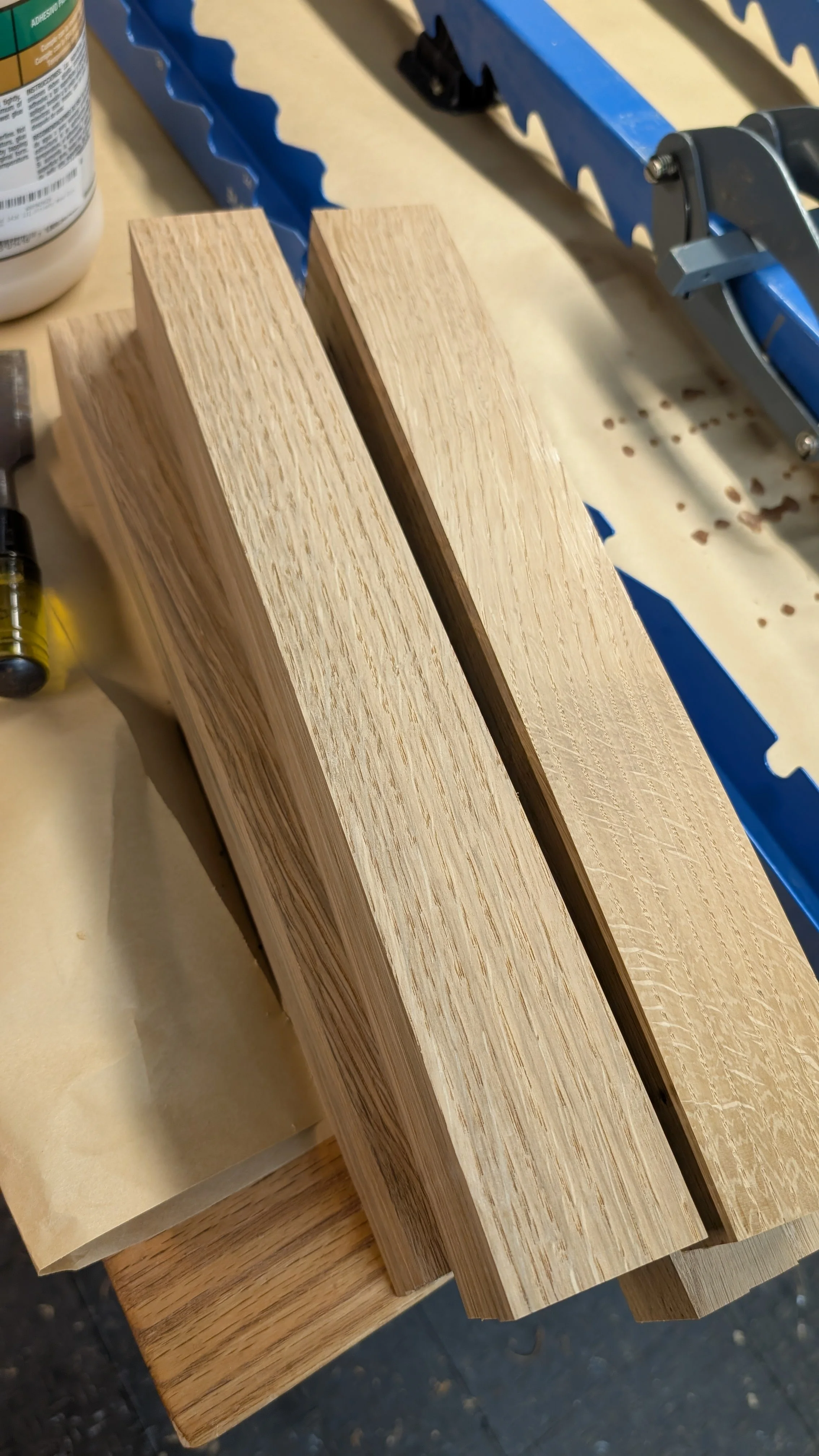
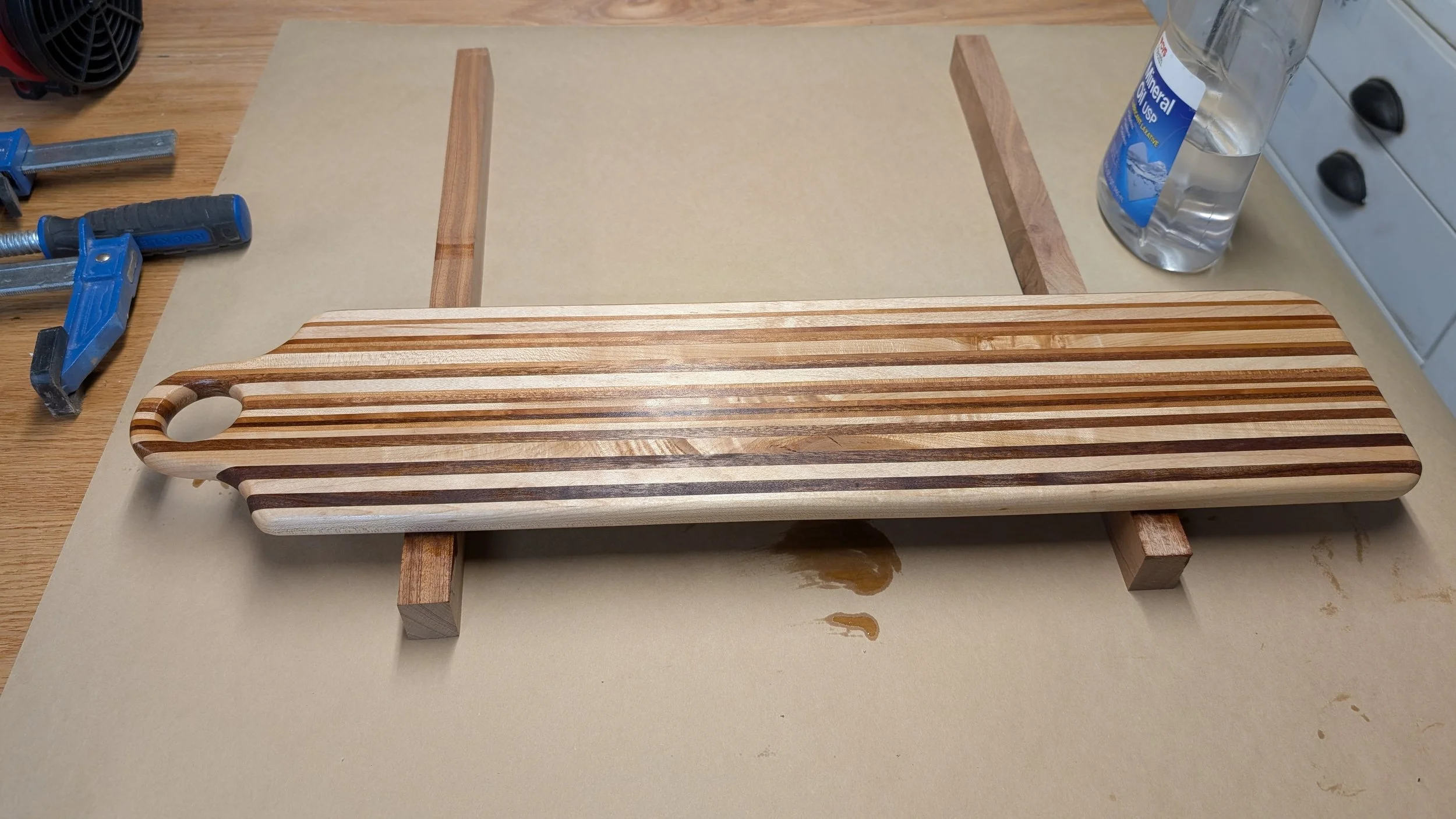
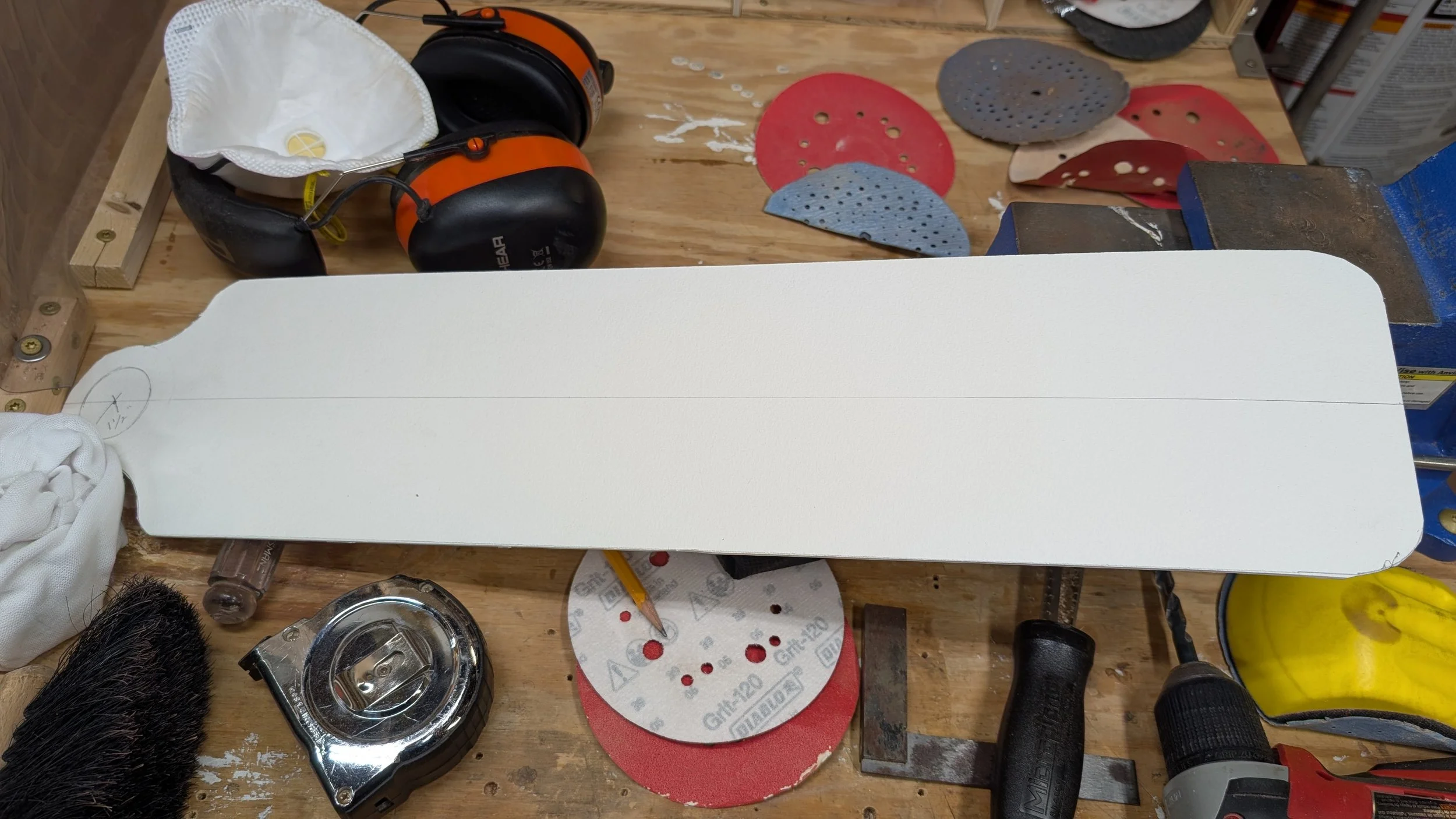
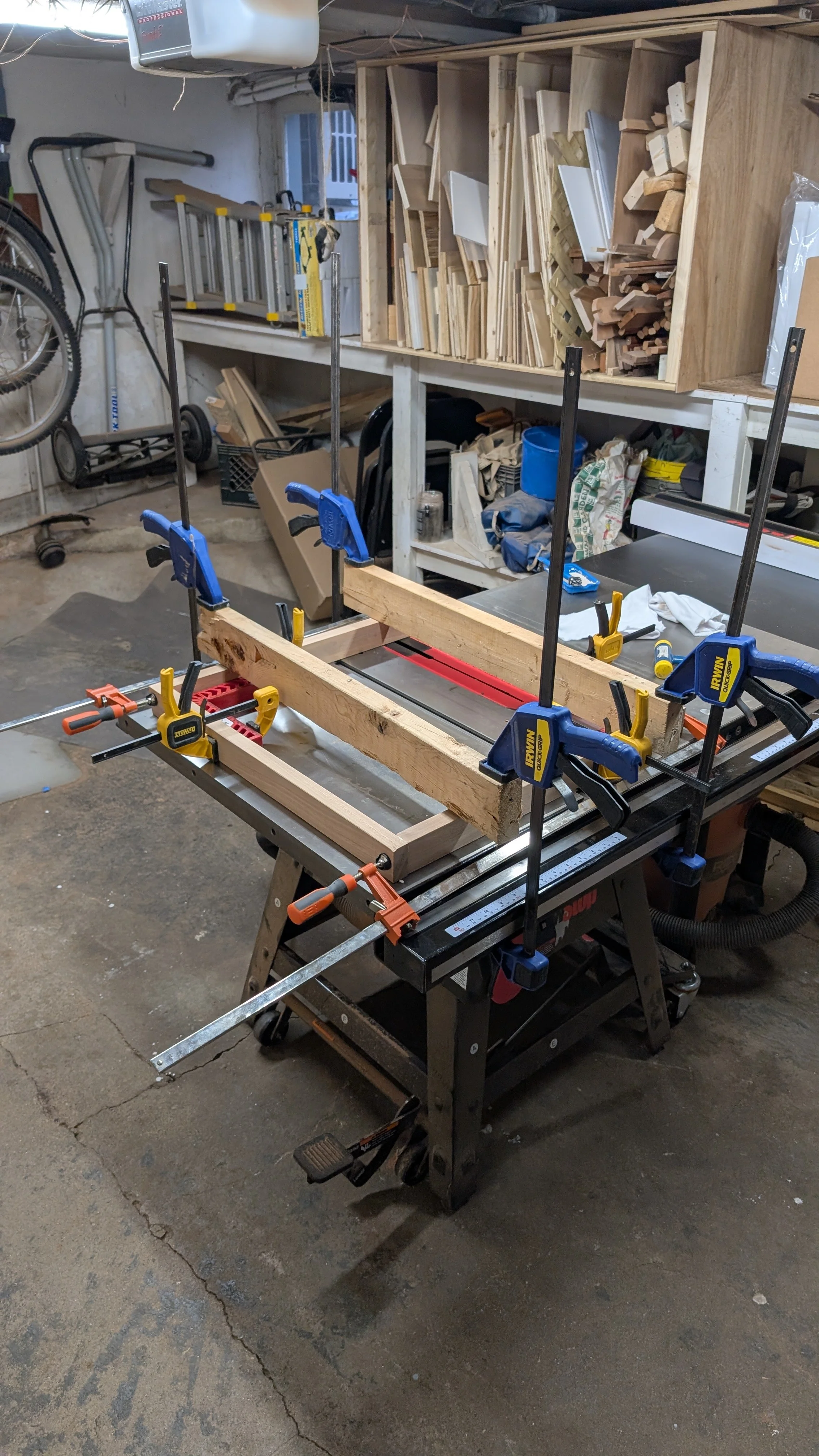
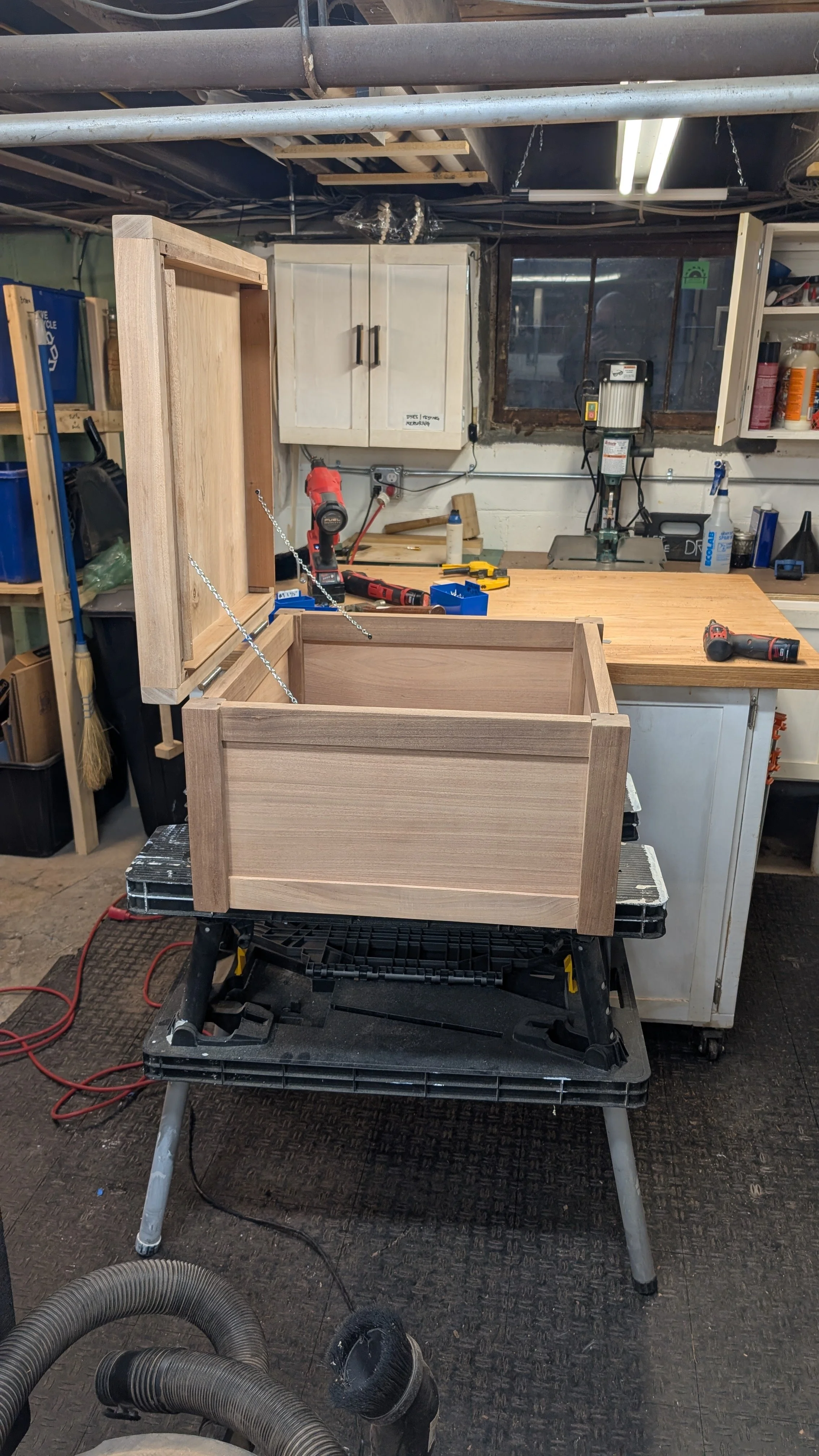
The second one was made from long thin cutoffs that I just couldn’t bring myself to discard, I mean they’re 8’ long after all. I decided to rip them all to 3/4” wide and then cut them into 24” lengths and glue them up into a 5 3/8” x 24” panel. After flattening and thickness planing the resulting panel on the jointer/planer it measured 5/8” thick. I immediately saw a charcuterie board and I made a paper template and marked it up and cut it on the band saw and put the hanging hole in the end with a 1 3/8” forstner bit. I rounded over all the edges with 1/4” round over bit and then sanded it from 120 grit to 220 grit and after carefully cleaning it applied mineral oil to it.

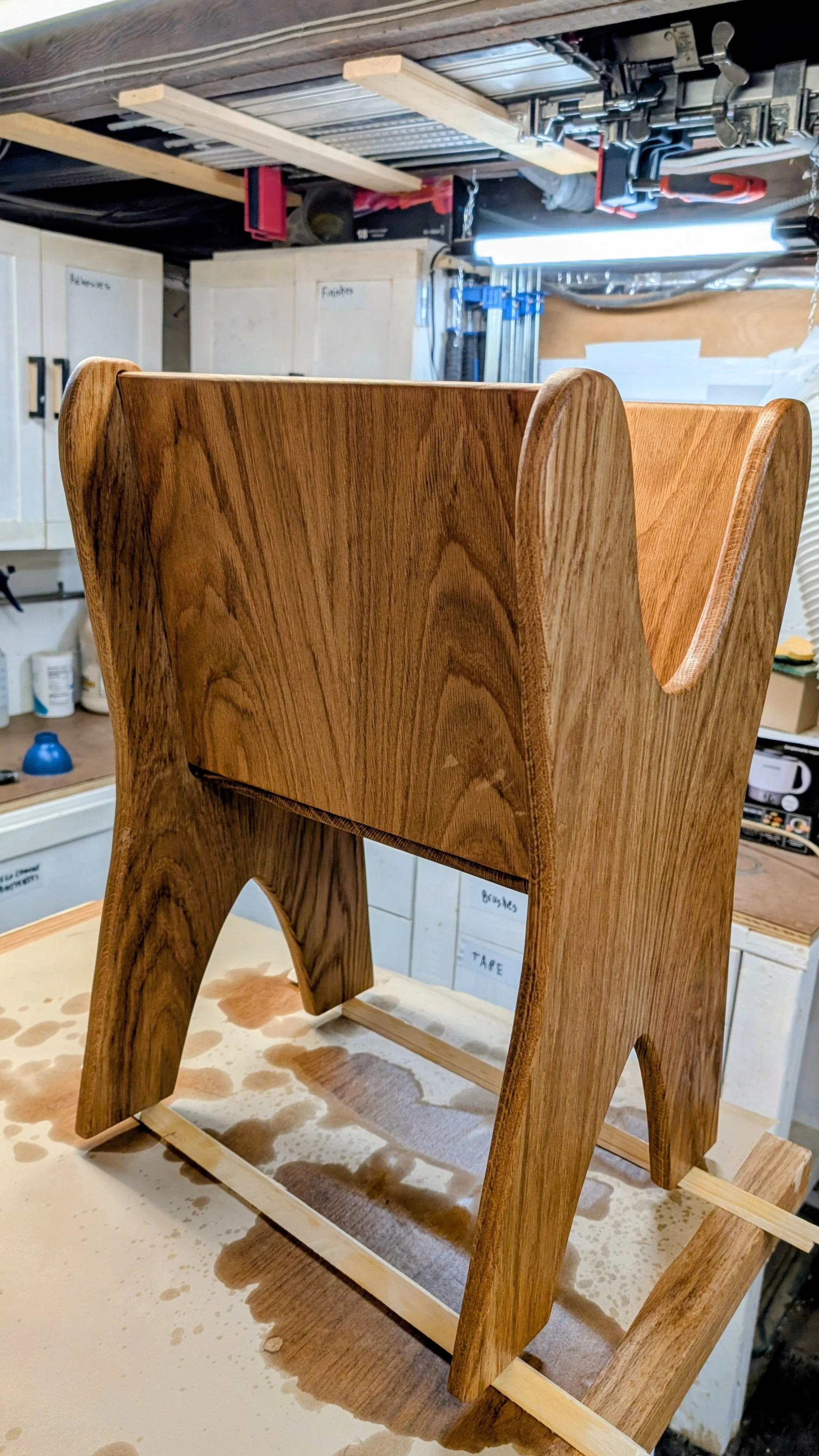
View fullsize PXL_20260121_144418622.jpg
View fullsize PXL_20260121_144355804.jpg
View fullsize PXL_20260120_220203775.jpg
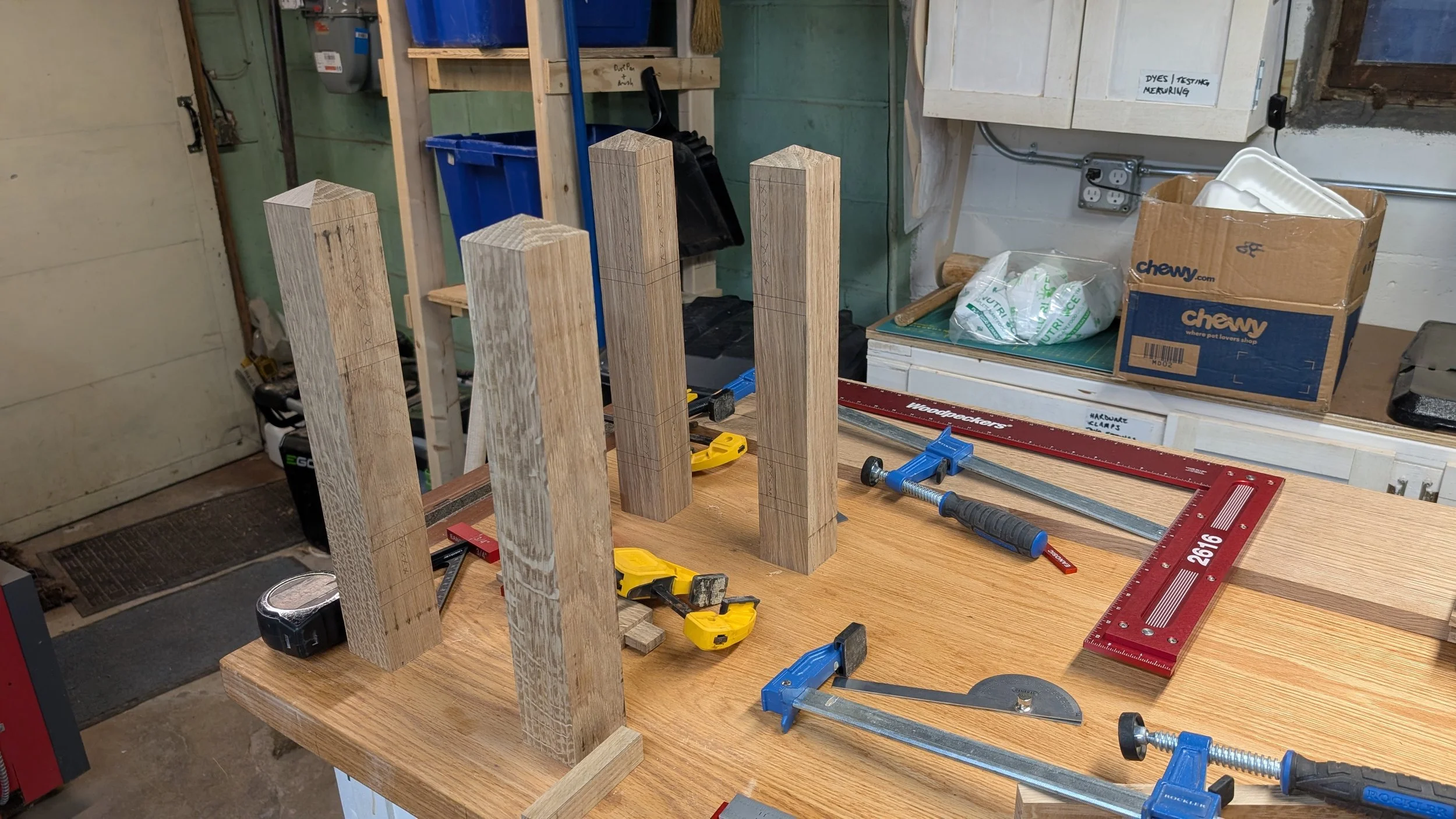
View fullsize PXL_20260116_172711513.jpg

That’s it just a couple of one’ish day builds…

In Journal Tags building, gift box, journal
Comment

Big Cutting Board

January 14, 2026

I was watching an old Hot Ones episode on YouTube with Andrew Rea who is on YouTube as Binging With Babish and Andrew says this:

This immediately struck a chord and I decided right then to make a Big Cutting Board. I also am accumulating a lot of extra lumber from past projects and I’m due for a cull to avoid a wood avalanche in my garage. I made the cutting board above out of Sapele and Maple. I glued up alternating strips that were 1 1/2” thick by 1" 1/16” wide into a rough dimension 24 1/2” x 16” panel. When it had cured I used planes and 60,80,120,220 grit sanding to flatten it. I cut it to size and rounded all the edges with a 1/4” round over router bit and then oiled the whole thing with food safe mineral oil. I put rubber feet ( compensating with some washers for a slight twist) and it was done. I really like it, I should have done it sooner.

In Journal Tags building, one day builds, journal
Comment

Storage Ottoman

January 3, 2026

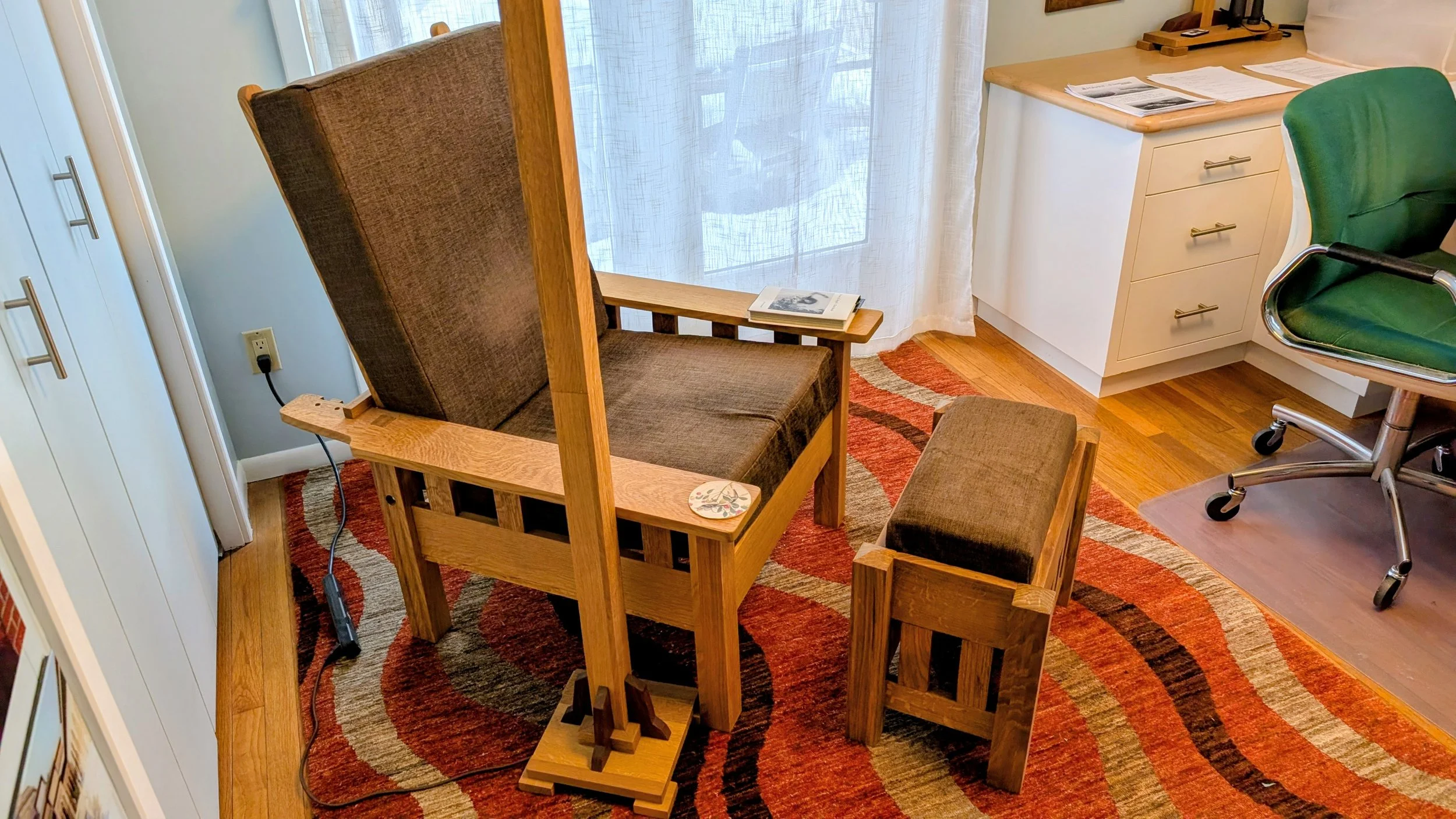
Back in 2022 I built a blanket rack to store and display the lovely blankets my beautiful and talented wife had spun and woven. We don’t super heat our house and so in the winter I like to have a blanket while we’re watching TV. The rack worked fine for making them available and displaying them.

However, we have two evil tabby cats who think that nice woolen blankets are something that they should claw and eat. This is not good. Finally we had to hide the blankets away in a closet to prevent further damage to them or the cats. Shortly after that we came up with an idea for a storage ottoman that would keep them handy and safe. Also my wife uses the ottoman to sit on when she is threading her loom and so something that moved around easily would also be great. I also wanted to make the ottoman only partly upholstered to limit evil tabby claw damage.

This is the design I came up with:

Storage ottoman on casters 19” tall by 24” wide by 24” deep with a hinged lid under the seat

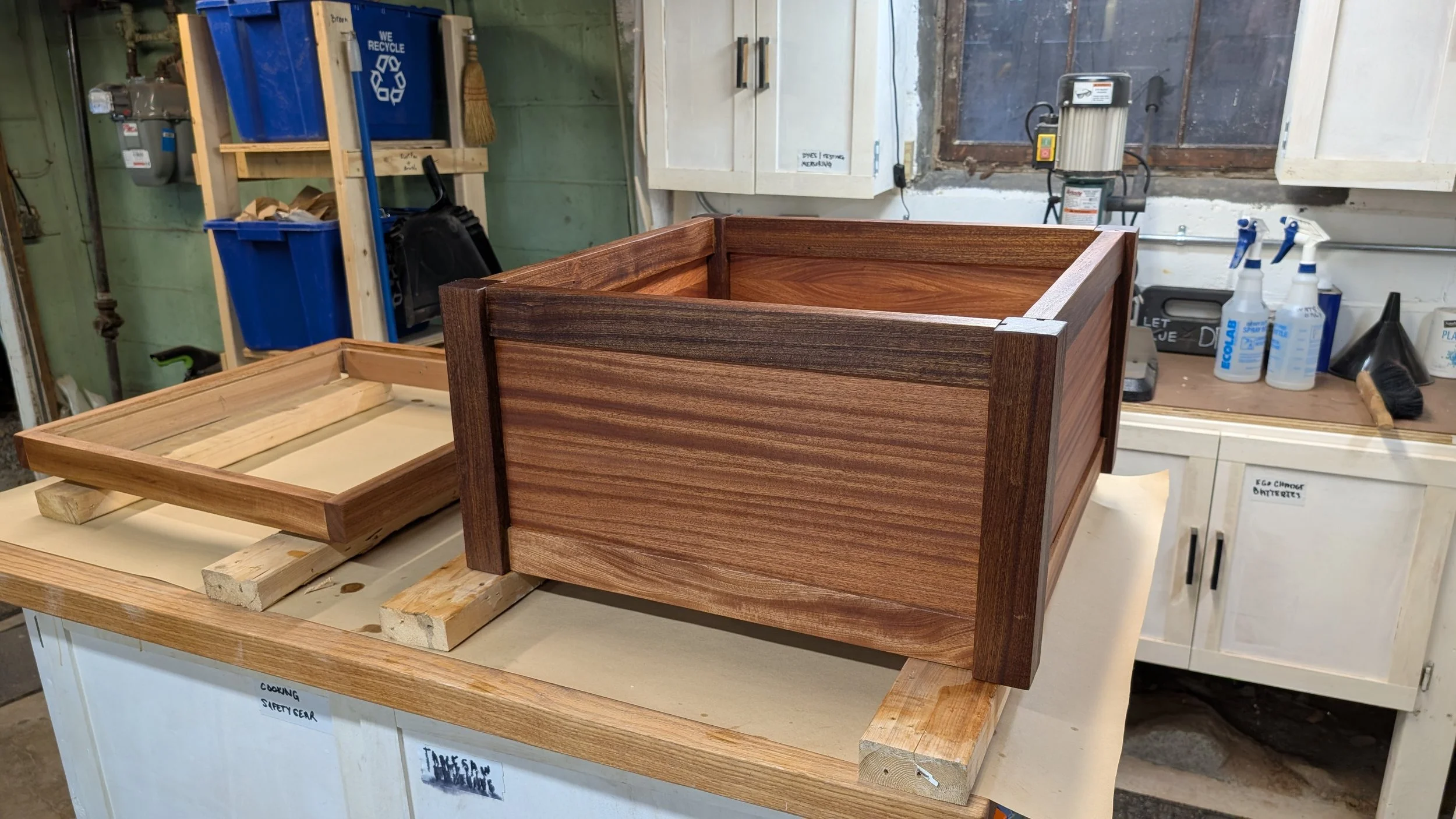
I designed a 19” x 24” x 24” ottoman on casters, it would be slightly larger than the original ottoman and use fabric that was left over from when we had our couch re-upholstered. I had a bunch of left over Sapele lumber from the new Fire Table Chairs so I only had to pick up some nice 1/4” Sapele veneer plywood that was veneered on both sides since I would be finishing the inside as well as the outside.

Because this would be seating as well as storage I made the corner posts actual 2” x 2” posts and all of the frame members were 1” x 2”. I used my new jointer/planer to dimension all of the parts exactly and to remove all of the saw marks.

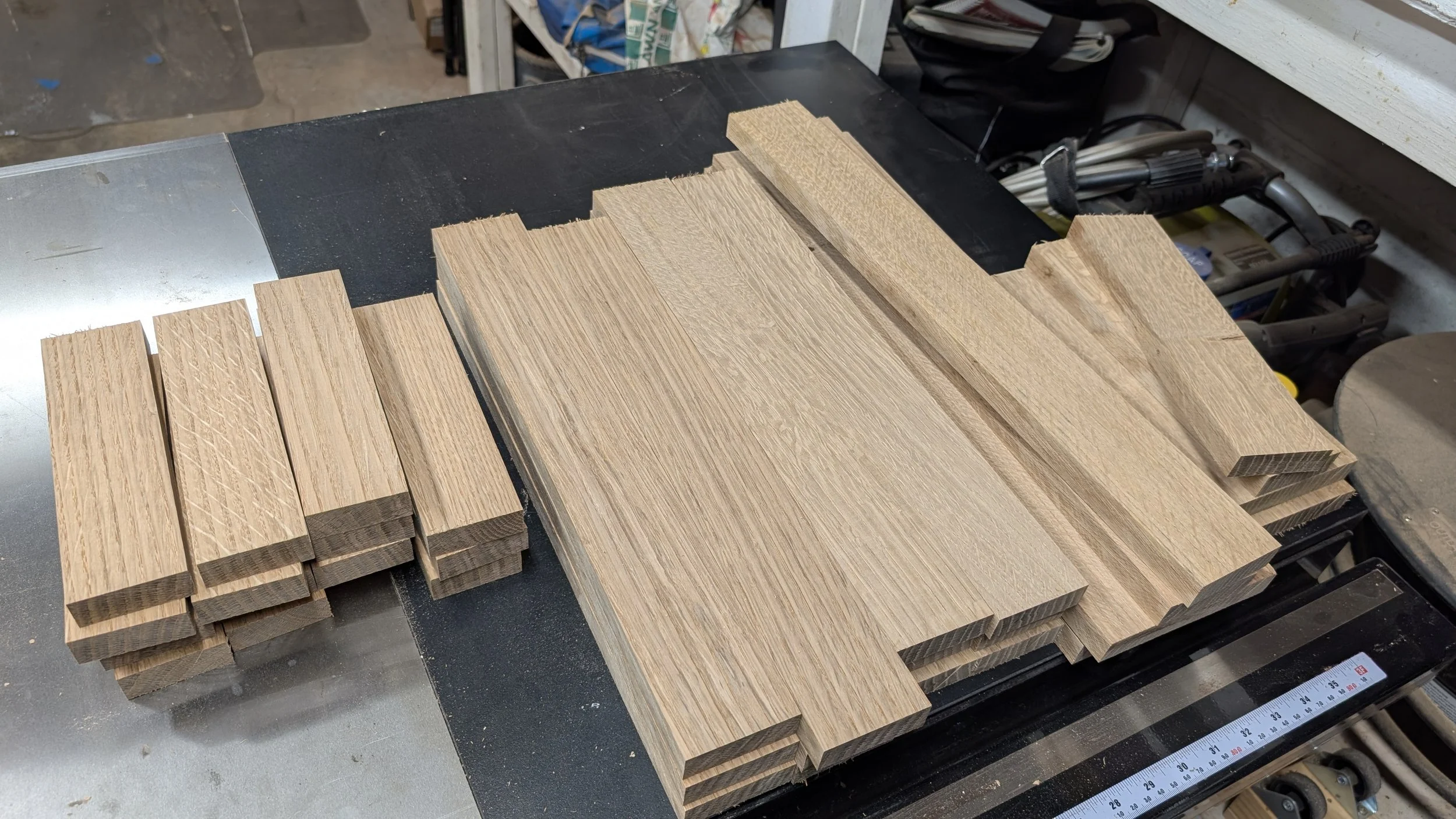
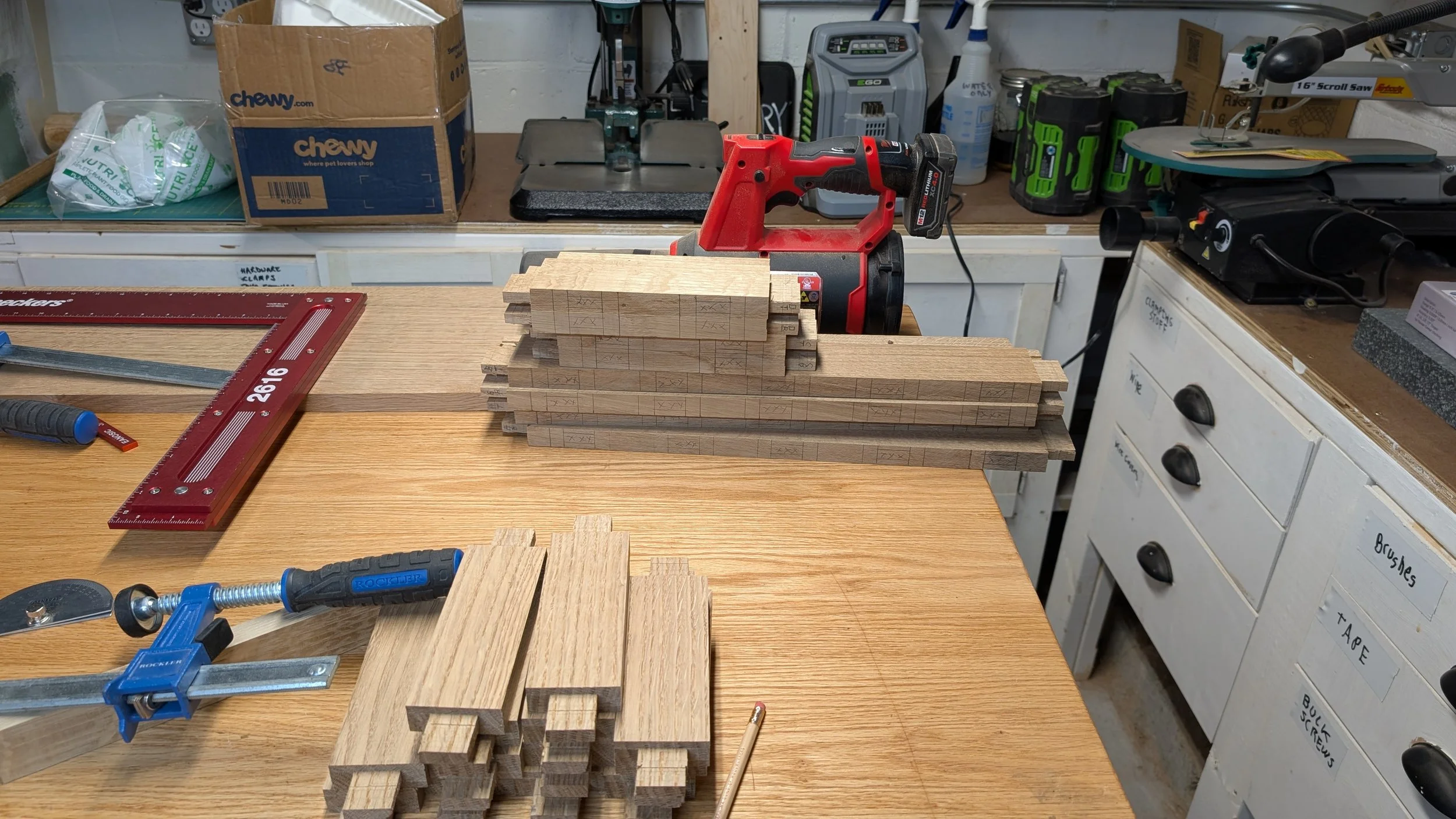
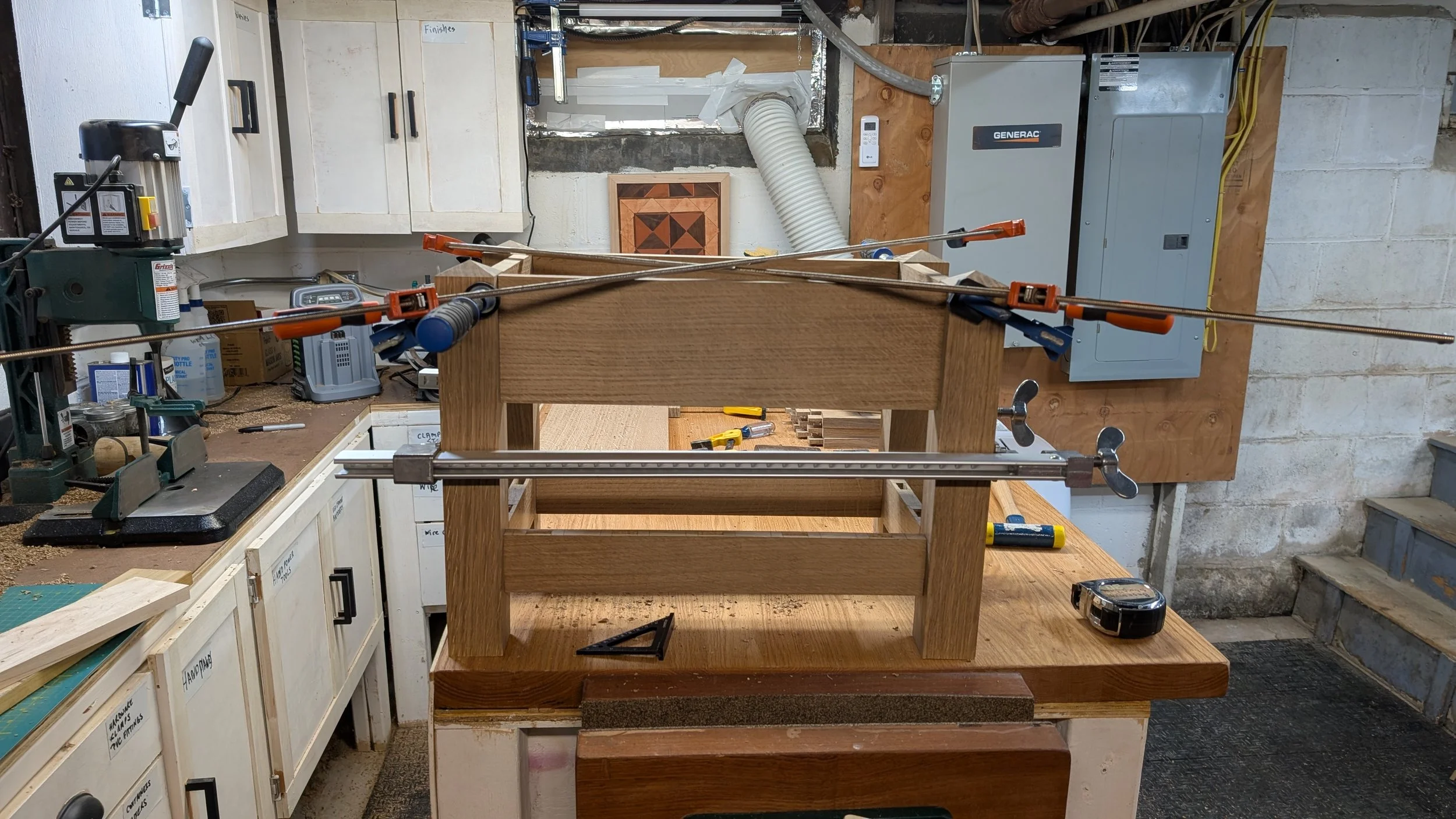
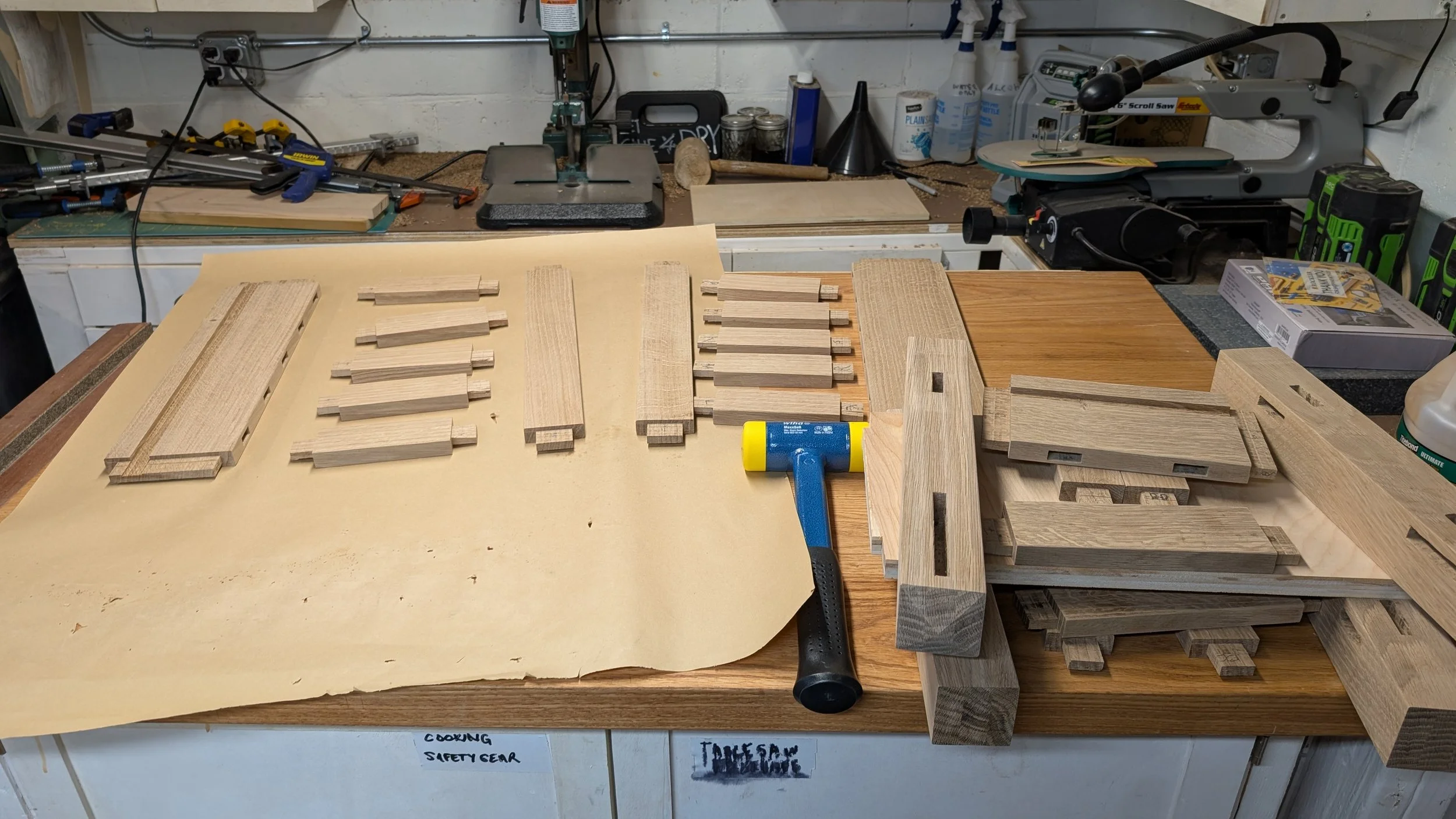
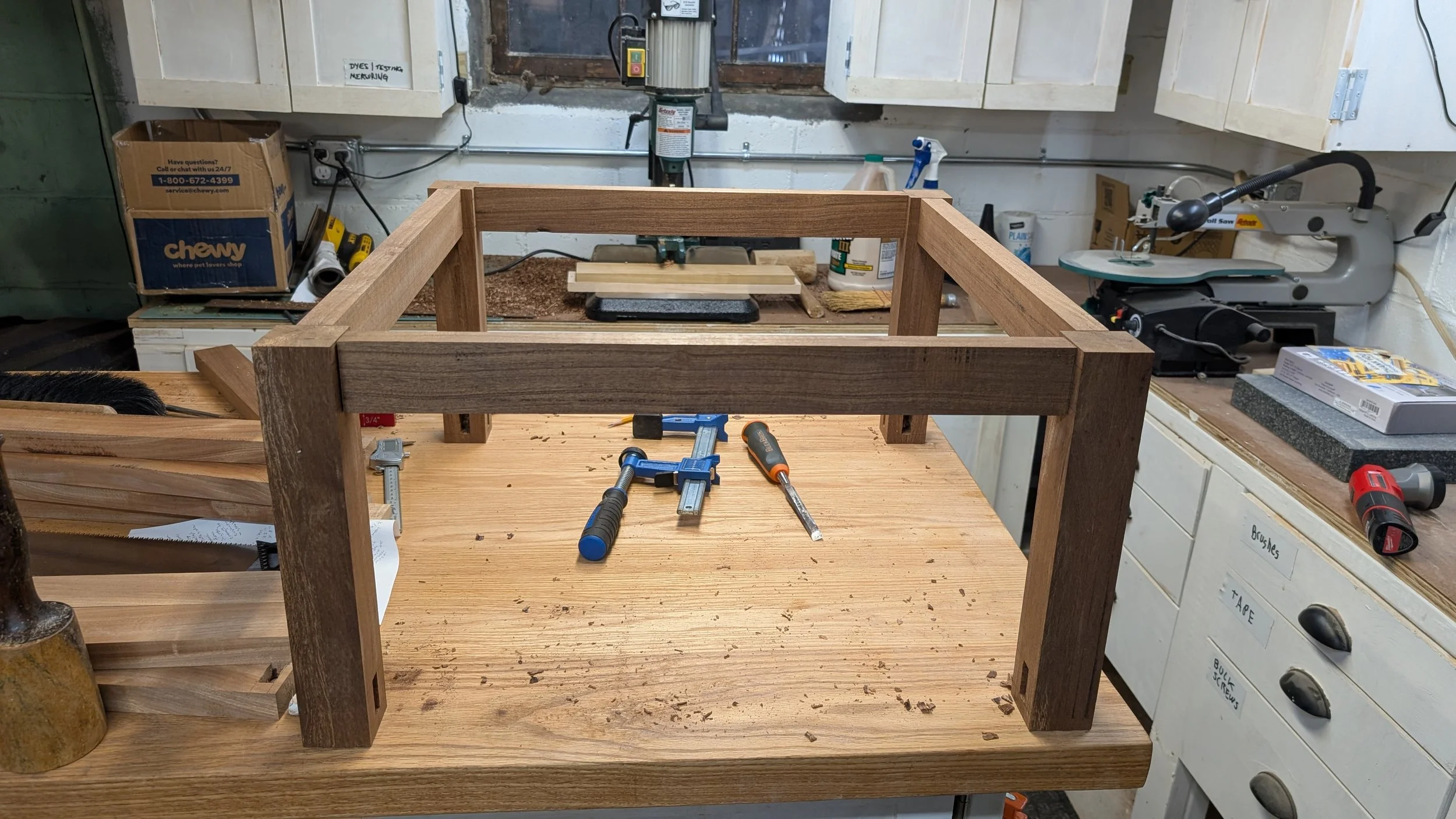
Once I milled all of the frame and seat frame parts to size I cut all of the mortices in the corner posts. I deliberately offset the tenons so that there would be extra material at the top and bottom of the posts to help give the frame extra support. I also centered them in the posts for the same reason. I made them 1” deep which which would require notching the tenons so they wouldn’t collide.

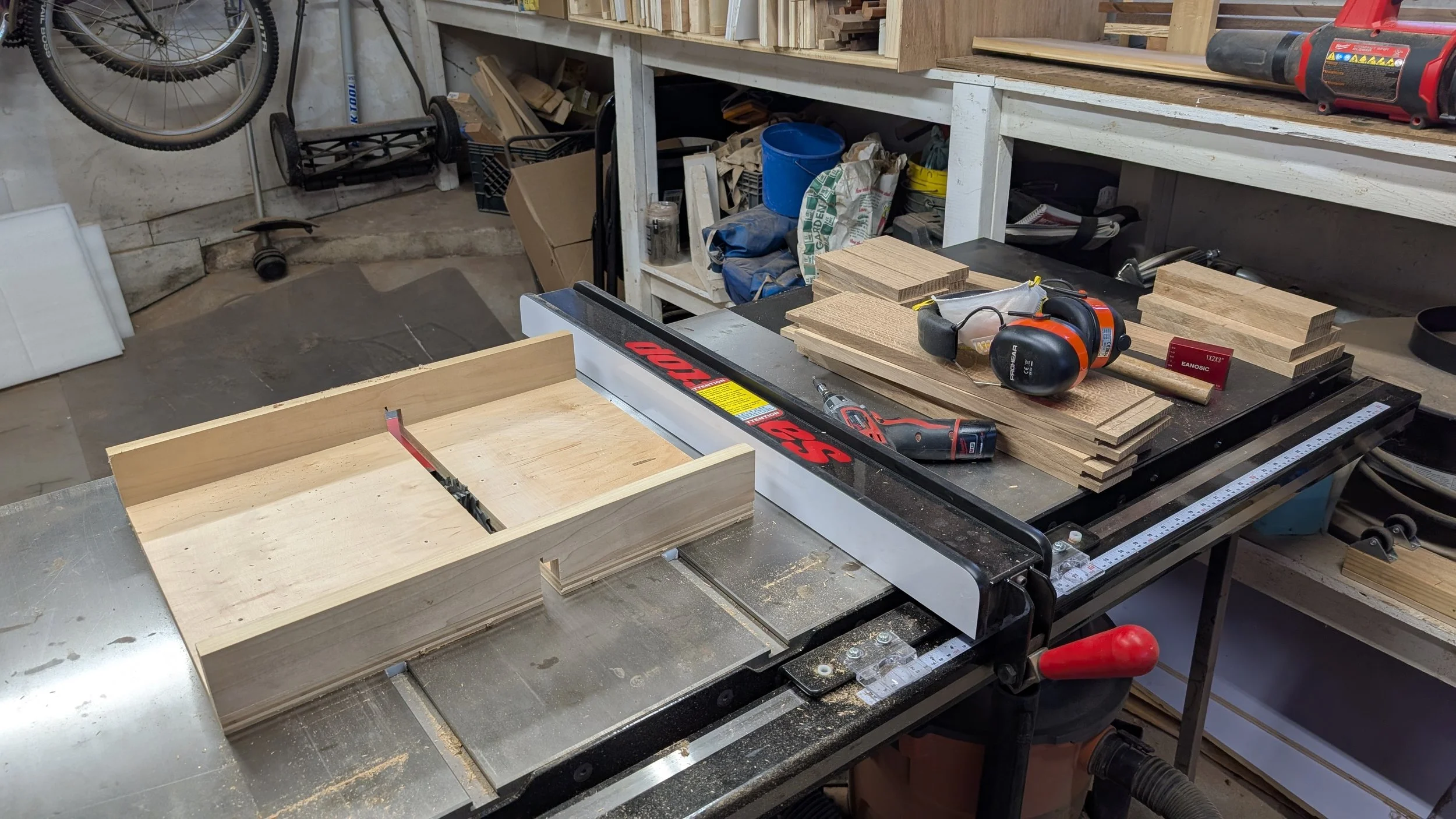
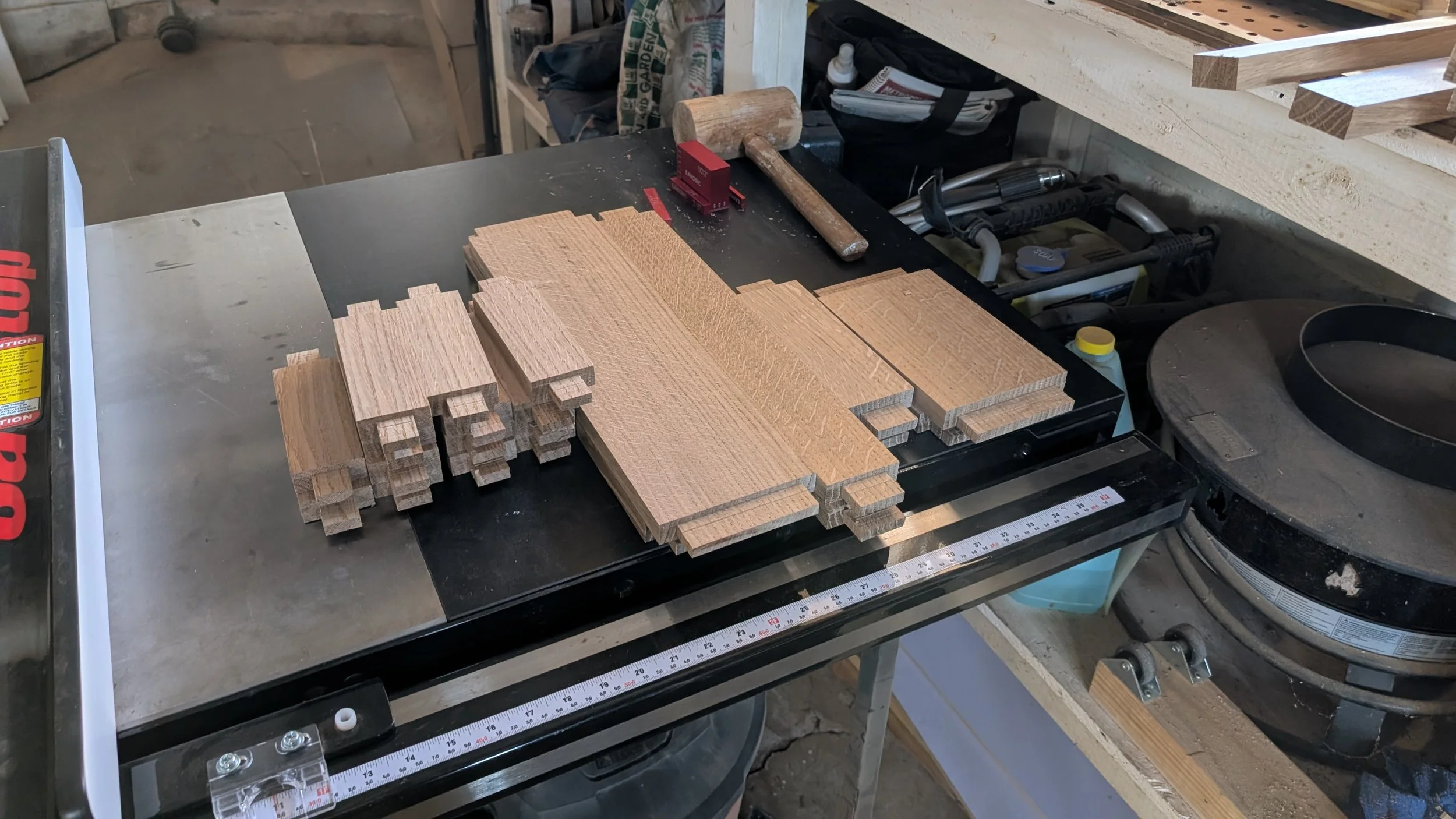
Then I switched my Sawstop table saw to dado mode, the first time I’ve done this, it turned out to be much faster and easier than I imagined. I used the dado stack and my table saw sled ( modified for dado usage ) to cut all of the tenons.

After that I cleaned up and dry fitted all of the mortices and tenons.

View fullsize PXL_20251217_141841067.jpg
View fullsize PXL_20251217_145652986.jpg

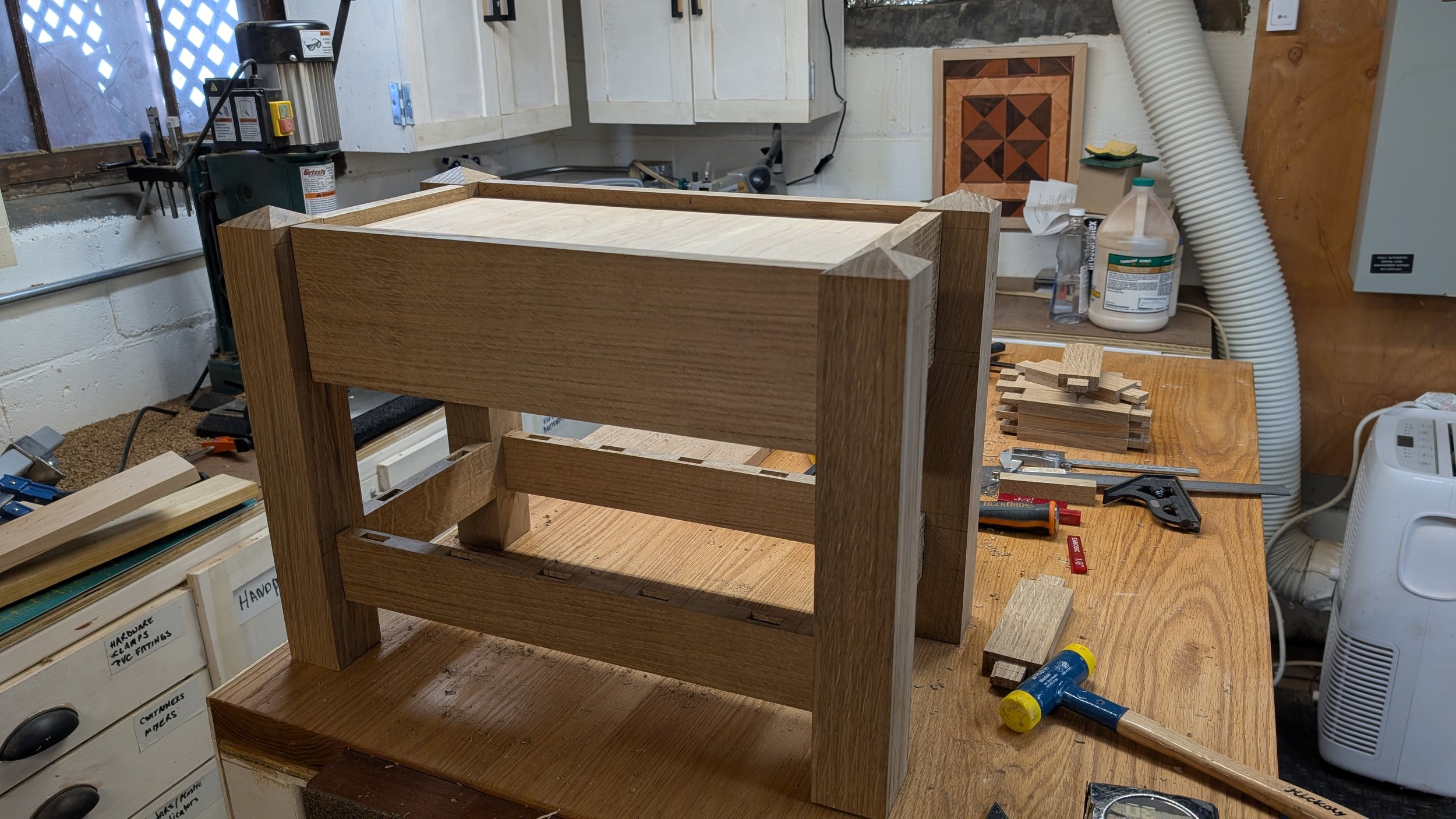
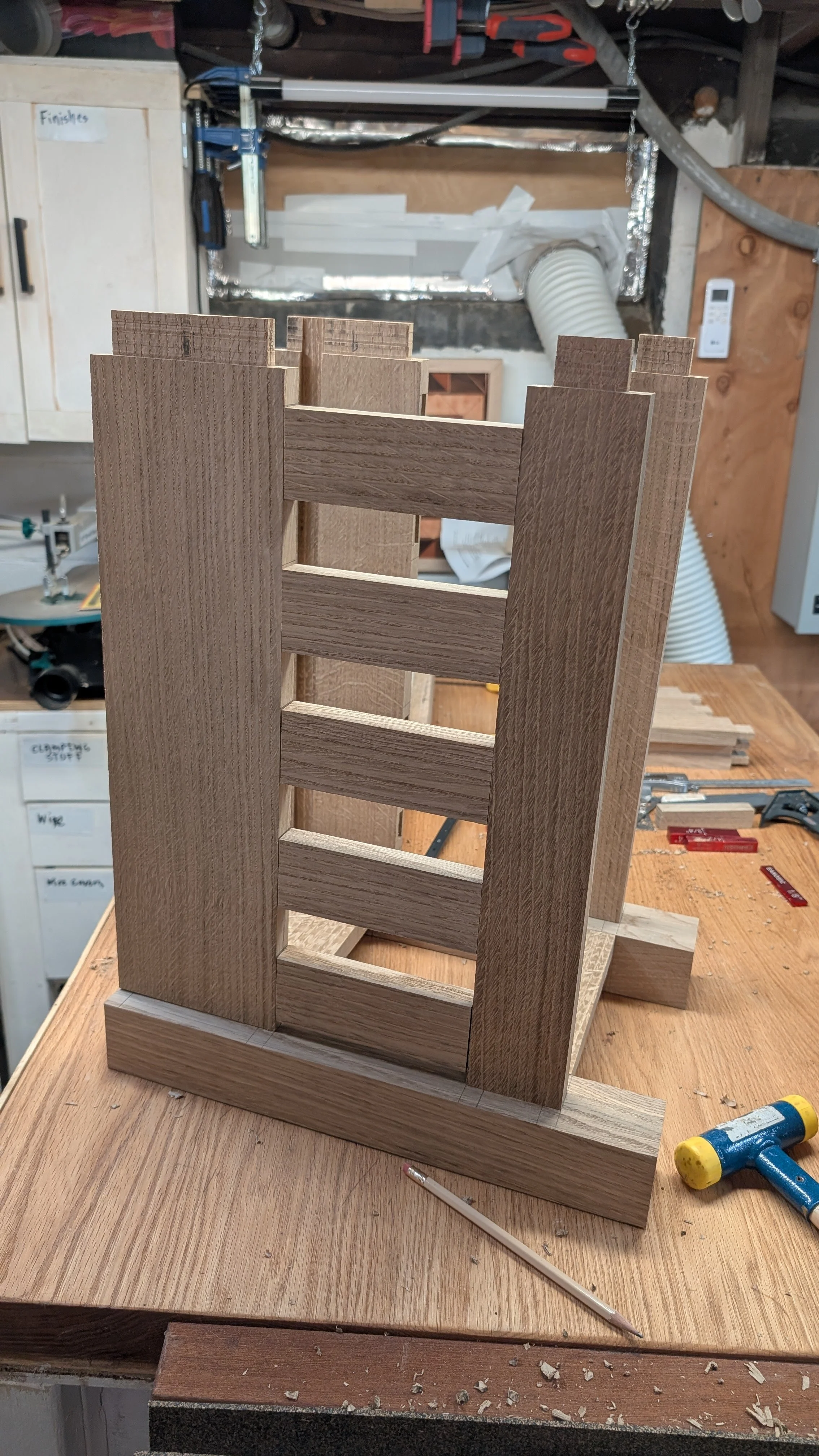
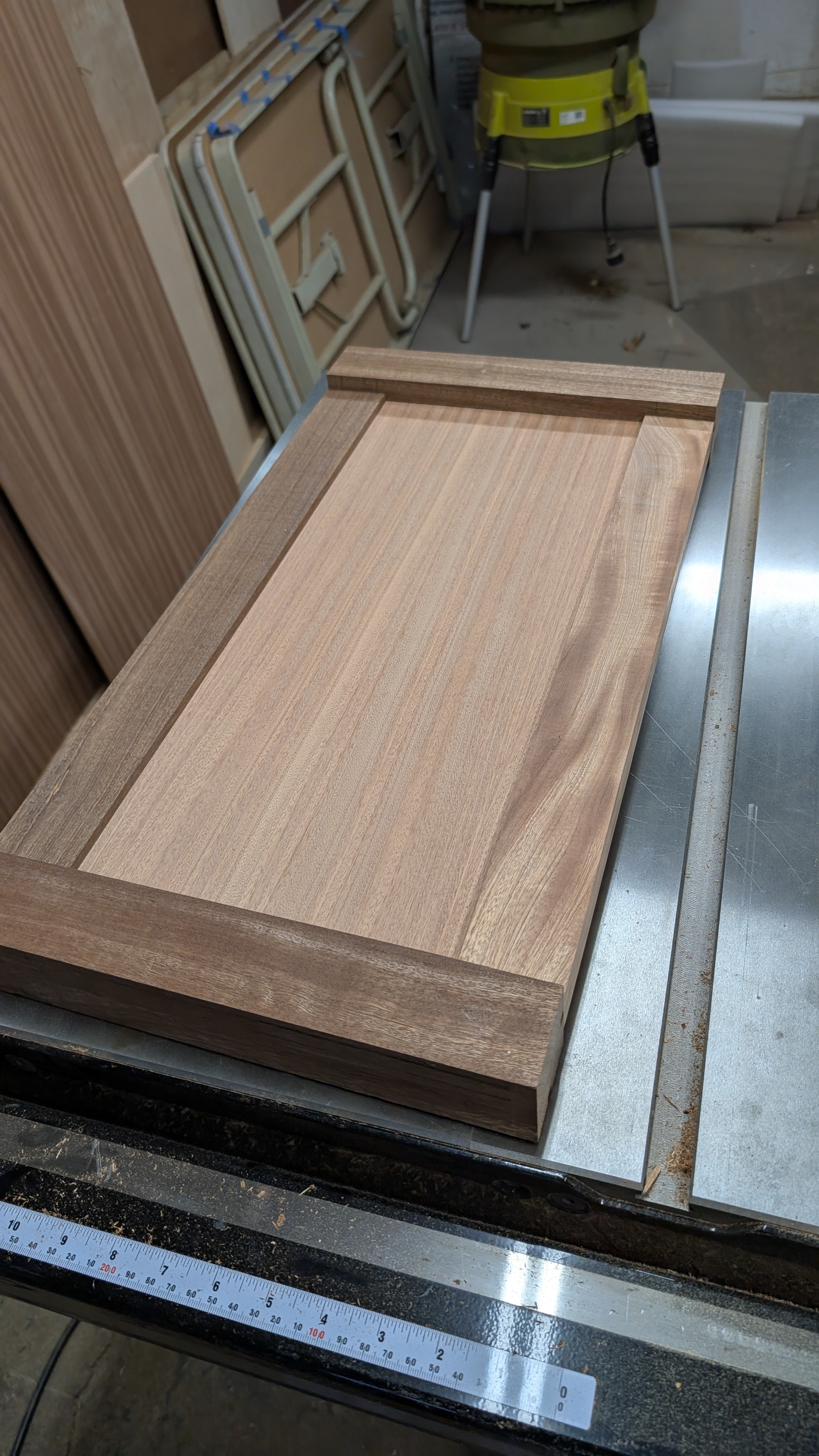
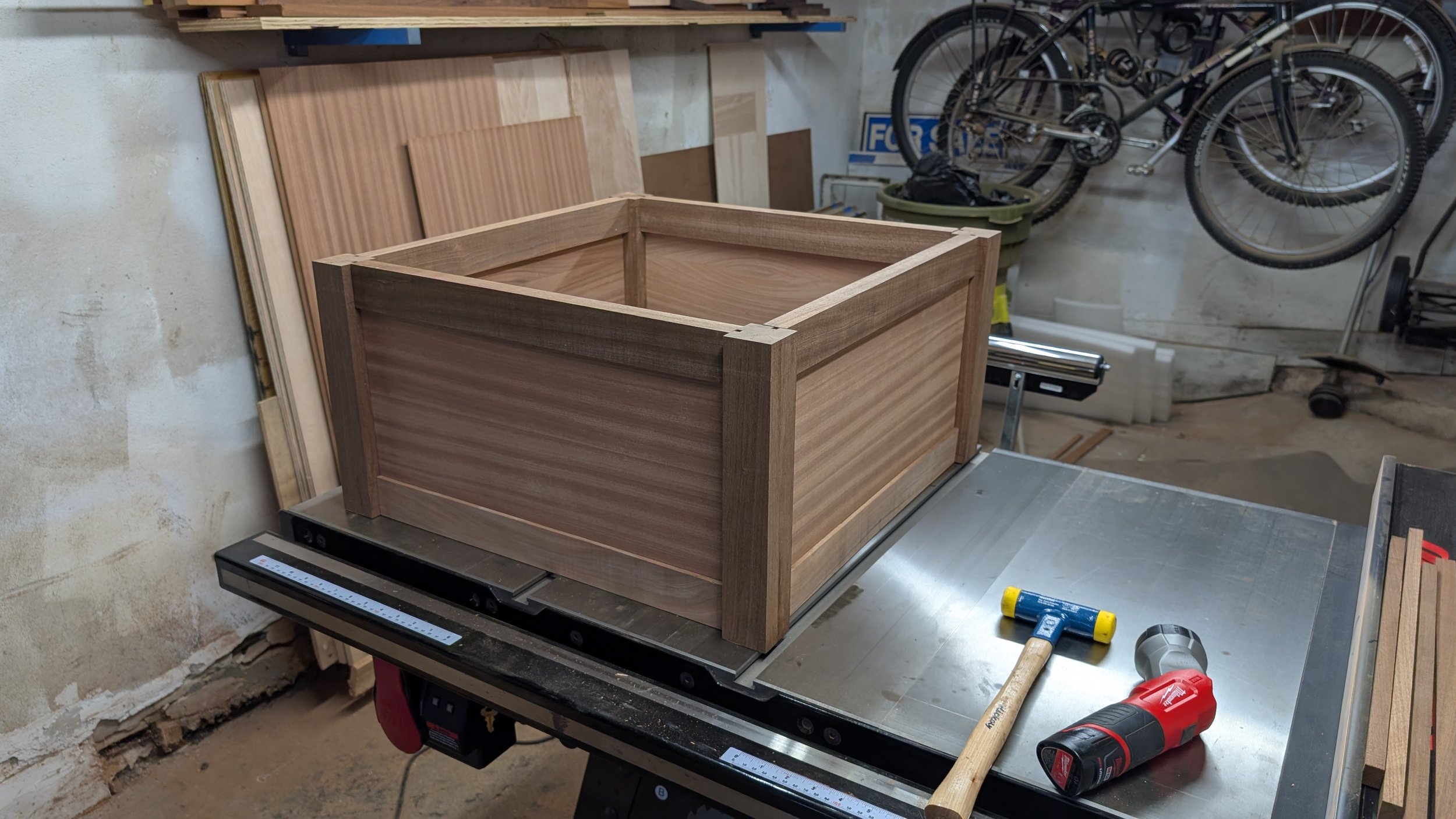
Then I reset the dado stack to 1/4” and cut the panel grooves in the corner posts. I cut the panels to size and did a dry fit of the whole body of the ottoman.

View fullsize PXL_20251220_193353056.jpg
View fullsize PXL_20251221_164402350.jpg
View fullsize PXL_20251221_164408749.jpg

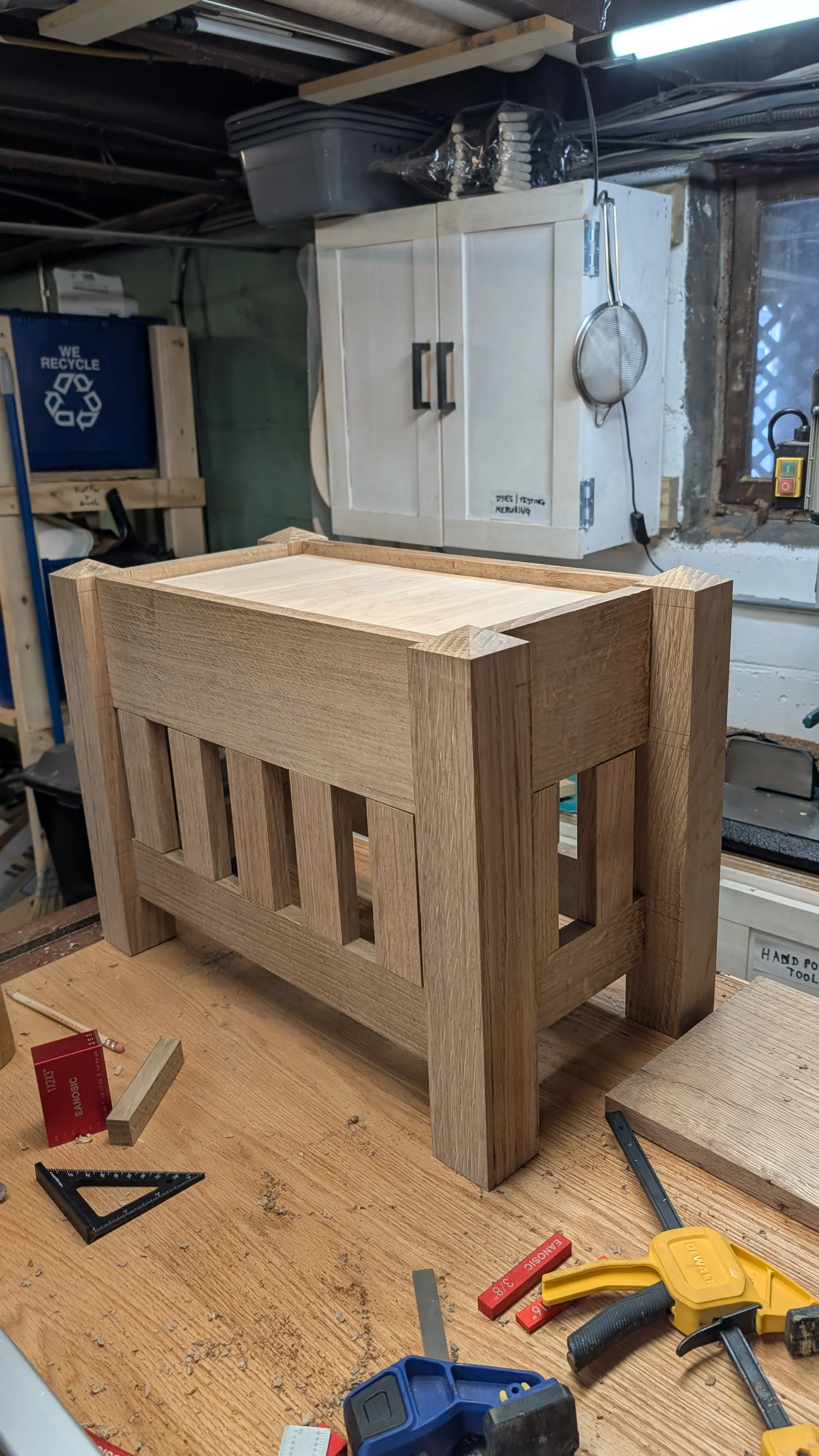
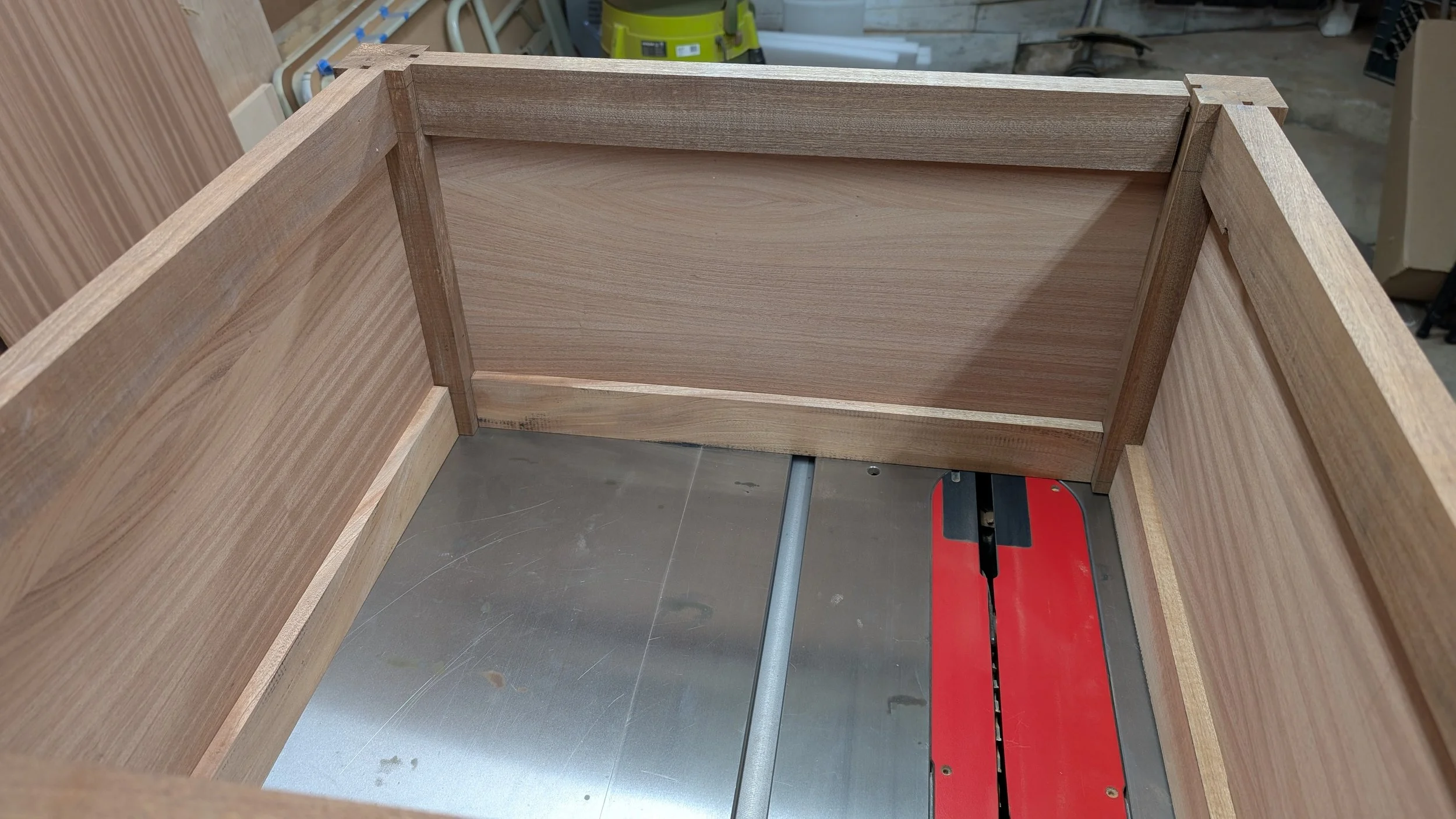
I also made up the frame for the seat which was also mortice and tenon and fitted that to the body. I added an inside cleat to support the seat and a 1/8” alignment edge that extended below the seat to make sure the top lid wouldn’t shift around when someone sat on it.

View fullsize PXL_20251221_172425847.jpg
View fullsize PXL_20251221_172607555.jpg

I then sanded everything from 120 grit to 220 grit ( trying something new to see if it had a good effect on the Hard Wax Oil finish with hardener ). I suspended my sander and vacuum hose from the ceiling with a bungee to reduce sanding fatigue.

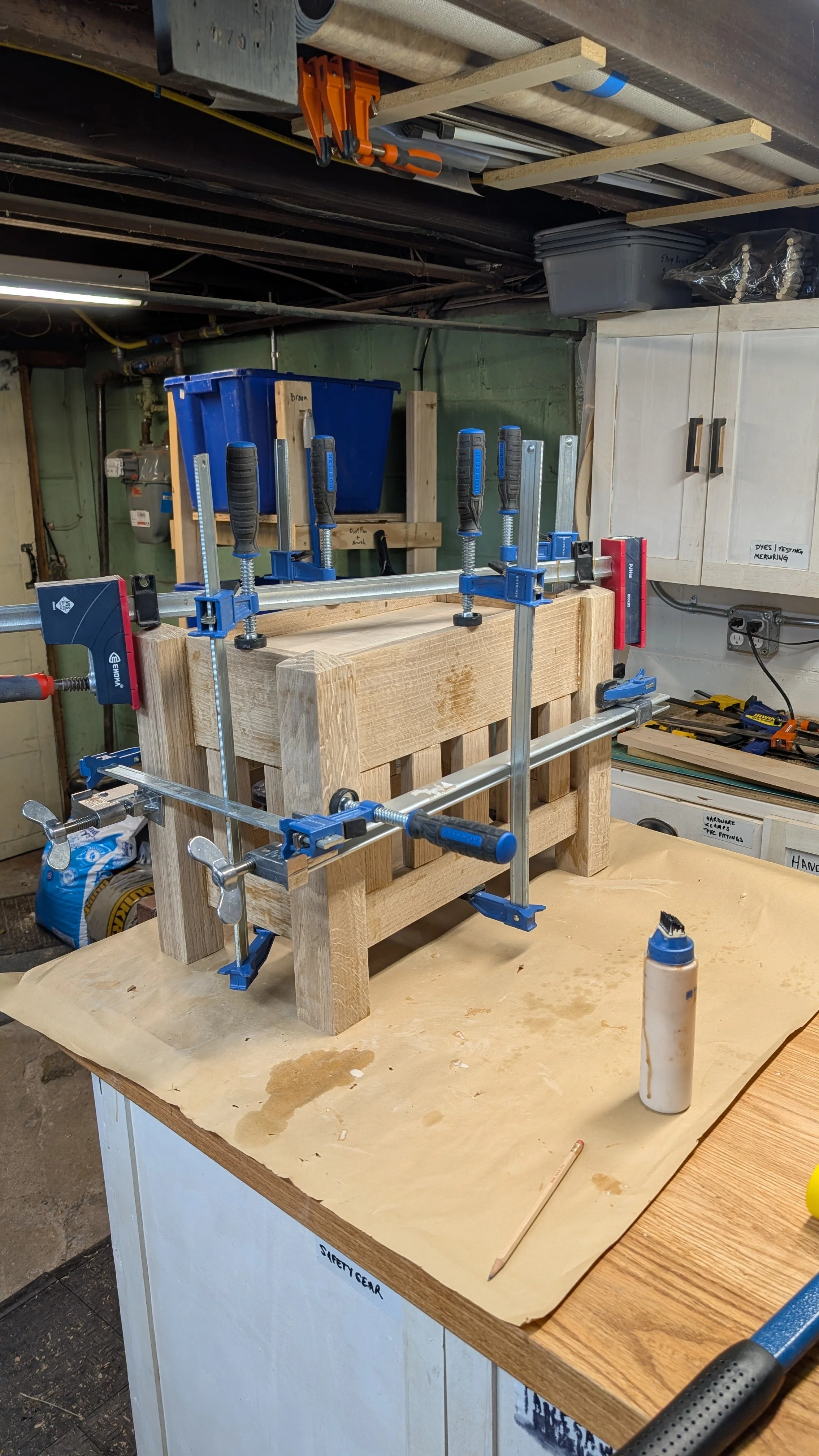
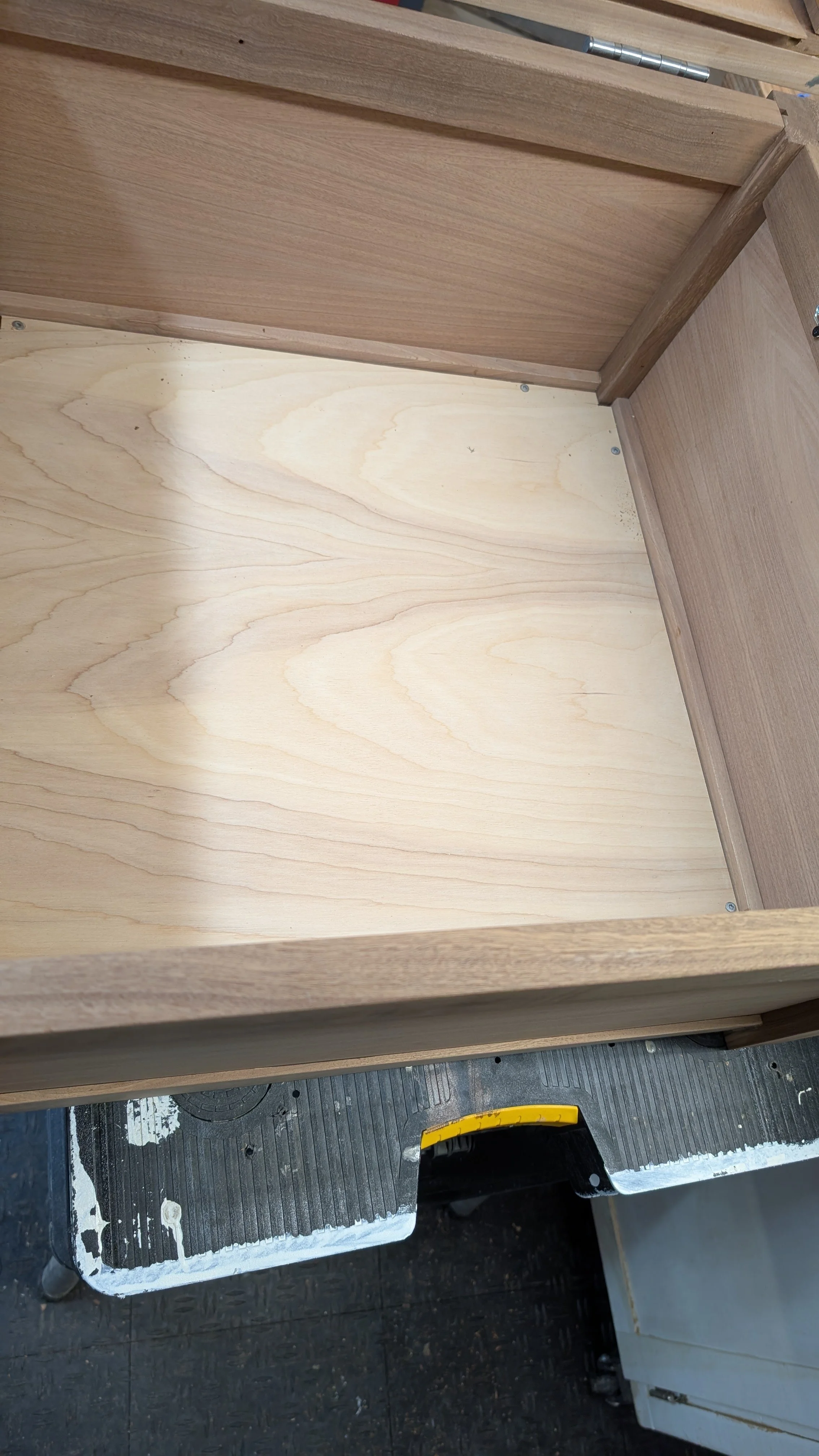
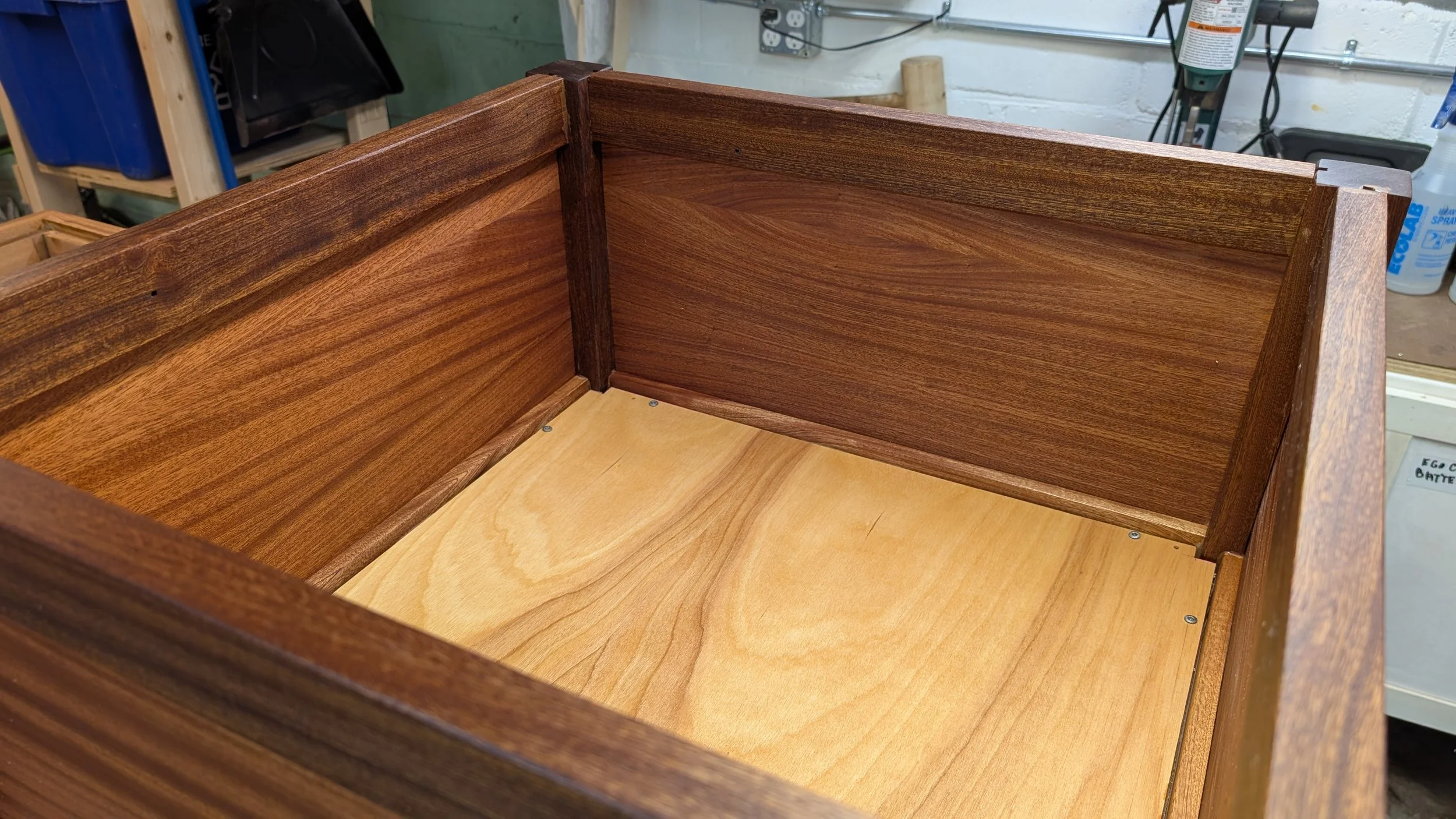
Then I glued everything up and installed the bottom of the box on cleats that I attached around the inside of the bottom frame. I countersunk and pre drilled all the holes from the bottom of the seat to attach the seat to the top frame and mounted the heavy duty hinges ( really passage door hinges ) and chains to hold the top open when getting things in and out of the interior.

View fullsize PXL_20251229_185501991.jpg
View fullsize PXL_20251231_202342414.jpg
View fullsize PXL_20251231_202359225.jpg
View fullsize PXL_20251231_202416860.jpg

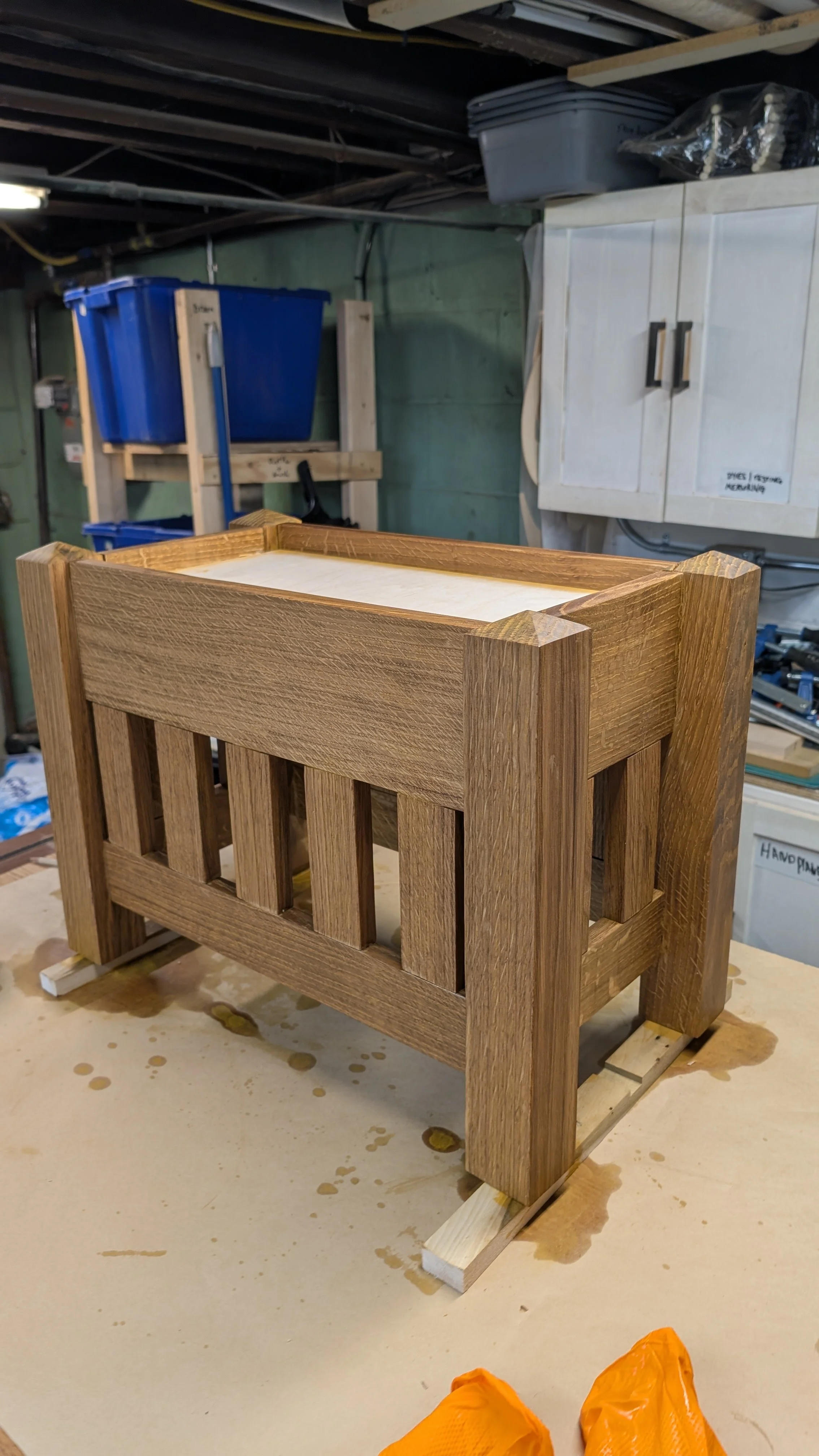
Then I took all the hardware off and put finish on everything including the interior.

View fullsize PXL_20260101_193115434.jpg
View fullsize PXL_20260101_193120031.jpg

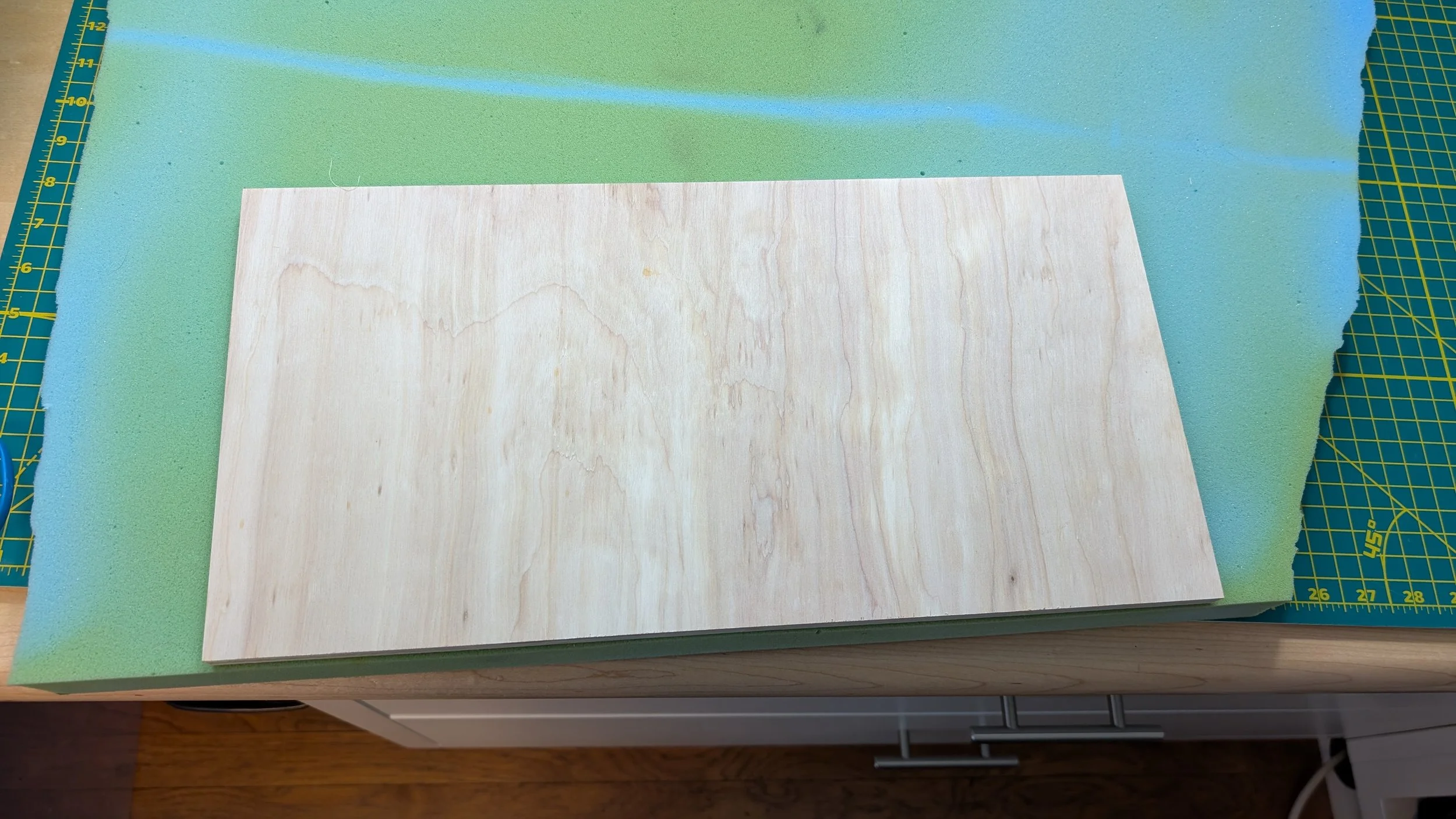
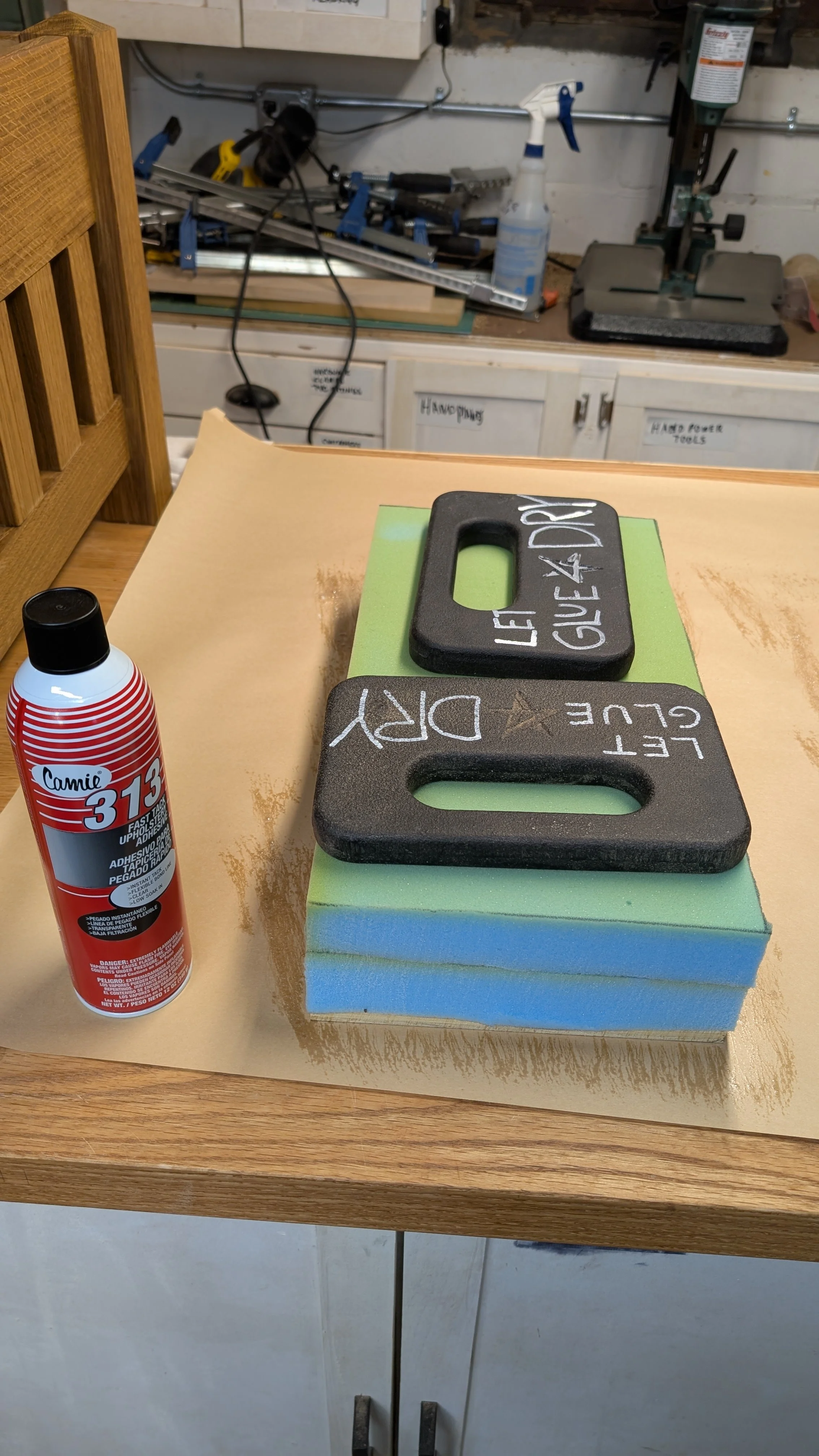
Finally I did the upholstery gluing two layers of high quality 1 1/2” furniture foam onto a 3/8” thick plywood backing. After shaping the top so it had a curved profile around the top, I covered the seat with upholstery fabric which matches our couch. My wife kindly helped by stitching a large remnant into a square that was just the right size to cover the seat cushion.

Then it was just final assembly and adding the casters and it was ready to deploy.

In Journal Tags building, storage ottoman, journal, upholstery
2 Comments

Three or four picture frames...

December 29, 2025

My beautiful and talented wife had a couple of pictures and a certificate that she wanted to frame and put up in the house. I volunteered to make frames for all of them.

The first item was a certificate from a Sherlockian club in Philadelphia that my wife is a member of, they are called “The Sons of the Copper Beeches” after a Sherlock Holmes story. I thought it would be cool to make the frame out of European Beech which is what a Copper Beech is. I was able to order the material from Rare Woods USA in Maine and it came in great condition and I just cleaned it up a little on my Jointer/Planer before cutting frame material from it. For this frame I put a bevel detail on the inside of the frame. The Beech is beautiful hardwood with a tan to almost pink coloring, this board was also quartersawn making it very nice. It was very easy to work with. I just used General Finishes Hard Wax Oil on it and it looked great. I made an identical one for one of my wife’s friends who is also a member ( hence the “or four” in the title of this post).
The second one was for a print from Calamityware called “Early Unicorn.” I had some left over Wenge from an earlier project and I made a thick square profile frame for this one. I used the same finish and I really like the grain of the Wenge around this image.

The third was a lovely print which I think we saw in a museum which references the “Year of the Rat” from the Chinese Zodiac, we’re both from a year of the rat and there are sewing/spinning references in it so it is very appropriate. I used some left over Sapele for this one and put a rounded profile on the inside of the frame. I like how the reddish color of the Sapele brings out the color in the print.

Frames aren’t terribly difficult but they are nice to see around the house. One small note is that I started using Polycarbonate instead of Acrylic and it is easier to work with because it doesn’t melt so easily when you’re cutting it.

That’s it for this small update.

In Journal Tags frames, building, journal
Comment

Fire Table Chairs: Take Two

October 18, 2025

Every defect gets respect

Every project is a learning experience, some lessons are taught while you’re building the project and some lessons come after you’ve completed the project. Back in 2023 I built a set of outdoor chairs to go with the Fire Table that I had also built. You can see my write-up of the project here.

I was very happy with how the chairs came out and we used them frequently over the next couple of years. However, as we approached the two year mark a problem emerged. The joints where the side rails of the chairs met the front leg with a through tenon joint were twisting and breaking. I immediately engaged in a root cause analysis process to understand the defect, like any engineer would.

The fundamental root cause was my inexperience at the time that I built the chairs, but the details were also instructional and informed the design for this project.

The first problem was the choice of material for the chairs. I had focused on the property of being weather, bug, and rot resistant without applying a finish and this led me to choose Western Red Cedar as the wood. I had ignored a couple of other important functional requirements, strength and hardness. Western Red Cedar is a very soft, relatively weak, light weight wood. The chairs that I was copying had been made out of Teak which is the opposite. I probably could have gotten away with it if I had increased the dimensions of all of the parts of the chair but I didn’t.

The joints that failed had a through tenon meaning that the mortise went completely through the leg. I had also foolishly made the tenon square and 1” x 1” because the side rail was 1 1/4” x 1 3/4” so I could. This meant that this tenon was surrounded by only 3/8” of material on each side of the 1 3/4” leg and only 1/4” of material above it. The softness of the Cedar also made it very difficult to cut a clean mortise without tearing out surrounding material meaning that several of my mortises didn’t fit great.

The chairs have sling seats that are suspended from the side rails of the chair by clamping bars bolted through the top of the side rail. I didn’t think about what this meant for the nature of the force exerted when someone sits on the chair. In addition to pulling down on the side rail it also exerts a rotational force inwards. This caused the through tenons in the poorly fitted mortises to rotate and put a lot of force on the meager 3/8” of material next to them and split it.

Finally I also went and looked closely at the original manufactured chairs I had copied and I was reminded that they had screws which had been countersunk and plugged which went through the front and the side of the leg into the rail and the stretcher. I had just ignored them thinking they were unnecessary if I used “real joinery” when in reality they were there to help the joinery resist the twisting force of the sling seat.

View fullsize New (L) Manufactured (R)
New (L) Manufactured (R)
View fullsize New (L) Manufactured (R)
New (L) Manufactured (R)
View fullsize New (L) Manufactured (R)
New (L) Manufactured (R)

The new design

Two of the chairs had developed this problem, the other two were hanging in there because I had gotten better at making the mortises when I made them. But, I figured it was only a matter of time before they failed as well so I decided to remake all of the chairs.

I would be able to unbolt and reuse all of the hardware and the fabric parts of the original chairs. I planned to eliminate all of the causes of failure from the first set of chairs in the new design.

I decided to make the new set out of Sapele which is an African hardwood with beautiful grain and color. Sapele has a Janka (hardness) rating of between 1410 and 1510 which is harder than Teak which is between 1070 and 1155 and about three times harder than Western Red Cedar which is 350. Sapele is also very weather resistant and it is cheaper than Teak and has less silica in it so it doesn’t dull your cutting tools as bad. It is also cheaper than White Oak which was the second runner up.

I eliminated the through tenons and made all of them rectangular 1/2” wide by either 1 1/4” or 2 1/4” by 1/2” deep which in the 1” thick legs left a lot of material on all sides of them. Also I added a countersunk 2 1/2” #10 stainless steel screw into the end of each of the rails front and back and from the sides. I plugged all the holes including the hardware holes which I didn’t do on the other chair.

Another controversial choice I made on the originals was trying to copy the manufactured chair’s joinery for the back leg and chair back rake. They had used a custom finger joint to create the angle between the back and leg and I had used an angled box joint. None of these joints had failed and the only issue I had with them was cosmetic. But, I had been given some feedback from a more experienced member of my woodworking guild that I should have done a glue laminated leg instead. I decided that I would make that the thing that I learned how to do on this project to have a more seamless and also potentially stronger leg.

The manufactured chairs that I was copying have an aluminum bar which curves out from near the top of the back and joins the two back rest frame members together. I had tried to fabricate these out of wood on the original and because of the grain direction they turned out to be fragile if the chair tipped over. I decided to replace these with my own aluminum version of the bar, not bent because I don’t have the tools to bend 6061 aluminum but out of multiple parts bolted together. This bar is important so that when you sit in the chair the sling back has spring to it and the chair back rest frame doesn’t get pulled inward.

I also decided to put a finish on these chairs even though technically the Sapele would also be fine outdoors with no finish. I chose to use Total Boat Lust Spar Varnish, this is a marine varnish which is formulated to allow rapid coat buildup without sanding and long curing times. It is typically used on the decks and other exposed wood on boats in a hostile environment on the ocean.

The project before the project

The first step in fabricating the new chairs was creating the fixture to glue up the laminated back legs. The legs are made up of 8 slices of 1/8” Sapele 2” wide and 36 inches long. I traced the outline of one of the manufactured chair’s back leg onto a large piece of brown paper. I also noted all the transitions and mortices on the tracing in the correct places.

I spray mounted the drawing onto a piece of 3/4” natural birch plywood that was wide enough so that there would be substantial material on either side of the leg when I cut it out.

I carefully cut each side of the leg on the band saw, it is important that the space between the two halves of the clamping fixture is the right width for the entire leg. I carefully cleaned up the edge with the sanding station being careful to come just to the line and keep the edge square.

I then glued these two pieces of the fixture to a matching stack of plywood with another 3/4” layer and a 1/2” layer to make the total height 2”.

View fullsize PXL_20250815_171029108.jpg
View fullsize PXL_20250817_172009168.jpg
View fullsize PXL_20250817_172011875.jpg
View fullsize PXL_20250818_125138767.jpg

Once the glue was completely cured, I cut the two sides apart following the top layer pattern and staying carefully on the waste side so as not to mess up the top pattern layer. Then I took each side to the router table with a 2” flush trimming bit with the bearing on the bottom ( top in this case in the router table) and cut the two new layers flush with the pattern at the top.

I then sanded the face of the fixture smooth and covered all the glue-up facing surfaces with packing tape. I screwed alternating wood spacer blocks to the bottom of the fixture so that they would support the contents of the fixture, slide past each other and allow the glue to mostly pass through. These were also covered in packing tape. A key tip on packing tape, the direction of the tape should be the direction that the fixture is going to move when clamping, not perpendicular. Also avoid any wrinkles.

Later I added some tape covered spacer blocks on top to keep the slippery glued up strips from rising up out of the mold.

View fullsize PXL_20250818_125141296.jpg
View fullsize PXL_20250819_132808317.jpg
View fullsize PXL_20250820_114451298.jpg
View fullsize PXL_20250821_122816860.jpg

The process to create the legs was to slice up two 1 1/16” x 2” x 36” pieces of Sapele into 1/8” strips on the table saw. I didn’t use a thin cutting fixture, I just pressed them against the fence and cut the 1/8” off the outside. There was some small variation in the strips but it had no effect on the lamination. I also didn’t try to additionally sand or flatten the strips I used them right off the saw. I did try to keep them in order as they were cut from the blank. It made the side pattern on the lamination quite nice.
I used a glue roller bottle from Rockler to spread glue on one side of each strip and stack them together. Once I had the eight layers stacked I just slid it into the fixture and matched the ends up with the marks I had made on the pattern on the top. I tried to keep them from sliding out too much at the ends, I had allowed about 1/2” of extra length. The target width for the legs was 1 3/4” so I had 1/4” to clean up the sides of the lamination.

I carefully aligned the sides of the fixture and closed the outside clamps first and each time I had to reset them I just tightened down the center clamp to keep things in place. Once I had the outside clamps fully in place and the center clamp tight I added two additional clamps mid-way in between. I left each leg in the clamp overnight. I would clamp up the next leg in the morning and then work on the rest of the parts for the chair while I waited for it to be done.
When a leg came out of the fixture I would clean up one side on my jointer and then cut the other side with the table saw to 1/16” over the final 1 3/4” width and then I would use the jointer to clean up the saw marks on down to the final size.

I would then mark the top and the foot by laying the leg on the chair I was copying or the other leg if it was already made and mark them and cut them on the chop saw.

Building the chairs

I’m not going to go into all the details of making the other parts of the chairs if you’re interested you can take a look at the linked post in the first paragraph. It was basically the same except in Sapele instead of Western Red Cedar and the design changes noted above.

I also have a mortising machine so that made doing the mortises much easier.

View fullsize PXL_20250827_125301542.jpg
View fullsize PXL_20250830_160634764.jpg
View fullsize PXL_20250903_114840061.jpg
View fullsize PXL_20250904_182259862.jpg

The “plugging” process was two phases. After the glue-up I then did any clean up sanding, tacked everything and cleaned it with alcohol and then masked every counter-sink hole. I then put on a coat of Total Boat Wood Sealer and let that dry over night. The next day I put a coat of Total Boat Lust Spar Varnish on every 1 1/2 hour making sure to get all the end grain, three coats in total (Total Boat says 6-8 but I think they just want to sell varnish and I’m not taking these out on the ocean). The next day I washed all the seat fabric for that chair and then I put all the hardware and fabric on the chair.

The back bar of the chair was made from two 1” standoffs made from 1” diameter 6061 round bar center drilled with a clearance for a 5mm x 60 mm bolt and a bar of 6061 1” x 1/2” that was about 18 1/2” inches long and marked and drilled for two holes centered on the back rest frame three inches from the top. I drilled the holes in the bar stock at the tap size for M5 standard threads. I tapped the holes. I sanded all the parts to 320 grit and coated everything in clear spray lacquer. Then they were bolted through the chair frame into the bar making the cross bar structure.

Second phase of plugging was to make all the 1/2” plugs required, sanding them so they would fit easily and then gluing and tapping them into place. After they were dry I would mask off the area around them and saw them flush with a flush cut saw. I then sanded each plug flush with surface and up to 320 grit and then went through the sequence of wood sealer and spar varnish on each of the spots that needed covering.

The plugs came out very pretty, their chatoyance was in a different angle than the surrounding wood so they gleam and show up also they are frequently a different color than the surrounding wood and stand out for that reason.

The spar varnish is so clear and thick it really highlights and magnifies the natural figure in the Sapele, it really shimmers beautifully. I am a crappy painter so there are runs and drips, you’ll have to find it in your heart to forgive me.

On these chairs I put screw in rubber feet on the bottoms of the legs so they wouldn’t be sitting directly on wet surfaces.

I’m really happy with these replacements, they are a big improvement on my original effort and they salvaged a lot of work I did on the first ones as well.

View fullsize PXL_20250927_141915360.jpg
View fullsize PXL_20250927_141931840.jpg
View fullsize PXL_20251018_130139796.jpg
In Journal Tags building, fire table chairs take two, journal
Comment

Dog ramp

August 9, 2025

My neighbor has a Miniature Dachshund that has been having trouble getting on and off of one of the beds in their home. I offered to build a ramp to help the dog get on and off of things. They sent me a picture of a commercial dog ramp that they thought was good and I deduced the angle and size of ramp from the clues in the picture.

I made the height/angle adjustable by having several possible holes for the strut to come down and brace the leg. I used 1/4” x 20 bolts and lock nuts on most of the pivots but used some 1/4” x 20 knobs on the adjustable position so it could be tightened and loosened without tools.

I built a perimeter frame out of 2” x 3/4” maple for the deck of the ramp that was 48” x 18” and put a 1/2” by 1/4” deep rabbet on the edge to receive a 1/4” natural birch plywood deck panel.

I made two frames for the strut and the leg out of 1 1/2” x 3/4” maple joined with lap joints. I rounded the ends so that they would contact the floor well and clear the deck when they pivoted.

I put a Natural Danish Oil finish on all the maple surfaces after sanding them to 320 grit.

My neighbor provided a rug which we cut to size to cover the plywood deck and my beautiful and talented wife sewed an edging on the cut sides to prevent unraveling. I glued the rug to the deck with 3M Super 77 spray adhesive.

As far as I know from watching the initial test with the young dog, he is not afraid of it and he ran up it without a lot of trouble.

View fullsize PXL_20250805_194449590.jpg
View fullsize PXL_20250805_194512601.jpg
View fullsize PXL_20250806_132542458.jpg
View fullsize PXL_20250806_133327059.jpg
View fullsize PXL_20250806_135131136.jpg
In Journal Tags journal, building, dog ramp
Comment

Stacked Laundry/Half-bath Cabinets

August 4, 2025

This is another “after twenty plus years of putting it off” sort of project. Since we remodeled the kitchen and moved the laundry into this half-bath off the kitchen there has been a narrow shelf and cabinet unit from Target next to the washer and dryer. It was not a good cabinet, and one of it’s many problems was that the top shelves were open and the vibration of the washer and dryer would walk things off the shelves onto the floor or into the sink. This was sub-optimal, but we lived with it for more than twenty years. Well, no more, I have replaced these cabinets with the ones above.

Because we need to be able to get a plumber/appliance repair-person behind the washer and dryer the cabinet needs to be easily removable. I therefore designed it as three stacking cabinets. Also, because of the close quarters with the sink, the middle cabinet needs two shorter doors instead of one door like the top and bottom. I decided to use frameless cabinet construction out of 1/2” natural birch plywood with one internal fixed shelf dadoed into the sides and the top and bottom rabbeted to accept the sides. Each cabinet is 24 inches tall and 12 inches deep so that I could get all of the parts out of one half sheet of plywood. To make the stack the same height as the washer and dryer and to hide the cleat that keeps them from slipping off when stacked I added a 2 inch tall perimeter base that interlocks with a 3/4” cleat on the top of two of the cabinets. They have a 1/4” birch plywood back.

View fullsize PXL_20250729_151412583.jpg
View fullsize PXL_20250729_153545795.jpg
View fullsize PXL_20250730_123210771.jpg

The doors are mortise and tenon 3/4” maple with 1/4” birch plywood panels.

View fullsize PXL_20250731_125727955.jpg
View fullsize PXL_20250731_140319996.jpg
View fullsize PXL_20250801_191506608.jpg
View fullsize PXL_20250801_191525266.jpg

I used concealed full overlay hinges.

I had sanded everything before assembly to 220 grit and then cleaned up any assembly issues with some spot sanding. I primed everything with Zinzer BINS Shellac Based Primer and then put on a coat of Benjamin Moore Acrylic Eggshell paint in Atrium White ( which we had from a previous home improvement ).

View fullsize PXL_20250801_195609272.jpg
View fullsize PXL_20250802_164248732.jpg
View fullsize PXL_20250802_130409635.jpg
View fullsize PXL_20250802_164254021.jpg

After unloading and disposing of the old cabinet, I installed the new ones and reloaded them. There is now more storage space and it all looks much nicer in the room.

In Journal Tags journal, building, laundry cabinets
Comment

A series of small projects...

July 22, 2025

As it sometimes goes the last couple of weeks in the shop have been focused on a series of small projects.

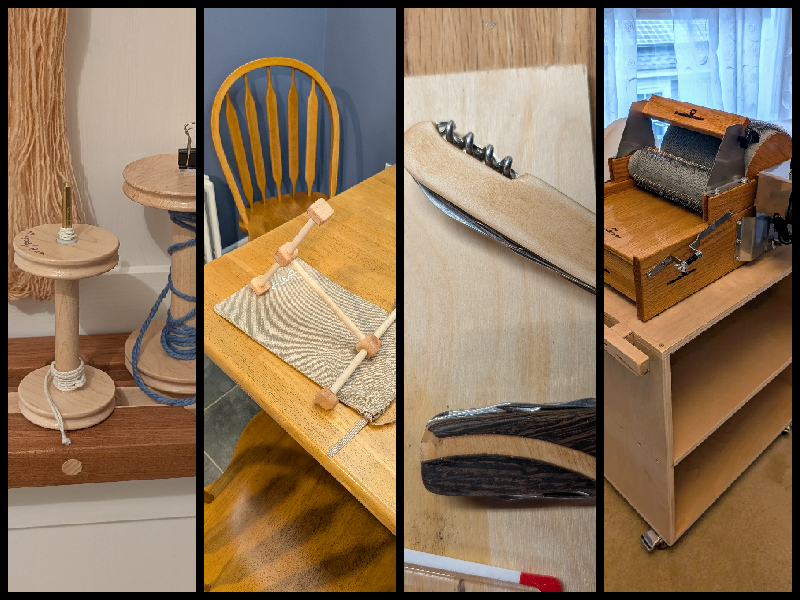
The first one was two more pocket knives that I wanted to put wooden scales onto. One of the knives was from a box of small knife bodies and other leather hardware that came from Noymer Leather back when my father was alive and worked there. Probably 30 years or more ago, it is the small rectangular one. It didn’t have any scales and was probably going to be covered in leather at the factory. The other was an old Swiss Army knife which I just popped the scales off of and used the originals as a template to cut out the veneers. I cut the scales on my scroll saw and did the fine shaping on my sanding station. The finish was just natural danish oil and then paste wax. I attached them to the knife bodies with J.B. Weld epoxy that I carefully brushed on in a distribution so that it wouldn’t squeeze out very much.

View fullsize PXL_20250712_151752907.jpg
View fullsize PXL_20250712_151738531.jpg
View fullsize PXL_20250712_151747193.jpg
View fullsize PXL_20250716_152159366.jpg

The second project was a cart for my beautiful and talented wife’s new shop tool, an electric drum carder. A drum carder is used to process fibers from sheep, plants, and other animals into clean organized rolls of fiber that can be spun into yarn. I built the cart for her “shop” the same way as I do for my shop, screwed together out of 3/4” natural birch plywood with a single fixed shelf inside for rigidity and a 1/4” natural birch plywood back. It is on locking heavy duty casters.

I went ahead and sanded the edges and corners so they wouldn’t snag the fiber and I put some handles on each end made from some ash scrapwood that I had from another project.

The third project was a small Niddy Noddy which is a tool for winding yard after you have spun it. It both organizes the yarn and because each winding around the device is a specific length allows you to figure out how many yards of yarn you’ve spun. This one is a 1 yard Niddy Noddy. It is designed to disassemble into three pieces so that it can be packed in a carrying sack for bringing to spinning and weaving classes. I dubbed it the “Mini Noddy.” I sanded everything to 320 grit and applied a couple of coats of paste wax.

The final project was a Lazy Kate which is a series of spindles on a platform that bobbins with yarn can be placed on while plying. Plying is the activity of taking one or more single ply yarns and combining them by winding them together into a new multi-ply yarn. This particular one is made to fold up for portability to weaving and spinning classes.

The platform is a glue up of Sappele and Rock Maple and I was able to use my new Jointer/Planer on this and it put a wonderful surface on it as well as making the glue-up near perfect. The pivot points are 1/2” dowels and I got a special drill bit to drill the holes 1/64” oversize to allow clearance for the dowels to pivot. I put 1/4” - 20 threads onto brass rods for the spindles and threaded 1/4” - 20 thread size holes in the dowels to screw them into. It took many tries to use the tapping die to cut the threads on the brass rods straight but I got it. I didn’t want to just glue them into the dowels because I feared in the process of gluing them the squeeze out would also glue the dowel to the hole. We’ll see how this all holds up in use. I cut the channels for the rods to lay down in with my router with the side fence on it.

I just sanded everything to 320 grit and then put a couple of coats of paste wax on it which I find works good with weaving tools.

View fullsize PXL_20250716_152149021.jpg
View fullsize PXL_20250717_154457785.jpg
View fullsize PXL_20250718_175638776.jpg
View fullsize PXL_20250721_105607607.jpg
View fullsize PXL_20250722_104720902.jpg

That’s the update for now…

In Journal Tags journal, small projects, building, one day builds
Comment

Three shop improvements

July 4, 2025

In between furniture projects I like to knock off some improvements to the shop that I’ve been thinking of for anywhere from days to years. These are three that I just completed.

The first one was to correct something about my main work island that had been bugging me almost since I built it a year or so ago. I had made the top of it out of crappy sheathing grade 3/4” plywood and a layer of 1/8” hardboard. It was a fine surface to get dirty and potentially damage but it was never actually flat. Because the plywood was pretty misshapen when I received it, if I was doing assembly on it square things would get out of true because they weren’t properly supported. I had taken to doing assembly on the cast iron surface of my table saw, this bothered me.

I decided to make a flat, rigid, top for the island and also add an overhang to make clamping along the edge better. I went with 2 x 6 red oak for cost reasons and I glued up a nice top that was oversize. It came out of the clamps pretty flat and I planed and sanded both sides checking them with a straight edge to make them both flat.

I removed the old top and the top frame from the island, I only screw together things for the shop so that I can easily modify or recycle them by just unscrewing them later. I reused the old 3/4” plywood top as the top skin of the island and screwed it to all the uprights and the center divider. I then attached the new top to the island using screws from the underside. I only put screws in where it was touching the plywood directly or where I could put in a shim. I was careful not to try to pull the top down to the plywood and deform it.

I cut the overhang to final size of 3” using my track saw and then I beveled the edges with a plane and did some cleanup sanding.

I put a finish of Tung oil on the surface since this type of finish was recommended for work surfaces. It is now nice and flat and very handy for clamping. And should I ever need to make it level, the leveling foot casters on the island make that possible.

PXL_20250623_191035596.jpg
PXL_20250624_131840563.jpg
PXL_20250624_190250605.jpg

The second improvement was to build a set of drawers for additional storage in a shelf unit that I built five years ago. When I built it I just made several deep tall shelves but I quickly found that to be cumbersome because organizing things was impossible, things at the back were hard to see and reach etc… I have been adding drawers into this unit to solve these issues for a while. This is the last set.

I had three sets of 18” full extension heavy duty drawer slides from a batch of cheap Chinese manufacture drawer slides I got a while ago from Amazon. So the drawers would be 18” deep, the case would be 19” deep for some clearance at the back.

I’ve been building these units as a free standing box with the drawers inside it because it protects the drawers from dust and moisture ( I paint them with mold/moisture resistant primer inside and out now as well…) It also makes them modular in case I rearrange the shop and want to put the drawer unit somewhere else.

The case and the drawers are all built out of 3/4” natural birch plywood, pretty good stuff, low voids, not incredibly heavy but strong. The drawer bottoms are 1/4” natural birch plywood. I ran out of the drawer pulls I was using in the shop so I used some shaker drawer pulls that I got a whole bag of at a guild auction.

This came together in a day including painting and it was dry and ready to assemble and install the next day. It has cleaned up that area and I now have some extra storage that is very usable.

View fullsize PXL_20250628_143652910.jpg
View fullsize PXL_20250628_143702737.jpg
View fullsize PXL_20250628_143718651.jpg
View fullsize PXL_20250628_143729905.jpg

The final shop improvement was a cart for a new tool. I have finally reached the point where I want/need a jointer/planer I got a combination unit that can operate on 8” wide material. This is perfect for the kind of work that I do and for the limited space in my shop. I donated my old table saw to the guild auction and that cleared up a space under the stairs to the basement of the perfect size.

I wanted to build a cart for this tool since I don’t want to be lifting it onto a bench every time I use it and I want it to be easy to move back to storage when it is not in use. I figured out the size of the cart to support it and prevent it from tipping and be at a good height for feeding material through the planer/jointer. I built the cart as a box with a center support inside and fixed shelves to provide internal stability. I used the same 3/4” natural birch plywood. I put a 1/4” plywood covering on one side.

I used 4” tall heavy duty casters with locking wheels for the wheels. I was able to screw the planer/jointer directly to the top so it is very secure. All of the manuals, accessories, tools, etc… that go with the tool fit in the shelves in the cart. It rolls easily around the shop and up and down the ramp to the garage with no problems.

The planer/jointer was easy to set up and the test cuts were excellent, this tool with help offset my relatively poor hand planing skills.

PXL_20250629_133512307.jpg
PXL_20250629_171444569.jpg

So that’s it for shop improvements for now and I’m taking a short break to do some non-workshop projects.

In Journal Tags shop improvement, journal, building
Comment

Footstool for Modern Wing-back Chair

July 4, 2025

After deploying the Modern Wing-back Chair that I built, my beautiful and talented wife suggested that a footstool that could hide underneath it would be a nice addition. I had left over cherry wood in the right dimensions to do it so I did a quick project to make one.

After determining the right dimensions, I rough cut all of the material for the top frame and the legs. I connected the frame parts using mortise and tenon joints, the legs I cut an offset 1” x 1” tenon on the top of each leg so the frame could sit on the shoulder. I then tapered each leg on the back and inside and then using the router table I applied a 3/8” round over detail to all of the visible edges of the legs and the frame to match the detail of the chair. The tenons on the tops of the legs also got drilled for a diagonal screw to pull them into the corner of the frame. The tenon stops 1/2” below the top of the frame to create four support points for the 3/8” plywood base of the cushion.

View fullsize foot stool front.png
View fullsize foot stool side.png
View fullsize PXL_20250613_125904230.jpg

After sanding from 60 grit to 320 grit ( and cleaning up the tapers and transitions of the rounding over process) I glued up the frame and installed the screws holding the legs in along with glue.

I cut a 3/8” thick plywood base with a 1/8” clearance around it for the base of the cushion. I glued 1 1/2” deluxe foam that had been shaped to have curved edges on four sides and 1” of polyester batting onto the plywood. I then covered it in the same fabric as the chair making sure to align the pattern so that it pointed in the same direction as the chair. I stapled the fabric on the back of the plywood panel and trimmed off any excess. I just friction fit it into the footstool so it is technically removeable.

I put a coat of General Finishes Hard Wax Oil finish on the cherry and let it cure and then I was able to install the cushion and deploy the footstool. I think it complements the chair nicely and it does add to the comfort of using the chair.

In Journal Tags journal, woodworking, building, footstool
Comment

Sewing storage wall cabinet

June 15, 2025

My beautiful and talented wife was complaining that her sewing materials, needles, zippers, pins, thread, etc… were stored in a myriad of work boxes and every time she needed anything she had to search five places. I suggested that I could make a wall cabinet to go above her sewing table, in the same style, that would provide storage for all of those things and more. She loved that idea and so I designed the cabinet and after approved drawings I got to work on it.

I decided to make it out of maple to match her sewing table which would be right below it. I wanted to add some interesting details to dress it up so I decided to do a marquetry pattern on the door fronts, a herringbone pattern of 1 1/2” wide slices of the same maple as the case. It would provide an interesting texture and pattern without contrasting too much.

I also decided to use dovetail joints for the cabinet to give the side view some features as well. I made a practice project from some scrap to practice making dovetails since I’d never used them before.

The overall size of the cabinet was 36” x 24” and 9” deep including the doors. I chose to make the doors bi-folding because 18” doors would be cumbersome next to the wall on the left and the door opening on the right. Also, the sewing table has bi-folding doors and I wanted to repeat that feature.

I put a divider up the center of the cabinet so that there would be six independently adjustable shelves inside.

After acquiring all the maple that I needed for the project I cut the blanks for the sides and laid out the dovetail tails on the sides so that the bottom and top would have the pins. I cut the tails manually using my gents saw and then traced them onto the corresponding ends and cut the pins. I removed the waste using a coping saw, chisel, and rasp. After fine tuning the fit, I cut grooves in the panels to receive the back and a top batten and bottom batten to give me something to attach the wall mounting hardware to.

View fullsize PXL_20250506_172639014.jpg
View fullsize PXL_20250514_181509612.jpg
View fullsize PXL_20250522_122352227.jpg

I built the frame of the doors as one big panel with the vertical frame parts for the doors centered at 9” intervals. I made split tenons on the three vertical frame parts that went into double mortices with a 1/2” space between them. This was so when the frame was assembled I could cut it into 9” ( or so ) panels and not show the mortices in the side frame. I assembled the frame and glued it up.

PXL_20250530_161118665.jpg
PXL_20250529_135443196.jpg
PXL_20250530_164613259.jpg

I routed a 1/2” W x 5/8” D rabbet around the inside edge of the back of the frames to hold the marquetry panels. I found that my Milwaukee trim saw was great for quickly cutting the waste out of the corners.

I cut 1/4” panels to fit and to be the backing for the marquetry. I laid out the marquetry and then traced the panel onto the slices of veneer and then numbered them and cut them to final shape on my scroll saw. After sanding the edges of each marquetry piece I coated one side of each panel with glue spread with a silicone grooved spreader to an even depth. I then assembled the marquetry on the glue and taped the pieces together with blue painters tape. I built a caul out of two pieces of 3/4” pine, one side I put 2” high legs in the corners and the top piece was just cut to size. I put blue tape on the inner faces. I put the panel on the lower section and taped it down to the caul so it wouldn’t drift around during clamping. Then I put the top of the caul on, and then a curved caul down the center to distribute pressure from the top to the bottom. I clamped all around the edges at even intervals. This made the marquetry come out really nicely.

View fullsize PXL_20250531_175026597.jpg
View fullsize PXL_20250604_120222045.jpg
View fullsize PXL_20250603_124317165.jpg
View fullsize PXL_20250604_121057935.jpg
View fullsize PXL_20250604_121753628.jpg

I smoothed each panel starting with a 60 grit diagonal pass to level everything and then going through the grits to 320 then spraying each with water and letting it dry and sanding it again at 320 to get a really nice smooth surface.

I then trimmed the edges of the panels so they fit nicely in the recesses in the back of the doors. I then mounted the piano hinges on the door sides with them all spaced out using plastic 1/8” spacers to give an even gap and to make them span exactly the 36” cabinet.

View fullsize PXL_20250605_142300491.jpg
View fullsize PXL_20250605_175101090.jpg

Then using my adjustable shelf hole drilling jig I drilled all the shelf pin holes on the inside of the cabinet and both sides of the divider. With that done I sanded all the parts to 320 grit and then assembled and glued up the cabinet.

The first part of the finish was natural danish oil. Then after 72 hours two coats of wipe on polyurethane. This matches the finish on the sewing table.

View fullsize PXL_20250610_154940520.jpg
View fullsize PXL_20250610_154854568.jpg
View fullsize PXL_20250610_154908087.jpg

After that had dried for 24 hours I reassembled everything and I secured the marquetry panels in the doors using framing points ( so if I wanted to change them out in the future that would be possible.)

My talented and beautiful wife helped me mount the case on the wall, remount the doors, install the knobs, install the magnetic catches, shelf pins, and shelves. She then had a great time putting things into the cabinet using the containers from ULINE that I had based the dimensions of the cabinet on.

View fullsize PXL_20250614_214203050.jpg
View fullsize PXL_20250614_214210897.jpg
View fullsize PXL_20250614_225132293.jpg
View fullsize PXL_20250614_225212272.jpg
View fullsize PXL_20250615_123901003.jpg
View fullsize PXL_20250615_123924092.jpg

I really like how this cabinet came out. I like how the marquetry and the dovetail details look on the cabinet. And it is an excellent storage solution for lots of sewing materials.

In Journal Tags building, woodworking, sewing cabinet, journal
Comment

Cruise around Japan

May 2, 2025

This April, we took a tour with Smithsonian Journeys and the cruise company Ponant around Japan, we visited multiple ports in the inland sea, the Sea of Japan, and across to South Korea. We flew to Osaka via Hong Kong on Cathay Pacific, an excellent airline, we arrived a day early and stayed at the airport hotel at Kansai Airport. We met the tour and boarded the ship at Kobe harbor which was about an hour bus ride from Osaka.

After boarding and unpacking in our very nice cabin with a generous sized balcony, we had dinner on board ( all of the food on the cruise was excellent ). The ship sailed for our next port Takamatsu and we attempted to sleep the confused sleep of the jet lagged.

Kobe Harbor from our balcony

After waking up multiple times I finally got dressed and found the lounge where they serve coffee and small pastry at 6:30 AM. One of the best things about tours that are cruises is that like magic you wake up in a completely new place every morning.

We had two excursions that day to Ritsurin Gardens and Shikokumura Museum. The garden was an enormous strolling garden along a river and multiple ponds. There were multiple tea houses, bridges, and other traditional buildings in the park. Many of the trees had been carefully maintained following the aesthetics of Bonsai but in full size trees. The landscape was very carefully designed to reveal views as you walked along the various pathways.

View fullsize PXL_20250412_225354121.jpg
View fullsize PXL_20250413_022927785.jpg
View fullsize PXL_20250413_023102325.jpg
View fullsize PXL_20250413_023308674.jpg
View fullsize PXL_20250413_023523840.jpg
View fullsize PXL_20250413_023651607.jpg
View fullsize PXL_20250413_024316266.jpg
View fullsize PXL_20250413_025039199.jpg

Shikokumura Museum was a collection of Japanese traditional buildings collected and moved to the site. The age of the houses spanned from the 1600’s to the 1920’s. Many of them were furnished with period interiors.

View fullsize IMG_1708.JPG
View fullsize IMG_1711.JPG
View fullsize IMG_1716.JPG
View fullsize IMG_1720.JPG
View fullsize IMG_1724.JPG
View fullsize IMG_1726.JPG

After returning to the ship, having lunch and a nap and some drinks and dinner, we again attempted to sleep and the ship departed for our next destination Hiroshima. Our cabin was great, the bed was very comfortable and we had plenty of storage space to unpack and put our big bags under the bed. The shower and bathroom were good sized for a cruise ship. We were on the third deck which was pretty much at the center of the ship so the amount of motion at this level was minimal. There were noises from the ship but most of them were various kinds of droning or continuous sounds so it wasn’t hard to fall asleep to them.

Hiroshima harbor view

We woke up at Hiroshima harbor which was very pretty. This trip really reminded us how mountainous Japan is, apparently only 30% of the land is flat. Every harbor we went to was ringed with mountains. After breakfast we got off the boat and took a bus to the Hiroshima Museum and memorial. The museum was very crowded so I don’t have any pictures but it was very well done and filled with devastating personal stories of the impact of the atomic bombing. The memorial park is beautiful, and it is incredible that the city has been rebuilt and is one of the nicest cities in Japan.

View fullsize PXL_20250414_015352159.jpg
View fullsize PXL_20250414_014216514.jpg
View fullsize PXL_20250414_013756744.jpg
View fullsize PXL_20250414_013045558.jpg

We returned to the ship and had lunch while the ship moved to anchor off of Miyajima Island where there is a huge Shinto Shrine that is built directly on the beach. We took tenders aka the life boats across to the town dock, the transit was very smooth and comfortable. The island is a very important sanctuary which was very important in Japanese history. There is also a Buddhist Temple at the same site. The town that surrounds both of them was also very cool looking. As with a lot of other sacred sites in Japan there were deer wandering all over the place, they are protected as “messengers of the Gods.” This makes them quite bold and they will steal things from tourists if they aren’t paying attention.

View fullsize IMG_1736.JPG
View fullsize IMG_1740.JPG
View fullsize IMG_1742.JPG
View fullsize IMG_1746.JPG
View fullsize IMG_1748.JPG
View fullsize IMG_1757.JPG
View fullsize IMG_1760.JPG
View fullsize IMG_1761.JPG
View fullsize IMG_1763.JPG
View fullsize IMG_1766.JPG
View fullsize IMG_1769.JPG
View fullsize IMG_1772.JPG
View fullsize PXL_20250414_075213186.jpg

After taking the tender back to the ship, there was a special briefing in the ship’s theater. The captain explained that there was going to be a pretty strong storm coming that evening and into the next day. We had been scheduled ( if you notice on the map) to go to Hagi the next day. This was canceled due to the weather because they would have had to use the tenders again and in six meter plus seas the tenders wouldn’t be safe and or comfortable and also because they are also the life boats the ship couldn’t be without them in those conditions.

So, we had a day at sea and caught up with our sleep. There was a bit of motion but on the third deck where we were at the center of the ship the movement was much better than higher up. The Smithsonian experts that were traveling with us caught up on giving lectures on various topics of Japanese history and culture as well.

The next day we arrived at Sakaiminato which is on the west coast of Honshu Island on the Sea of Japan. We went on an excursion to Matsue Castle which was built during the Edo Period, notably a period of peace in Japan which lasted for about two hundred and fifty years. This castle never had to be defended and was surprisingly well preserved. We started with a river boat tour through the moat around the castle, we had to lay down in the boat so that they could lower the roof as we went under several of the low bridges. Our boatman was a local retired gentleman who sang us traditional songs at various junctures.

We then went up and visited the Castle which in reality was more of a fortress and less of a castle because it wasn’t a residence, but mainly a defensive military installation. The beams and joinery were very impressive and the architecture of the fortress on the landscape was lovely.

IMG_1796.JPG
IMG_1800.JPG
IMG_1803.JPG
IMG_1806.JPG
IMG_1808.JPG
IMG_1817.JPG
IMG_1822.JPG
IMG_1826.JPG
IMG_1832.JPG
PXL_20250416_000455121.jpg
PXL_20250416_002924690.jpg

That evening we departed across the Sea of Japan headed for Busan, South Korea. We woke up and had breakfast outside on the front deck with a great view of the very space age modern city of Busan in the background.

Our excursion that day was to Gyeongju, The Capitol of Ancient Silla this included visiting ancient royal tombs, the incredible Gyeongju National Museum which we could have spent a week at, and the Bulguksa Temple, one of the most important and oldest Buddhist temples in South Korea.

The temple complex was incredible, beautiful grounds, colorful buildings, many temples and statues. The entire place was decorated for Buddha’s Birthday celebration.

We had lunch out at a local Korean restaurant.

View fullsize IMG_1833.JPG
View fullsize IMG_1834.JPG
View fullsize IMG_1835.JPG
View fullsize IMG_1837.JPG
View fullsize IMG_1840.JPG
View fullsize IMG_1841.JPG
View fullsize IMG_1855.JPG
View fullsize IMG_1858.JPG
View fullsize IMG_1865.JPG
View fullsize IMG_1866.JPG
View fullsize IMG_1872.JPG
View fullsize IMG_1887.JPG
View fullsize IMG_1890.JPG
View fullsize IMG_1896.JPG
View fullsize PXL_20250417_050646801.jpg
View fullsize PXL_20250417_051003886.jpg
View fullsize PXL_20250417_051119567.jpg
View fullsize PXL_20250417_051359173.jpg
View fullsize PXL_20250417_051508478.jpg
View fullsize PXL_20250417_051519186.jpg
View fullsize PXL_20250417_052203095.jpg
View fullsize PXL_20250417_052438418.jpg
View fullsize PXL_20250417_053410848.jpg
View fullsize PXL_20250417_053452412.jpg
View fullsize PXL_20250417_054113399.jpg
View fullsize PXL_20250417_054319815.jpg
View fullsize PXL_20250417_054427635.jpg
View fullsize PXL_20250417_054549414.jpg
View fullsize PXL_20250417_055530616.jpg
View fullsize PXL_20250417_061854666.jpg

It was a wonderful day, and I would like to return to South Korea someday and spend more time visiting more of the country.

During dinner that evening the ship set out to Moji, Japan on the other side of the Sea of Japan. The ship had two dining options, a formal restaurant on deck two and a buffet restaurant on deck six. The buffet restaurant also had outdoor seating which was great when the weather was good. The formal restaurant on deck two was good when there was a lot of ship motion because it had less motion than deck six and the waiters brought the food so you weren’t trying to carry food and manage your “sea legs.” The ship also had 24 hour free room service which we used a couple of times.

Our excursion in the morning was to Akiyoshido Cave which is a huge limestone cave in an area that is dominated by limestone karst. It was a beautiful cave with huge chambers, lots of water features, and colorful minerals. Unlike lava tubes, the path was smooth and it was a pretty easy walk without requiring any special equipment.

View fullsize IMG_1914.JPG
View fullsize IMG_1918.JPG
View fullsize IMG_1919.JPG
View fullsize IMG_1924.JPG
View fullsize IMG_1929.JPG
View fullsize IMG_1932.JPG
View fullsize IMG_1934.JPG
View fullsize IMG_1936.JPG
View fullsize IMG_1938.JPG
View fullsize IMG_1940.JPG
View fullsize IMG_1944.JPG

The next day we arrived in Uno, Japan where our excursion was to the Kurashiki Bikan Historical Area and the Ohashi Family House, a two hundred year old merchant’s home.

The historical area had many historic buildings and shops that sold indigo dyed clothing which is a local product.

View fullsize IMG_1946.JPG
View fullsize IMG_1948.JPG
View fullsize IMG_1952.JPG
View fullsize IMG_1953.JPG
View fullsize IMG_1954.JPG
View fullsize IMG_1955.JPG
View fullsize IMG_1957.JPG
View fullsize IMG_1963.JPG
View fullsize IMG_1964.JPG
View fullsize IMG_1968.JPG
View fullsize IMG_1970.JPG
View fullsize IMG_1974.JPG
View fullsize IMG_1976.JPG
View fullsize IMG_1978.JPG
View fullsize IMG_1980.JPG
View fullsize IMG_1983.JPG
View fullsize IMG_1984.JPG
View fullsize IMG_1985.JPG

Finally the ship returned to Kobe, Japan and we disembarked in the morning. Due to the schedule of flights we stayed over one more night at the hotel at Kansai Airport before flying to Hong Kong and then on back to Boston.

It was a good trip and a great way to see more of Japan while traveling very comfortably. As always when we visit Japan I learned a lot more about their complex and unique history and culture.

In Journal Tags travel, Japan, Cruise, journal
Comment

One day builds...

April 2, 2025

I was just thinking about how pleasurable it is to have a shop, tools, materials, and hardware and be able to have an idea for a solution to a problem and be able to implement it in a day or less.

The shoe rack above was inspired by needing to keep our shoes with laces organized in our foyer which has a door that closes on the inside. This is critical because one of our cats, who we’ll call “the nibbler,” has taken to snipping shoe laces by nibbling them when you least expect it. I can’t emphasize how much fun it is to be about to go somewhere, pull on your shoes, and have the laces come away in your hands. I’m sure it amuses the cat.

I built it in an hour or so out of off-cuts from previous projects and using only hardware I had in the shop already.

Sometimes you just see materials around the shop and an idea will enter your mind and you can have a short side quest following that inspiration. This pocket knife was like that. I was cleaning up the shop and I moved a box that had a bunch of small knives with no scales on them that I inherited when we cleaned out my father’s shop years ago. My father was a mechanic who maintained industrial sewing machines at a leather goods factory in what is now called the Seaport District in Boston. He brought these home from work, I guess they were supposed to be covered in leather.

I had some beautiful veneers made out of wenge wood and curly maple left over from my recent clock project and I realized that they would make cool scales for one of these knives.

A little bit of gluing, cutting, sanding, finishing and I had created a pocket knife that I carry now.

It can also be motivated by finally overcoming inertia and fixing a problem that has been lingering for years. Like the sand paper organizer above. I’ve been stuffing sand paper containers into a jumbled drawer and having them pop open and jam the drawer or spill their contents forcing me to re-sort them by grit when they all mix together. This has always irritated me, but I put off doing “the right thing” for a very long time. Recently, I recovered a bunch of 1/2” plywood from a wine storage case that we no longer use ( turns out we are wine drinkers, not collectors ). I saw this blank space on the back of this bench, and had just experienced the frustration again and in a couple of hours I had fabricated this organizer.

Or someone else has an idea and I can help them execute the idea. My neighbor had the piece of wood with a hole cut in it ( was left over from a kitchen remodel ) and wanted to use it as the lid for a cold frame to start plants outside.

We were talking about it and I volunteered to build the cold frame and also use up some scrap wood and other materials that I had around the shop. Even the primer was from a prior project.

It took less than a day if you don’t count paint drying time….

And finally you might be married to a beautiful and talented woman who does spinning and weaving. In this case there are many “tools of the trade” like the “temple” above which is an expandable bar that can be used to keep the width of a weaving project consistent by gripping the edges in this case with spiky teeth and applying outward tension.

It is fun making functional items and seeing them used to make beautiful things. Also many of these tools have a history that goes back hundreds and hundreds of years.

I love having a shop and being able to do these kinds of projects, they may not be elaborate or difficult, but they deliver a solution and a great deal of satisfaction.

In Journal Tags building, one day builds, journal
Comment

Modern Wing-back Chair

March 31, 2025

When I replaced our bed last year, I ended up salvaging the old bed frame which was solid cherry. I cut up the usable parts and a friend from the woodworker’s guild I belong to helped me use his drum sander to remove the finish. I ended up with a respectable amount of usable material. What to make with it?

I’ve always liked wing-back chairs and I’ve always wanted a chair for our bedroom, so this turned out to be a good chance to make a wing-back chair for the bedroom. I didn’t want to make a fully upholstered wing-back chair like so many traditional ones are. I had an inspiration for a modern one that had minimal upholstery and a modern frame that would be exposed to show off the joinery.

I also wanted something with simplified lines that delivered the feel of a wing-back without the extra curves and embellishments of a traditional one. I drew up some sketches, see below:

View fullsize PXL_20250208_123145619.jpg
View fullsize wingback front view.png
View fullsize wingback side view.png

I stole some critical dimensions from a set of dining room chairs that we own that are very comfortable. So the seat dimensions, leg lengths, back rake angle etc… I’d never built a chair like this before so I realized that I should probably prototype as many of the features as I could using some cheap material before I committed to the cherry.

The first thing I built a prototype of was the joint I intended to use between the legs and wings and the seat. I wanted a single joint that would lock into a mortise in the seat. The back rib of the chair would flow down into the back leg, the front arm support would flow down to the front leg and the wing would also use the same joint just without a leg below it. I planned to cut the mortises in the seat blank and the leg/wing blanks with a set of router templates.

See the prototype below:

View fullsize PXL_20250211_134931755.jpg
View fullsize PXL_20250211_134956482.jpg
View fullsize PXL_20250211_134711473.jpg
View fullsize PXL_20250213_131744642.jpg

It took two router templates per joint but the concept worked fine and was repeatable. Next I got some relatively straight, unblemished, pine boards from the local big box hardware store ( took some digging.) My plan was to build the whole chair at least to the point where I could explore all of the things I had questions about including an unconventional approach to the upholstery.

You can see the progression below:

View fullsize PXL_20250213_184045815.jpg
View fullsize PXL_20250214_163652375.jpg
View fullsize PXL_20250214_182849787.jpg
View fullsize PXL_20250215_135248479.jpg
View fullsize PXL_20250216_170701246.jpg
View fullsize PXL_20250219_161136265.jpg
View fullsize PXL_20250219_161001445.jpg
View fullsize PXL_20250219_180351520.jpg
View fullsize PXL_20250219_195258866.jpg

Because of the relative angle of the back to the wings it wasn’t possible to put in panels to support the upholstery. So I opted to put in hidden framing that was compound mitered and fitted between the uprights at uniform intervals. I just screwed and glued the framing since every mortise and tenon would have been very difficult and time consuming for something that wasn’t going to be visible in the end result.

I would then cover the framing by stapling on burlap and then I would glue the covered cushions to the burlap using a contact adhesive made for doing upholstery.

See detail of the prototype below:

View fullsize PXL_20250223_031754534.jpg
View fullsize PXL_20250228_170556274.jpg
View fullsize PXL_20250228_170613191.jpg

This approach worked great and I learned a couple of things in the process that would let me improve the final chair. In this cushion I glued the fabric to the front of the cushion as well as the back which caused any wrinkles to be glued in place. I realized that I only needed to glue the fabric that wrapped around the back so that the front could move and flatten as needed.

Having a full scale chair to test I also realized that I had made the joints larger than needed and they were impinging on the seat area. Also in general the seat was a little too small given the thickness of the cushions. So I reduced the size of the joints by 1/2” and I widened the seat by 2” and made it deeper by 1”. I was also able to measure the footprint of the chair in both floor space and air space and then make sure it would fit nicely where I intended to put it. I taped out the area on the floor to make sure.

This is where I made a process error. I remade the templates with the changes based on the prototype. I did not test them on another prototype joint. This was a mistake because in remaking them I had introduced an error which would affect the fit of the joints. I was far enough into making the final chair before I found out that I couldn’t really go back. Fortunately I was able to fabricate shims which when glued in filled the error completely and there was no structural compromise.

I also tested things like cutting tapers on the legs, rounding them over etc… The prototype was a good investment in time. I moved on to building the final chair using cherry.

I didn’t have enough material to make the seat blank out of solid cherry at the thickness that I wanted so I made the center out of 7/8” ash which was salvaged from the slats of the bed frame. I created a rabbit on the center section and a mirrored rabbit on the cherry border pieces so they would be nicely aligned. I used lap joints in the corners of the cherry border because I realized that I was going to be cutting into those joints to mount the legs and mortise and tenon joints would mostly disappear in that process.

See this sequence below:

View fullsize PXL_20250302_195505728.jpg
View fullsize PXL_20250306_174305704.jpg
View fullsize PXL_20250310_205810451.jpg

I also rounded the front corners, cut scallops and tapers in the sides of the seat and rounded over the edges. The difference in the thickness of the center and the frame provides a nice recess for the seat cushion (which is mounted on a piece of 3/8” plywood) to drop into.

Because of the rake of the back support and the leg, I could not cut the back legs out of a single piece of material so I had to make an upper and lower section and glue them together with a lap joint to make the leg blank. Making accurate lap joints is more challenging than it seems and I had to fill them a bit to make up for some error. I used the band saw to cut them out of glued up material so that they would be 1 1/2” square. Because some of the salvaged wood was a little bigger than 3/4” thickness I had to cut those pieces to final thickness on the table saw. Fortunately this worked out OK with the blade set to full height.

After dry fitting everything, shimming all the joints, figuring out the stretchers and their mortises and tenons, trimming the legs to length, tapering the lower legs on the back and the inside, rounding over all the edges, and sanding everything to 320 grit… I was ready for assembly.

See sequence below:

View fullsize PXL_20250312_170115754.jpg
View fullsize PXL_20250312_170517637.jpg
View fullsize PXL_20250313_164313305.jpg
View fullsize PXL_20250315_204705776.jpg
View fullsize PXL_20250318_173430043.jpg
View fullsize PXL_20250321_173458679.jpg
View fullsize PXL_20250324_150158683.jpg
View fullsize PXL_20250327_002325575.jpg

I also fitted the arms and mortised them into the wing support and pinned them to the arm support with a 1/2” maple dowel.

Another process error I had was that I had to fill a bunch of the joints and I wasn’t neat enough in applying the filler. This made for a lot of remedial sanding in the end, I will be much more careful and use some masking and smaller spatulas for filling next time.

I used a combination of 60 grit sandpaper, micro-plane rasp, and Japanese saw-rasp to smooth and shape all of the joints so that they flowed with the legs, supports, and the seat. There was a lot of shaping to get nice transitions all around. I finished all the shaping with sanding up to 320 grit.

Now I had to put finish on the whole piece, two coats of General Finishes Hard Wax Oil which brought out the color and figure of the cherry very nicely.

After the finish was dry, I made paper templates of all of the sections that would be upholstered. I used the templates to cut the burlap to cover the inside and outside of the support framework. I stapled the burlap in place. The back would be covered with just fabric glued to batting, stapled on the inside and glued to the burlap.

The inside cushions are a layering of 1 1/2” Lux Foam and batting, the fabric is wrapped around the cushion and only glued on the back. The seat cushion is the same cushion glued to the 3/8” plywood blank and then the fabric is fitted and stapled on the back to the plywood. It just drops into the recess in the seat.

The other cushions are glued to the burlap and the support frame.

Here is that sequence:

View fullsize PXL_20250327_150142896.jpg
View fullsize PXL_20250328_195927569.jpg
View fullsize PXL_20250329_191229463.jpg
View fullsize PXL_20250330_165724125.jpg

And that is the final product. I learned a lot doing this project and I’ll improve many of my processes for the next one based on this. My upholstery is getting better. I’m very happy with the first chair that I designed myself. It delivers on all of my goals. It is also very comfortable to sit in…

In Journal Tags building, wing back chair, journal, woodworking
Comment

Retired five years, an update...

March 16, 2025

Yesterday was the five year anniversary of when I gave my final notice and retired. I’ve enjoyed myself for these five years, a lot of sad and disappointing things are going on in the world but none of them would be any easier to deal with if I also had to deal with a full time job. I’m grateful for each day I get to determine my own agenda, work on my own projects, or just watch videos and take a nap.

My relevance to my old career and the people from it continues to diminish, I have less and less contact with folks that I used to work with. I don’t really follow “the industry” anymore. I spend most of my time doing woodworking projects. I’ve improved the shop and done a lot of interesting projects (you can read about them here).

I joined the Eastern Massachusetts Guild of Woodworkers which is a great group of people who all have similar interests to mine. Ironically many of us are retired folks from various technology industries. I enjoy spending time with them every month and having a group of more learned woodworkers to get advice and ideas from.

We’ve been traveling ( you can read about trips here ) and have future plans for travel. I haven’t done any business travel and I’m so happy to not have to anymore. I was thinking about this in the beginning of the year because that used to be the season of “management off-sites.” These were always hard for me being an introvert and being forced to socialize 24/7 for several days at some god-forsaken golf resort in California. They were tiring and ultimately pointless, at least for me.

So, in summary, still not bored, enjoying myself, planning to continue.

Another update in another few years…

In Journal Tags retirement, journal
Comment

The Clock

January 29, 2025

Since I retired nearly five years ago and started doing wood working projects I have been thinking of making a clock. Partly because I think clocks are cool and partly because one of my ancestors was a clock maker. Stephen Hasham ( 1764 - 1861) of Charlestown, NH is my 2nd great-grandfather and he was also a prolific clock maker, he made the movements and the cases. He made church clocks, and clocks for houses, several of his clocks are still in Charlestown, NH and I’ve been there to visit them. My work can’t hold a candle to his, but I am inspired by him and his exceptional craftsmanship.

When I started this project I was thinking about the style that I wanted to do and I was drawn to something that was Art Deco inspired, not a replica but influenced by strong geometric designs. I came up with an initial design and planned to make the case of the clock’s decoration using marquetry so I upgraded my band saw to one that could resaw hardwood stock so I could make the 1/8” stock for the marquetry. I also got a scroll saw so that I could cut out the decoration and the inserts in different woods.

This is the initial design:

The main body color was going to be Curly maple with the darker wood being Sapele and Wenge. The face would be 1/8” aluminum with the dial engraved and faux-engine-turned.

I cut all of the marquetry stock and transferred the design using carbon paper to the front blank and used the scroll saw to cut out the pattern and the matching infill sections.

View fullsize PXL_20241025_182818285.jpg
View fullsize PXL_20241104_165440898.jpg
View fullsize PXL_20241025_182910902.jpg
View fullsize PXL_20241106_125502004.jpg
View fullsize PXL_20241109_123006588.jpg

It was about this point that I started having reservations about this design. It just wasn’t reading the way I wanted, the light wood and thin design elements weren’t doing it for me. I went forward on this front piece through gluing up the marquetry, sanding it and trying a couple of finishes that should have enhanced the curly maple figure. I learned a lot about process, order of operations, and those finishes but I didn’t like the result. I also realized that the scale of the clock was not right either so I scrapped that design and came up with a new version.

Here’s the new version:

View fullsize deco clock 3 front.png
View fullsize deco clock 3 back 1 to 1 v3.png
View fullsize deco clock 3 side 1 to 1 v3.png

I went with a bolder simpler geometric pattern ( click on the images above to expand). The dominant color is the dark Sapele with Curly Maple as the contrast. I also added a dark ring around the clock face made from wenge and instead of trying to inset the face into the marquetry I decided to apply it on top of it. The good thing about this design was that I was able to cut all the veneers on the band saw with a lot of precision and control which made the joints clean and consistent.

I rebuilt the case with new proportions and the new veneers leaving the sides oversize until I had applied the marquetry and then I cut them to size and mitered them.

The top of the clock is cut from a glue up of two pieces of 3/4” Sapele which I cut to a 1/4” overhang of the case body and then I did a double bevel of the top at 22 degrees and 45 degrees. The plinth is made from 3/4” Sapele and has a 45 degree bevel on the top. I also shaped the bottom of the top and the top of the bottom to have a 1/4” rabbet sized so that the resulting rectangle would fit inside the box. This worked to help keep the box square and to allow me to fix the top and the bottom to the body of case.

View fullsize PXL_20250119_151644268.jpg
View fullsize PXL_20250121_151301485.jpg

I had to do two scary operations next. First, I had to use a 4” hole saw to cut out the front of the case to accommodate the clock mechanism. I didn’t want this clock to have a battery powered quartz movement, I wanted a wind up mechanical movement. I got a German made one from a web site called Clockworks. It mounts inside the case behind the face on adjustable brackets that are screwed to the case.

This brings me to the second scary operation which was to cut out a door on the back of the case. I needed the door to be big enough so that I could install the clock mechanism after the case was glued up. I hid the entry hole for the scroll saw blade behind one of the hinges. I used the scroll saw to very carefully and slowly cut out the door.

Fortunately both operations came out great and the hole saw didn’t just tear the marquetry off the plywood backing…

I also realized that mechanical clocks like to be level and there was a good chance that the wooden base would change shape or the place that I was going to display the clock would be out of level. While I was looking around for tiny adjustable feet ( I didn’t find any ) I found these semi-spherical feet for handbags made from brass. The screws had a 3/8” flat head. I realized that if I glued these screws into the bottom of the case I could partially screw the feet on to get about 1/4” of adjustment in each corner. This worked out great using some CA glue to fix the screws into 1/16” recesses cut with a Forstner bit.

View fullsize PXL_20250125_135613898.jpg
View fullsize PXL_20250126_170125809.jpg
View fullsize PXL_20250127_124720244.jpg
View fullsize PXL_20250125_150208035.jpg
View fullsize PXL_20250126_170051016.jpg

To make the face of the clock I bought an .SVG file on Etsy of an “Art Deco” clock face that I liked. I deleted a couple of elements from it and sized it for the 6” diameter dial that I wanted and printed it full size. I used carbon paper to transfer the design to the aluminum. I used my dremel tool with a small ball nose bit to engrave all of the numbers and markings into the aluminum. I did some sanding to remove burrs and then I painted all the engraved areas with black acrylic paint. I then sanded the face up to 7000 grit and polished it with a polishing wheel on the drill press and some polishing rouge. I then sprayed it with clear acrylic applying a couple of coats. I ended up improvising the design in the center because my attempt at doing a faux-engine-turning decoration wasn’t satisfactory. I like the hand made nature of the dial, it certainly reflects my current skill level.

View fullsize PXL_20241112_164319286.jpg
View fullsize PXL_20241112_192420596.jpg
View fullsize PXL_20250129_150633342.jpg

Finally I glued up the case using many many clamps. I then did some touch up sanding and then I applied two coats ( over two days ) of General Finishes Hard Wax Oil.

Once the finish was done I roughed up the back of the clock face and used CA glue to attach it to the clock case. After that was solid I installed the clock mechanism into the clock.

I then had to spend a little time getting the chiming to be correct relative to where the hands are but it is working great now keeping good time.

I’m very very happy with the final result.

View fullsize PXL_20250127_172451985.jpg
View fullsize PXL_20250129_145345410.jpg
View fullsize PXL_20250129_150650795.jpg
View fullsize PXL_20250129_150732138.jpg
In Journal Tags building, clock, woodworking, journal
Comment

Reykjavik Iceland and Helsinki Finland Trip ( December 2024 )

January 28, 2025

In the past we’ve done trips to someplace warm in December like Barbados for example. Which is always lovely, you should go. This year perhaps caused by global warming and a prior year with very little winter we decided to visit winter by going to a couple of Nordic countries and also countries we have always had on our list.

I worked for Nokia ( a company founded in Finland ) for a few years but never got to visit the mother-ship in Espoo, Finland (just outside Helsinki). I’ve worked with a lot of folks from Finland and really enjoyed the experience and I have to say that Nokia was one of the kindest and most thoughtful companies I ever worked for. I think a lot of that comes from the culture of Finland.

Iceland Air has a great deal where you can book a flight via Reykjavik to someplace else like Helsinki, Finland and take a long layover ( up to seven days I think ) in Iceland for no extra charge and then continue on your journey after enjoying Iceland. They also have very good service and very reasonable airfares. So, we booked a three day layover in Reykjavik and then three more days in Helsinki.

We visited modern art museums, the museum of Icelandic Punk Music ( in a former public restroom), the national museum, tried to see the northern lights ( at an abandoned NATO base ), and toured a huge lava tube. Along the way we had a lot of great food and really excellent cocktails ( there are a couple of local Gin producers who are using local botanical elements to make truly excellent gin ). We got a Reykjavik City Pass which got us into most of the museums and free passage on the trains and busses which were excellent.

Since it was the holiday season there were lights everywhere and we got to learn about the Yule Cat which is an enormous supernatural cat that finds people who haven’t gotten new clothes or haven’t finished their weaving and punishes them. I love the whole concept.

It was cold and dark most of the day, the sunrise was at 10:00 AM, sunset was at 3:00 PM… it wasn’t much of a sun either, it just skimmed the tops of the mountains on the horizon before disappearing again. When it was clear the mountains were beautiful and we saw a volcano erupting just outside Reykjavik. There was frequent light snow, they don’t even report it on the weather report because it would be like reporting that there will be air today.

View fullsize IMG_1503.JPG
View fullsize IMG_1508.JPG
View fullsize IMG_1512.JPG
View fullsize IMG_1525.JPG
View fullsize IMG_1527.JPG
View fullsize IMG_1528.JPG
View fullsize IMG_1537.JPG
View fullsize IMG_1541.JPG
View fullsize IMG_1556.JPG
View fullsize IMG_1557.JPG
View fullsize IMG_1559.JPG
View fullsize IMG_1573.JPG
View fullsize IMG_1584.JPG
View fullsize IMG_1595.JPG

We flew to Helsinki and arrived around mid-day so we had time to get situated in our hotel and to go to the Christmas Market at Senate Square. It was a very traditional European Christmas Market with stalls selling all kinds of holiday items as well as mulled wine, meat pies, etc… It was a Saturday so it was pretty crowded as we made our way around.

The next day we went to see an exhibit about Gothic influences on modern art, it was fantastic. Then we visited the Design Museum which had an excellent exhibit about mending, preservation and reuse as art. As in Iceland the food was excellent and the cocktails were also locally inspired and very good.

On our final day we took a ferry to the Fortress of Suomenlinna which was built to guard the entrance to the harbor. It was an interesting site that was a multi part museum as well as a community where a lot of folks lived year round. Other parts of the fortress had been converted into civic auditoriums and other civic buildings. It was a nice ferry ride and it was fun to walk around the fortress and learn more about Finland’s history.

View fullsize IMG_1598.JPG
View fullsize IMG_1599.JPG
View fullsize IMG_1600.JPG
View fullsize IMG_1602.JPG
View fullsize IMG_1601.JPG
View fullsize IMG_1603.JPG
View fullsize PXL_20241207_170700997.jpg
View fullsize IMG_1604.JPG
View fullsize IMG_1607.JPG
View fullsize IMG_1612.JPG
View fullsize IMG_1613.JPG
View fullsize IMG_1632.JPG
View fullsize IMG_1633.JPG
View fullsize IMG_1655.JPG
View fullsize IMG_1664.JPG
View fullsize IMG_1668.JPG
View fullsize IMG_1669.JPG
View fullsize IMG_1673.JPG
View fullsize IMG_1678.JPG
View fullsize PXL_20241209_115227763.jpg
View fullsize IMG_1688.JPG
View fullsize IMG_1693.JPG

All in all it was a great winter getaway, our own winter arrived a few weeks later but it was nice to experience it in countries that really know how to celebrate it.

In Journal Tags travel, reykjavik, helsinki, journal
Comment

San Francisco trip to Bay Area Maker Faire ( October 2024 )

January 28, 2025

My birthday present to myself in 2024 was a trip out to San Francisco to visit the Bay Area Maker Faire because I’m a huge fan of makers of all kinds and I’d heard of this faire from multiple sources for years. I also wanted to visit the Computer History Museum because even though I practically commuted to Mountain View, CA while I was working I never got time to see it there. When I was very young I went to the Boston, MA incarnation before it moved to the west coast.

I stopped in at the Computer History Museum first, it was a lot of fun seeing so many of the computers that were important in my career, Apple II, TRS-80 Model I, IBM PC, Compaq DeskPro, Cray supercomputers, ( they didn’t seem to have any of the Honeywell DPS-8 family of GCOS machines ), and even an Amiga. It was a lot more extensive than what I remembered from my childhood.

I have to say that Software history wasn’t very well done and was very biased towards gaming and towards Silicon Valley companies ( essentially whoever was paying for it ).

View fullsize PXL_20241018_174441821.jpg
View fullsize PXL_20241018_174508213.jpg
View fullsize PXL_20241018_174519095.jpg

Bay Area Maker Faire is held at an amazing venue across the bay from San Francisco at Mare Island which is a former naval base. There are huge buildings along the water and big cranes and railway tracks. Most of the maker exhibits were in former coal bunkers where they used to store coal for the battleships. Every form of making was represented there, from costumes to programming, from wood working to metal sculpture. It was great to walk around and just see the imagination and self expression and inventiveness of each of the exhibitors. They even had a dark area for stuff that would light up, so cool.

I was there early on both days that I went and that was a good plan because everything got a lot more crowded than I was comfortable with by just after lunch. One issue I had as an older/heavier human was that there wasn’t much seating in the shade, as in none… I ended up finding a shadow of a building and a raised bulkhead door to sit on. I know it is a west coast right to always be warm and in the sun, but honestly I just burn up and get too hot in that situation.

View fullsize PXL_20241020_181241243.jpg
View fullsize PXL_20241020_172838562.jpg
View fullsize PXL_20241020_170956645.jpg
View fullsize PXL_20241020_170948266~2.jpg
View fullsize PXL_20241020_165419102.jpg
View fullsize PXL_20241020_165026713.jpg
View fullsize PXL_20241019_172431213.jpg
View fullsize PXL_20241019_171911096.jpg
View fullsize PXL_20241019_171805185.jpg
View fullsize PXL_20241019_171608824.jpg
View fullsize PXL_20241019_171044184.jpg
View fullsize PXL_20241019_170650308.jpg

I also got to have my birthday dinner with a couple of lovely friends that I hadn’t seen in a number of years. It was great to catch up with them and have a wonderful meal at my favorite steak house in the country Harris’ Restaurant. I’ve been going to Harris’ for decades and I just love the vintage interior, classic food, classic drinks, great wine list, amazing steaks ( from their own herd, aged by them ). They’re looking a little threadbare at the moment but still excellent. I think the pandemic may have done them some damage.

That’s the trip report finally, I really enjoyed it!

In Journal Tags travel, journal, making
Comment

Some small projects...

September 15, 2024

After finishing the bed project I took some time off and caught up on my comic book reading and other non-workshop activities. My beautiful and talented wife in that same time-frame went to weaving school and came back with a lot of new knowledge. One of the tools that she discovered at the school was a warp tensioning device like you see in the image above. When it is in use during the initial setting of the warp on the loom, the warp is passed over and under the rods before it passes over the beam, this helps even out the tension and make it consistent as the warp is wound up. She described it to me and showed me some pictures of them and I figured I could make one pretty easily.

View fullsize warp tension device.png
View fullsize PXL_20240914_172932939.jpg
View fullsize PXL_20240914_172944849.jpg

I had some maple that was 1 1/16” x 9 1/2” x 24” which had some bark inclusion and milling chatter marks on one side that was perfect for making the parts for the clamping mechanism. I made a pretty detailed drawing because the clamping mechanism needed to fit the back beam of the loom fairly precisely and I wanted the center of the rods to be in line with the top of the beam.

I had to order 3/4” poplar dowels which took a few days to come, but they were nice and smooth and straight which was excellent.

The front part of clamp opens with a hinge in the front to grasp the four rods and then there is screw knob that screws down into a threaded insert in the body to clamp down on the rods. The kerf from cutting the front so it would hinge provides the difference that allows it to clamp firmly on the rods. I installed the hinge on the end with a chunk of rod clamped in the furthest hole so that the hinge would be installed to close fully without putting stress on it.

I created a bar clamp from two 1 1/16” x 1 1/16” x 5 1/2” pieces of maple with clearance through holes drilled at the ends. I couldn’t find long enough bolts at the hardware store so I got some 1/4 20 stainless all-thread rod and cut my own bolts. I used 1/4 20 wing nuts and some 1/4 20 bolts to secure them and make them hand-tightenable. I screwed the clamps to the outside of the bar holders at the matching angle to the 45 degree shoulder I cut on the bar end of each of them. The angle matches the angle of the back beam on the loom and registers everything firmly and at the right height.

I sanded everything to 320 grit and then I waxed it all with a coat of paste wax.

My beautiful and talented wife was planning to send a gift to one of her friends. It inspired me to offer to make a presentation box for the gift and so I volunteered. I had happened to have purchased some curly maple from WoodCraft when it was on sale for 70% off. I decided to make the front and the back of the box out of that material and the sides out of some Sapele left over from the bed project.

I wanted to make the panels book matched and 1/4” thick. The stock that I bought was 3/4” thick so I had to make a resawing jig for my 10” RIKON band saw. I don’t think most people would try to resaw anything with such a small and underpowered band saw but I figured I’d give it a try. I have a 1/2” 3 tooth per inch blade on my band saw and it is surprisingly rigid and cuts pretty well. I did manage to stall the band saw several times but by patiently finding the slow feed rate required I was able to cut two book matched panels 4 1/2” wide.

I edge glued them together and the resulting panel required some flattening with the sander but in the end it came out very nice. The figure on the front panel has a great “face” image of something like a snake or an alien. I got both the front and the back of the box out of one glue up. I flattened and sanded to 320 grit both sides since I wanted to finish both the outside and the inside of the box.
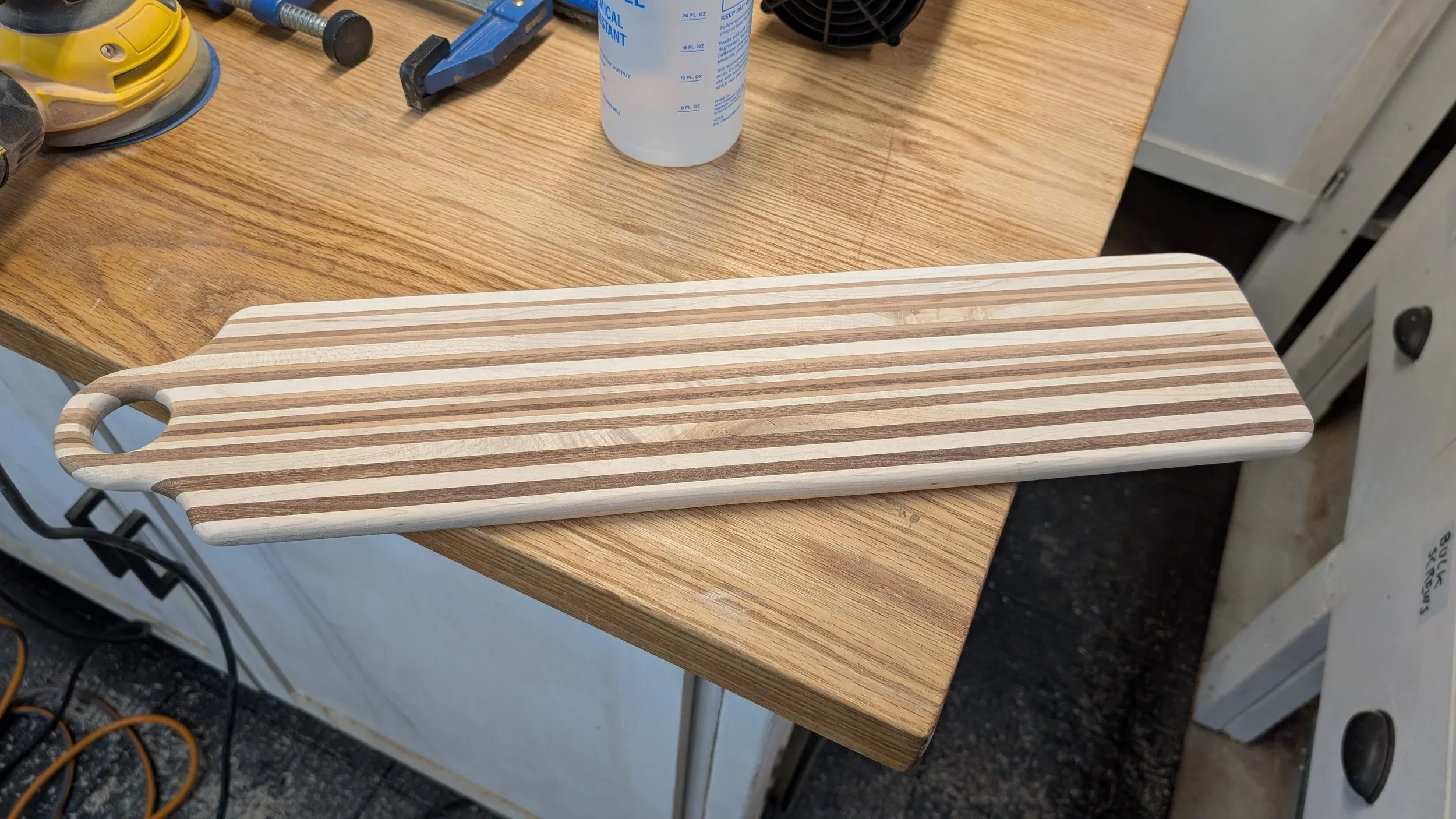
I have to say I thought the milling on the original blanks was pretty rough when I got them but I later realized with the curly grain going every direction it probably doesn’t plane very well.

I cut the grooves for the front and back of the box and then cut miters for the sides. I also cut a small bevel on the inside and outside of both sides of the box. I put hard wax oil finish on the panels and then installed them in box and glued it up with tape to hold and align the miters. I made sure the box was square and flat by doing the assembly on my cast-iron table saw table.

Once the glue was set I cut the box open on the table saw, sanded the new edges and then put hard wax oil finish on the outside and inside of the box.

I mounted the hardware and after a couple of days I put some paste wax on the box to add some additional sheen.

View fullsize PXL_20240902_123258670.jpg
View fullsize PXL_20240902_123310851.jpg
View fullsize PXL_20240902_123327278.jpg
View fullsize PXL_20240902_123358823.jpg

The final project was a new version of a weaving tool that I’d made before. My beautiful and talented wife has been using the tapestry/rug loom that I made for her to weave rag rugs. These are rugs that are made with strips or tubes of scrap fabric from old clothes, sheets, drapes, etc…

In order to keep the warp the same width while you’re weaving using such a heavy material for the weft, one uses a device called a temple. The temple is a stretcher placed across the warp that pulls on the edges setting the warp to a specified width. Previously I had built a temple that used spring clips to grab the warp, see below:

View fullsize PXL_20240914_170940345.jpg
View fullsize PXL_20240914_170947365.jpg

The device has adjustable length by sliding the center bar out and the pins secure it at a specific setting. This one worked ok but the clips were hard to secure onto bulky fabric while holding everything in place. So I agreed to make a different style that uses pointed metal teeth on the underside to grab the fabric and stretch it to the right distance.
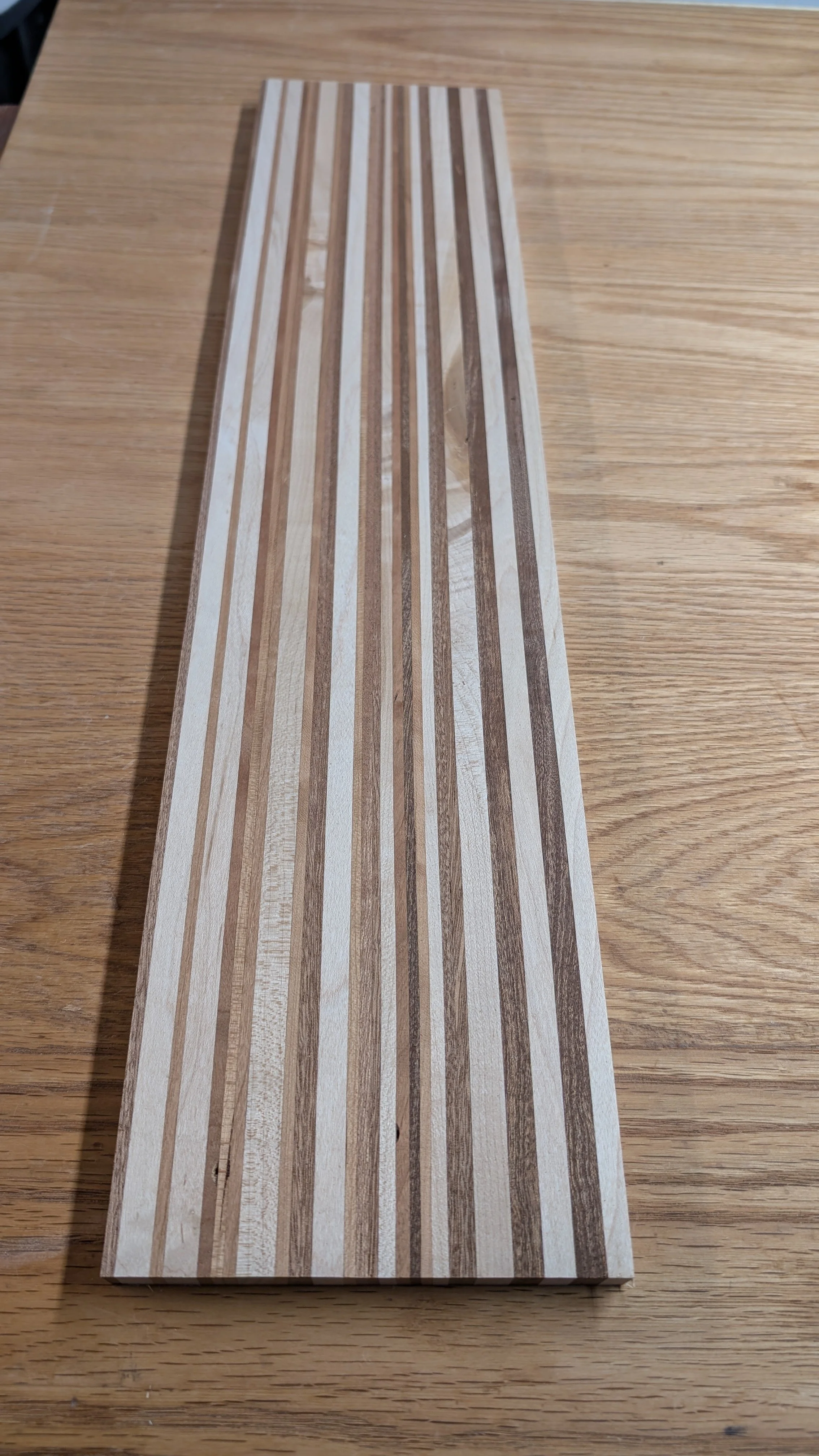
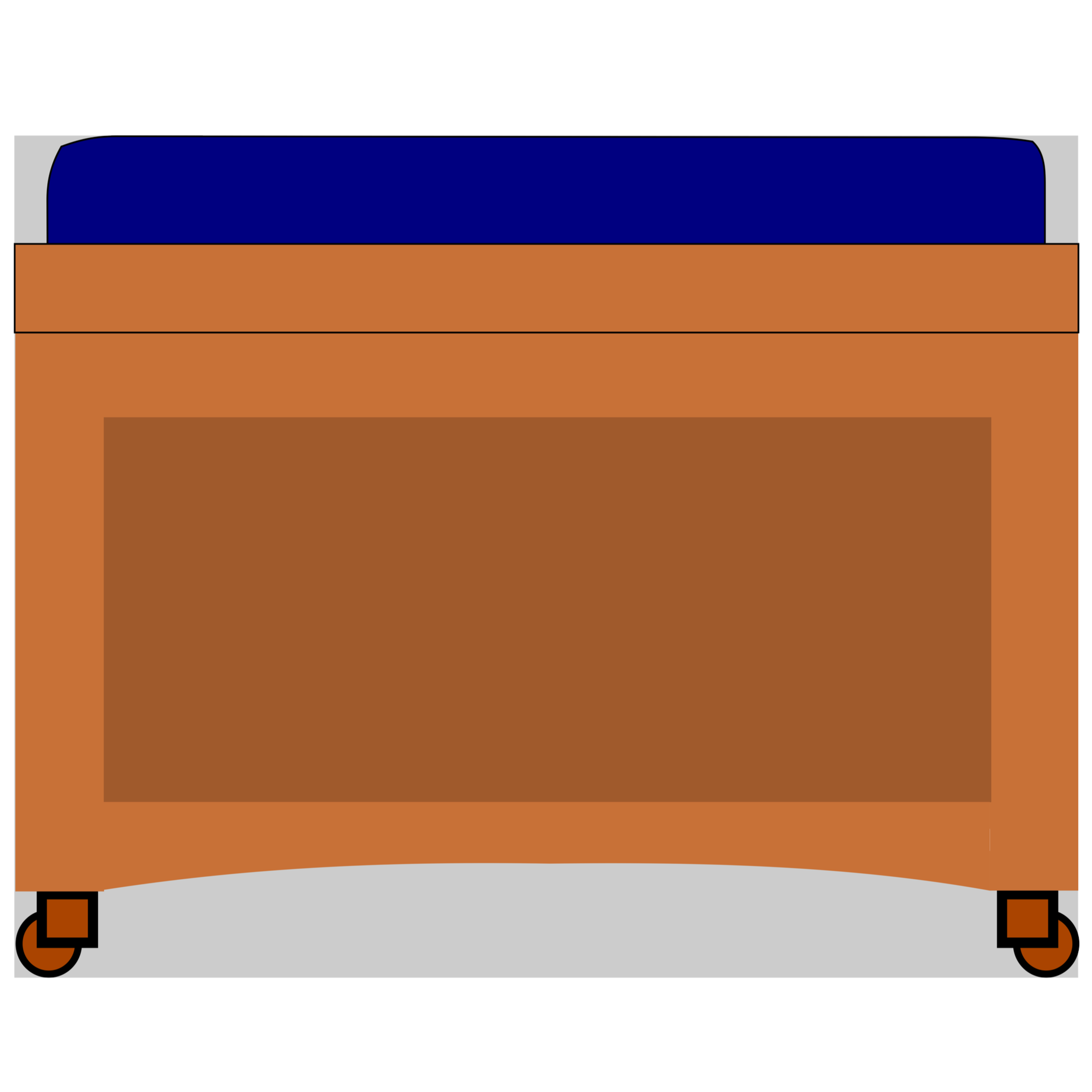
I made it out of the same western red cedar that I made the one above and instead of using metal pins I used some 3/8” oak dowel rod to make the pins for this one, the knob head for the pins is just 1” maple rod segment drilled for 3/8” fit and then glued on and rounded.
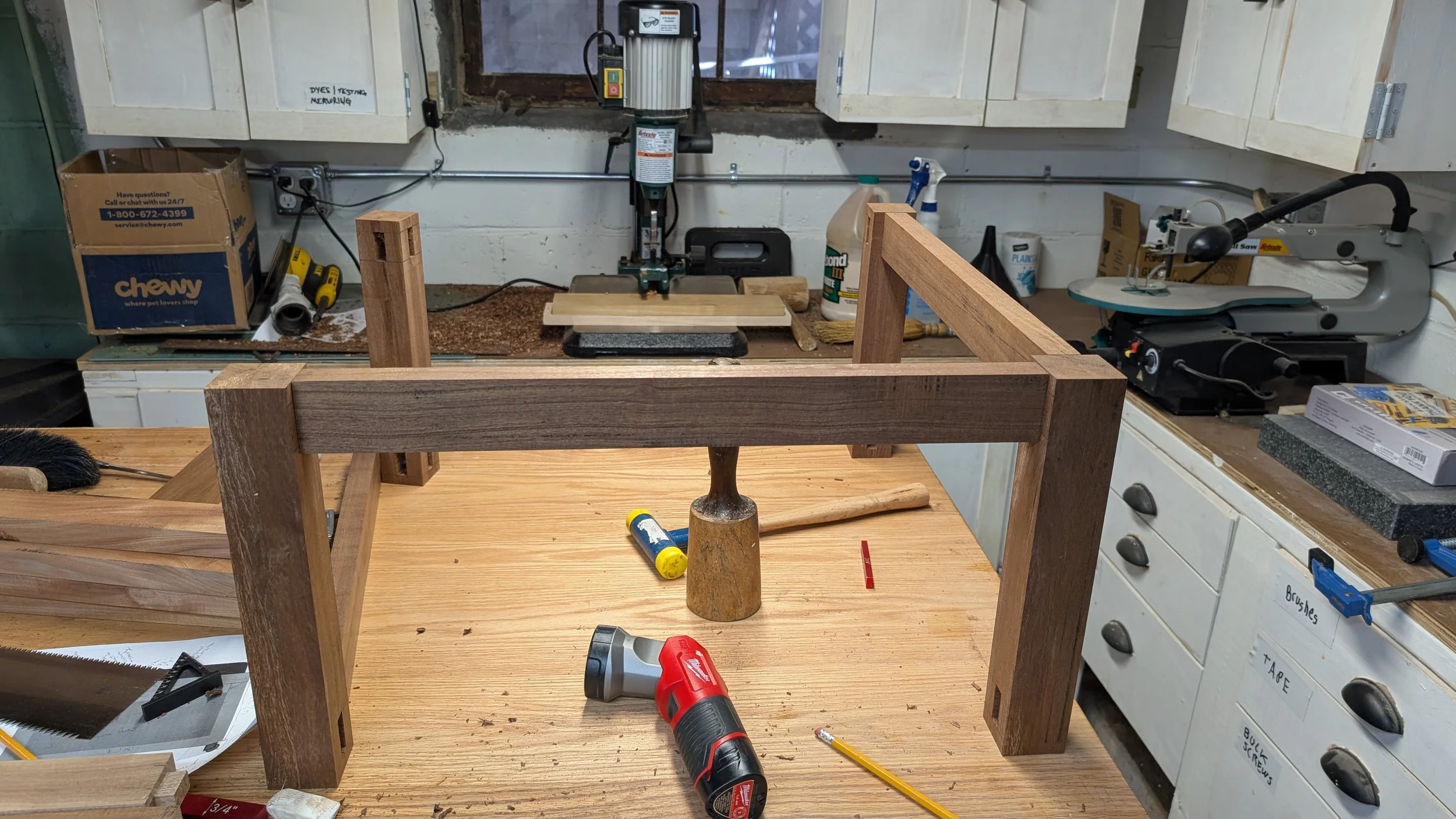
I made the teeth out of some heavy gauge stainless steel finish nails I sharpened by spinning in the drill against the sanding disk. I cut the teeth to length using my reciprocating saw and a metal cutting blade. I glued them in using CA glue.

I sanded everything to 320 grit and then put a coat of paste wax on everything.

View fullsize PXL_20240914_165633354.jpg
View fullsize PXL_20240914_165646069.jpg
View fullsize PXL_20240914_165748765.jpg
View fullsize PXL_20240914_165707030.jpg

That’s it for now, I’m working on designing a new project and I’ll share my progress soon.

In Journal Tags building, weaving, journal, gift box
Comment

Re-purposing Skills

August 13, 2024

I’m retired but I still do a lot of projects. Most of them are solitary projects with perhaps one collaborator. They are by and large not software projects, they are wood working, music, art, writing and publishing projects. I don’t work for the client of these projects and in many cases I am one of the clients of them. My role is diverse: designer, manager/planner, engineer, fabricator, and delivery guy. Schedules and priorities are mostly mine or very much in my control. I have a great deal of latitude to decide what is “good enough” and what is “done.”

I find that my life before I retired provided me with a lot of the skills that make this new life satisfying. I have a lot of experience looking at a large task and breaking it down and prioritizing it into a series of smaller tasks that are reasonable in scope. I readily recognize what is going to be difficult and that allows me to focus on those tasks and spend time figuring them out. The main psychological benefit of this is that I’m not afraid of big projects because to me they’re just a string of little projects.

Over the years I’ve gained the knowledge about myself of what I’m good at and what I’m not good at. This has allowed me to plan things that challenge me but also play to my strengths. For example, I am not good at very fine details that need to be perfectly executed, and though I admire the skill of people who can do this my personal taste leans more towards restrained details. I generally plan my designs with this in mind.

In my career I learned to believe in myself to be able to learn on job what I need to know in order to succeed at a task. In fact it is really the learning style that is most effective for me, classes and school were never very engaging for me. This also reduces my fear at perhaps getting into a project and then not being able to finish it.

I also learned to “grind,” which is where you have to do something day in and day out for a long time in order to finish a project. In the old life it was testing, bug reporting, triage, bug fixing, building, repeat… in the new life it is building a sub component, test fitting everything, taking it apart, adjusting or building the next thing, repeat… until you’re done.

Probably the most powerful thing is patience. Once you accept that something is going to be challenging and is going to take a long time you can settle in to a process and drive it to completion. I wasn’t patient at the beginning of my career but by the end of my work career people would often comment on how patient I was. I am happy to say that I’m patient with myself as much as I was ever patient with my co-workers.

Finally, having a personal process and incrementally improving that process was something I learned in my career. It allows me to plan projects that are going to teach me something new and keep the rest of the process constant while I do that. If something doesn’t work, I just don’t do that again. I look back over the last four years or so of projects and I can identify the process and infrastructure improvements that have been added to my process and it is very satisfying.

In any case these were just some thoughts that were going through my mind for a while recently so I figured I’d share them.

In Journal Tags journal, building, about the process, essay
Comment
Older Posts →

Latest & Greatest

Blog RSS
Featured
Jan 22, 2026
Gift box and charcuterie board
Jan 22, 2026
Jan 22, 2026
Jan 14, 2026
Big Cutting Board
Jan 14, 2026
Jan 14, 2026
Jan 3, 2026
Storage Ottoman
Jan 3, 2026
Jan 3, 2026
Dec 29, 2025
Three or four picture frames...
Dec 29, 2025
Dec 29, 2025
Nov 9, 2025
Better Storage frees up floor space in the shop
Nov 9, 2025
Nov 9, 2025
Oct 18, 2025
Fire Table Chairs: Take Two
Oct 18, 2025
Oct 18, 2025
Aug 9, 2025
Dog ramp
Aug 9, 2025
Aug 9, 2025
Aug 4, 2025
Stacked Laundry/Half-bath Cabinets
Aug 4, 2025
Aug 4, 2025
Jul 22, 2025
A series of small projects...
Jul 22, 2025
Jul 22, 2025
Jul 4, 2025
Three shop improvements
Jul 4, 2025
Jul 4, 2025

Tags

  • building
  • journal
  • projects
  • python
  • software

All content on this site is Copyright 2007-2024 by James Goodwin unless otherwise noted.